
Your shop front isn't just a boundary; it's the most hardworking member of your sales team. Professional sign design is the critical difference between a business that blends into the background and one that commands attention on a crowded UK high street. It's the first interaction a person has with your brand, and in a competitive market, you don't get a second chance to make that visual impact.
You've likely felt the frustration of seeing potential customers walk straight past your door, or perhaps you're worried about wasting money on a display that's hard to read. Choosing between 3D letters, LED displays, or flat fascia panels can feel like a minefield, especially whilst trying to stay on the right side of UK planning regulations. We understand that you need a durable, professional finish that actually drives footfall rather than just filling space.
This guide will show you how bespoke sign design transforms your physical presence into a powerful, customer-attracting landmark. We'll explore the latest 2026 trends, compare different material options, and clarify the essential rules you need to follow to ensure your investment stands the test of time.
Key Takeaways
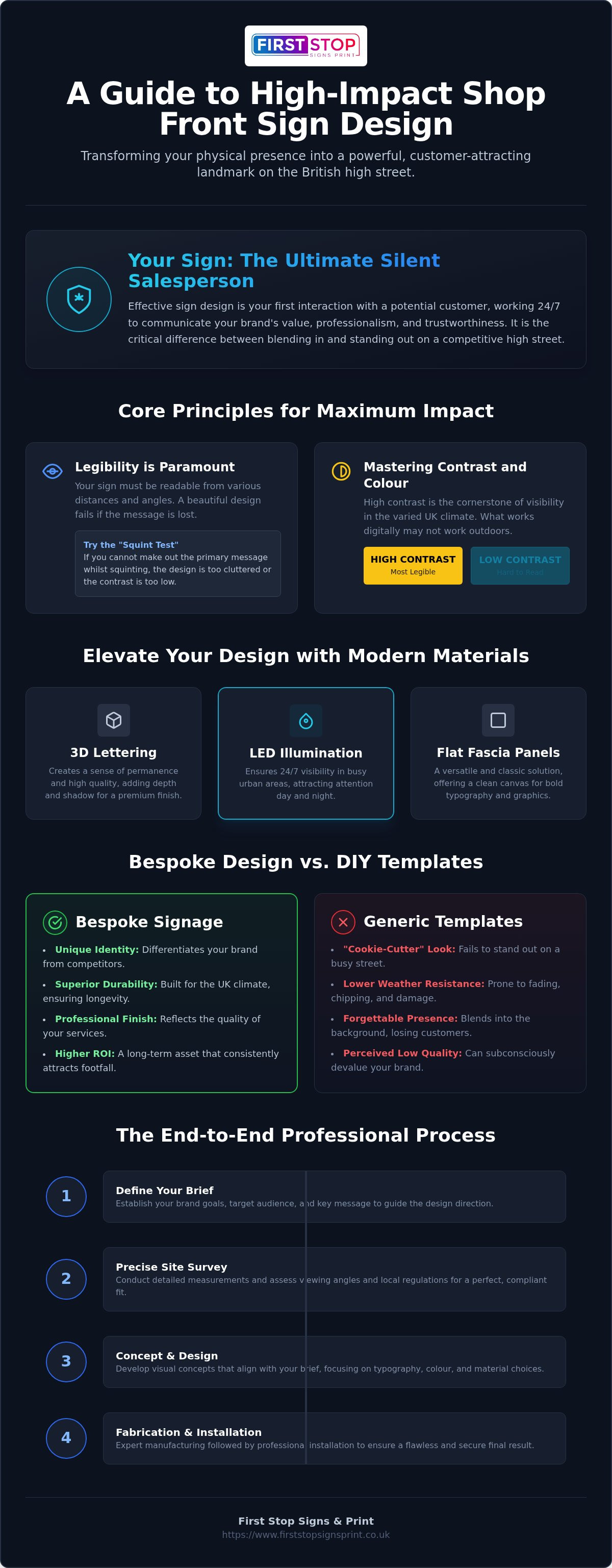
- Learn how strategic sign design uses intentional typography and colour to act as a "silent salesperson" that communicates your brand’s value instantly.
- Discover practical techniques like the "squint test" to ensure your high street presence is legible and effective from any viewing distance.
- Understand the benefits of 3D and LED materials for creating a sense of permanence and maintaining 24/7 visibility in busy urban environments.
- Explore the professional end-to-end process, from defining your initial brief to conducting a precise site survey for a perfect fit.
- Recognise why bespoke signage offers better longevity and weather resistance for the UK climate compared to generic, off-the-shelf templates.
Understanding Sign Design: More Than Just a Business Name
Signage is often the first touchpoint between your business and a potential customer. Effective sign design isn't simply about printing a name on a board; it's the strategic arrangement of typography, colour, and negative space to project your brand's core values. Think of your shop front as a "silent salesperson" that works 24/7. It shapes first impressions, builds trust, and communicates your level of professionalism before a single word is exchanged. By adhering to the Core principles of signage, you ensure your visual identity is both functional and aesthetically pleasing.
Professional sign design provides a bridge between your digital identity and the physical world. On a busy British high street, your business faces constant competition for attention. Whilst generic DIY templates might seem cost-effective, they often result in a "cookie-cutter" look that makes your shop forgettable. Bespoke design allows you to differentiate your brand, ensuring you stand out amongst a sea of competitors. It's essential to categorise your signage needs into three main types: informational signs that provide facts like opening hours; directional signs that guide footfall; and promotional signs designed to drive immediate sales.
The Psychology of Physical Branding
Human psychology plays a massive role in how we perceive physical spaces. In the UK, certain colours trigger specific emotional responses. For instance, deep blues often suggest reliability and authority, whilst vibrant yellows can evoke a sense of optimism or urgency. Beyond aesthetics, the role of "wayfinding" is vital. Clear, well-placed signs reduce customer anxiety by making your premises easy to navigate, which directly improves the overall experience. This physical presence builds a level of trust that digital-only brands often struggle to replicate. People feel more secure dealing with a business that has a tangible, high-quality physical footprint.
Signage as a Business Asset
Viewing your shop front as a capital investment rather than a mere expense changes your perspective on quality. A high-quality sign contributes significantly to local brand awareness in areas like Romford and London, where foot traffic is high. The perceived value of your services or products is often tied to the quality of your exterior. If a sign looks cheap or poorly maintained, customers subconsciously assume the service inside will be the same. Investing in a durable, professional finish ensures a long-term ROI by consistently attracting new footfall and reinforcing your brand's position in the community. It's an asset that pays dividends every time a passerby stops to look.
Core Principles of High-Impact Sign Design
High-impact sign design is a blend of science and art. It requires a deep understanding of how the human eye perceives information whilst moving through a busy environment. The most beautiful logo in the world fails if it cannot be read by a driver or a pedestrian from a distance. To ensure your investment works effectively, you must prioritise legibility and readability above all else. A common industry technique is the "squint test"; if you cannot make out the primary message of your sign whilst squinting, the design is likely too cluttered or the contrast is too low.
Viewing distances are equally vital. A sign intended for a high-speed road requires much larger lettering and simpler graphics than one on a pedestrianised side street. For those looking to understand the technical requirements of visibility, the official UK sign design standards provide excellent data on how letter height correlates with reading distance. Applying these rigorous standards to your commercial premises ensures your brand is visible long before a customer reaches your door. If you need help visualising how these principles apply to your shop front, you can speak with our experienced design team for tailored advice.
Mastering Contrast and Colour
Contrast is the cornerstone of visibility. Whilst your brand might use subtle pastel shades in digital marketing, these rarely translate well to outdoor environments. Effective colour pairings for outdoor signage typically involve dark text on a light background or vice versa. Black on yellow is statistically the most legible combination from a distance, followed by white on blue or green. You must also consider the local lighting conditions in the UK; a colour that looks vibrant in a bright studio may appear dull under the flat, grey light of an overcast Essex afternoon. Limiting your palette to two or three primary colours prevents visual clutter and keeps the focus on your name.
Typography That Tells a Story
Your choice of font communicates your brand's personality instantly. Sans-serif fonts are generally preferred for modern, high-visibility signs because their clean lines are easier to process at a glance. Serif fonts can evoke a sense of tradition and heritage, but they require careful handling to ensure the thin strokes don't disappear when viewed from an angle. Proper kerning, the spacing between individual letters, and leading, the vertical space between lines, are essential. If letters are too close together, they blur into an illegible block for passing traffic. Using bold weights for your primary business name creates a clear visual hierarchy, allowing taglines to remain in a lighter weight without competing for attention.
Negative space, often called "white space", is just as important as the graphics themselves. In a busy urban environment like London, the eye needs a place to rest. A design that fills every square inch of a sign board actually becomes harder to see. By leaving roughly 30% to 40% of your sign face as empty space, you allow your core message to "breathe" and stand out more effectively against the background noise of the street.
Materiality and Dimension: Elevating Design with 3D and LED
Choosing the right materials is the stage where sign design transitions from a digital concept to a physical landmark. Whilst flat fascia boards provide a clean canvas, adding dimension through 3D elements or illumination creates a sense of permanence and quality that flat prints simply cannot match. The choice of material should reflect your brand’s personality; for instance, brushed metal suggests sophistication and durability, whilst polished acrylic offers a modern, high-gloss finish. When planning your exterior, it's vital to consult the UK government guidelines for outdoor advertising to ensure your material and lighting choices comply with local safety and planning standards.
The Power of 3D Letters and Logos
Built-up 3D letters are the gold standard for businesses looking to make a statement. By adding depth, you create a dynamic sign that interacts with natural light. As the sun moves across a Romford or London high street, the shifting shadows provide a natural animation that draws the eye. This tactile quality suggests a business that's established and invested in its location. For a deeper dive into the technical aspects of these displays, explore The Ultimate Guide to 3D Lettering.
Illuminated and LED Signage
In urban environments where the day doesn't end at 5 pm, illumination is a necessity. Modern LED signs offer incredible versatility, allowing you to choose between backlit effects for a bold look or halo-lit designs for a more subtle, premium glow. LEDs are significantly more energy-efficient than traditional neon, offering lower running costs whilst providing a sharper, more consistent light. This is particularly important for London nightlife venues or businesses that want to maintain brand recognition 24/7. You can find more detail on choosing the right luminous style in our guide to Illuminated Shop Signs UK.
Dimension isn't just for the street-facing facade. Interior sign design can be elevated using 3D wall panels to add texture to reception areas or bespoke metal wall art to create a premium office atmosphere. These elements work together to create a cohesive brand experience from the moment a customer sees your shop front to the moment they step inside your building. By integrating these textures, you turn a functional office space into a branded environment that inspires both staff and visitors alike.
The Sign Design Process: From Concept to Installation
A successful project starts long before the first piece of acrylic is cut. High-quality sign design follows a methodical process to ensure the final product is both beautiful and functional. It begins with an initial brief where we define your specific goals, budget, and brand guidelines. This ensures the creative direction aligns perfectly with your business identity. Once the vision is clear, we move to a conceptual design phase. Here, we create digital mock-ups that show your sign in situ, allowing you to see exactly how it will look on your specific building before production begins.
Technical specification follows, where we select the precise materials, fixings, and illumination methods. This stage bridges the gap between a visual concept and a durable physical structure. Finally, professional installation ensures that the sign is mounted safely and finished to a flawless standard. A poorly installed sign can ruin even the best sign design, making expert fitting a non-negotiable part of the journey. To ensure your project meets every standard, you can book a site survey with our team to get started on the right foot.
Navigating UK Planning and Compliance
You may need Advertisement Consent from your local council, particularly if your sign is illuminated, oversized, or located in a Conservation Area. Failing to secure this can lead to costly fines or orders to remove the display. Safety standards for projecting signs are also strict to protect pedestrians. Using a professional signage company provides legal peace of mind. Experts understand these regulations and can help manage the application process on your behalf, ensuring your shop front is fully compliant from day one.
The Importance of a Site Survey
A comprehensive site survey is the foundation of a perfect fit. We don't just measure the width of the fascia; we assess visibility angles from the street and check for electrical access for LED installations. "Measuring twice" is vital for bespoke 3D logos to ensure they don't overlap architectural features or look cramped. We also assess the structural integrity of the mounting surface. This allows us to choose the correct fixings for long-term durability, ensuring your sign remains secure against the unpredictable UK weather for years to come.
Why Bespoke Sign Design Wins Over DIY Templates
Choosing a generic online template might save time at the checkout, but it often costs your business more in the long run. Bespoke sign design is about creating a unique visual identity that avoids the forgettable "cookie-cutter" aesthetic common on many high streets. When every shop uses the same five fonts and three layout styles, customers stop noticing the individual brands. A custom approach ensures your premises reflect your specific values and stand out amongst the noise of a crowded environment. It's the difference between being a background detail and a local landmark.
Longevity is another critical factor where bespoke solutions outperform cheap alternatives. Professional signs are engineered specifically for the unpredictable UK weather. Whilst a basic vinyl banner or foam board might look acceptable on day one, they quickly succumb to wind, rain, and UV fading. Bespoke sign design incorporates high-grade materials like cast acrylic and powder-coated aluminium, ensuring your investment looks as sharp in five years as it did at installation. A professional designer also understands the technical shift required to translate a flat, 2D logo into a 3D masterpiece, considering how depth and shadows affect legibility from different angles.
Tailored Solutions for London and Essex
Success in local markets requires an understanding of regional architectural styles. A sign that works for a modern glass front in Canary Wharf might look out of place on a traditional Victorian shop front in Romford. By working with a local partner, you gain access to expertise that respects these nuances. Exploring creative shop sign ideas can help you find a style that drives footfall whilst remaining sympathetic to your building's character. Proximity also means you have a reliable team nearby for future maintenance or updates, providing a level of service that faceless online printers cannot match.
Investing in Your Brand Future
View your signage as a one-time capital investment that delivers multi-year returns. High-quality sign printing and fabrication act as a permanent advertisement, reinforcing your digital marketing efforts every time a customer walks past. It’s the physical anchor of your brand identity. When your exterior looks professional, it builds immediate trust and justifies your pricing in the eyes of the consumer. Ready to transform your physical presence? Contact First Stop Signs Print today for a bespoke consultation and let us help you become the most visible business on the block.
Transform Your Business into a Local Landmark
Your physical presence is the most powerful marketing tool you own. By prioritising high-impact sign design, you move beyond simple identification and start communicating your brand's true quality to every passerby. We have explored how strategic legibility, premium 3D materials, and energy-efficient LED illumination work together to build trust and drive footfall on busy UK high streets. A bespoke approach ensures your business isn't just another face in the crowd but a professional destination that commands attention.
First Stop Signs Print brings decades of experience in commercial print and design to every project. As specialists in 3D and LED bespoke signage, we provide expert installation services across London and Essex, managing the entire process from the initial site survey to the final fitting. Don't settle for forgettable templates when you can have a durable, high-visibility finish that lasts for years. Book your bespoke sign design consultation with First Stop Signs Print today and take the first step towards a more visible, successful future. We look forward to helping your brand stand out.
Frequently Asked Questions
Do I need planning permission for my new shop sign design?
You generally need Advertisement Consent if your sign is illuminated, digital, or exceeds specific size thresholds set by UK planning authorities. Smaller, non-illuminated signs often fall under "deemed consent" rules, but it's always safer to check with your local council. Conservation Areas and Listed Buildings have even stricter requirements. We help our clients navigate these regulations during the site survey to ensure your sign design is fully compliant before installation begins.
What is the best material for a durable outdoor business sign?
Aluminium composite (ACM) and cast acrylic are the gold standards for durability in the UK climate. ACM panels are incredibly rigid and resistant to rust, making them ideal for large fascia boards. Cast acrylic is perfect for 3D letters because it maintains its colour and high-gloss finish even after years of UV exposure. These materials withstand wind and rain far better than cheaper foam alternatives, protecting your brand's physical presence for the long term.
How much does professional sign design cost in the UK?
The cost depends entirely on the complexity of the project, the materials chosen, and whether you require illumination. A bespoke 3D logo using premium metals will naturally require a different investment than a flat, non-illuminated fascia panel. We focus on providing tailored solutions that offer the best return on investment for your specific location. Instead of fixed price lists, we provide detailed quotes based on your unique brief and site requirements.
Can you design a sign if I only have a basic logo?
Yes, we specialise in translating basic 2D brand assets into high-impact physical displays. Our designers understand how to add depth, choose appropriate textures, and select colour palettes that work under outdoor lighting conditions. We don't just copy your logo; we adapt it for the physical environment. Whether you need 3D built-up letters or a custom-shaped LED display, we can evolve your existing identity into a powerful landmark for your business.
What is the difference between a fascia sign and a projecting sign?
A fascia sign is mounted flat against the building’s exterior, typically above the entrance, and serves as your primary brand identifier. A projecting sign is mounted at a right angle to the wall, making your business visible to pedestrians walking along the pavement from either direction. Using both in your sign design strategy ensures maximum visibility from multiple angles, capturing the attention of both passing traffic and foot traffic effectively.
How long does the sign design and manufacturing process take?
Most bespoke projects take between two to four weeks from the final approval of the design to the actual installation. This timeline allows for precise manufacturing, electrical wiring for LED components, and the sourcing of high-grade materials. If your project requires Advertisement Consent from the local council, you should account for an additional eight weeks for the planning application process. We provide a clear schedule at the start of every project to manage expectations.
Is LED signage energy efficient for small businesses?
Modern LED displays are exceptionally energy efficient and offer a significant cost saving over traditional neon or fluorescent lighting. They use a fraction of the electricity and have a much longer lifespan, often lasting over 50,000 hours of continuous use. This makes them a sustainable choice for small businesses that want 24/7 visibility without high running costs. LEDs also provide a sharper, more consistent glow that enhances your brand’s professional appearance.
Do you provide sign installation services in London and Essex?
Yes, First Stop Signs Print provides professional installation services across Romford, London, Essex, and the surrounding Home Counties. Our team handles the entire process, including site surveys and structural assessments, to ensure your signage is mounted safely and securely. We serve diverse areas from West London to Hertfordshire, bringing expert craftsmanship to every project. This end-to-end service ensures that the final result perfectly matches the quality of the initial design.


