

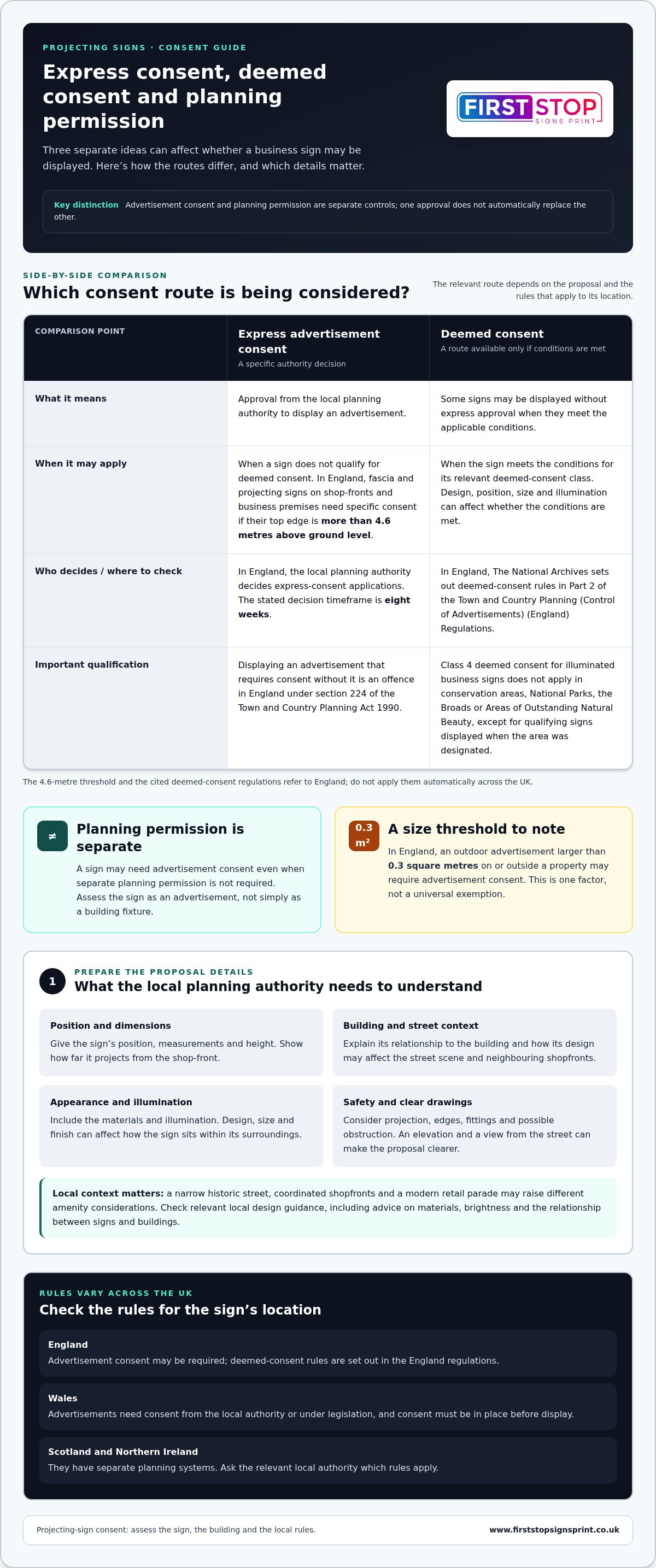
A projecting sign doesn’t automatically need planning permission. If you’re asking whether you need planning permission for a projecting sign, in England a sign whose top edge is more than 4.6 metres above ground level needs specific advertisement consent, according to The National Archives. Signs that meet the conditions for deemed consent may not need express approval from the local planning authority.
It’s easy to assume a sign attached to your premises is simply a building detail, but its size, position and illumination can affect which rules apply. In Wales, advertisements need consent from the local authority or under legislation, and consent must be in place before display.
This guide explains when advertisement consent may be needed, how deemed consent and safety requirements affect projecting signs, and what to raise with your local planning authority. It also covers the general conditions that apply to business signage, helping you understand the key considerations before settling on a design.
Key Takeaways
- In England, a shop-front or business projecting sign with its top edge more than 4.6 metres above ground level needs specific advertisement consent, according to The National Archives.
- Some signs may benefit from deemed consent, but the rules depend on their design, position, size and illumination.
- Consider how a sign affects the building and street scene, as well as whether it can be displayed and maintained safely.
- Before displaying a sign, establish which consent applies and whether the property owner or relevant highway authority must also give permission.
- The National Archives sets out the deemed-consent rules in Part 2 of the Town and Country Planning (Control of Advertisements) (England) Regulations.
When is planning permission required?
For a projecting sign, distinguish planning permission from advertisement consent: a sign may need advertisement consent even if separate planning permission isn’t required. The rules also differ across the UK, so don’t apply England’s thresholds automatically in Scotland, Wales or Northern Ireland.
Applying for advertisement consent
Advertisement consent is approval for displaying an advertisement under advertisement control. In England, the local planning authority decides applications for express consent, and The National Archives states that the decision is made within eight weeks. For fees, use the relevant authority’s current application information, as the applicable charge depends on the application route.
To establish what applies, give the authority the proposed sign’s position, dimensions, height, illumination and relationship to the building. A drawing showing how far the sign projects from the shopfront helps describe the proposal. Do projecting signs need planning permission in England, Scotland, Wales or Northern Ireland? In England, advertisement consent may be required; in Wales, advertisements need consent from the authority or under legislation. Scotland and Northern Ireland have separate planning systems, so ask the relevant local authority which rules apply.
Planning permission and advertisement consent
Planning permission and advertisement consent are separate controls, and one approval doesn’t automatically replace the other. This matters because an advertisement can fall under advertisement control even when the work doesn’t otherwise require planning permission.
In England, an outdoor advertisement larger than 0.3 square metres on or outside a property may require advertisement consent, according to The National Archives. The threshold is one factor, not a universal exemption: other rules can apply to illuminated signs, location and deemed consent. A projecting sign attached to a shop-front should therefore be assessed as an advertisement, not simply as a building fixture.
Express consent for projecting signs
Express advertisement consent is a specific decision from the local planning authority, needed when a sign doesn’t qualify for deemed consent. For shop-fronts and business premises in England, fascia signs and projecting signs need specific advertisement consent if their top edge is more than 4.6 metres above ground level, according to The National Archives.
Do signs need consent in conservation areas or on listed buildings? Class 4 deemed consent for illuminated business signs doesn’t apply in conservation areas, National Parks, the Broads or Areas of Outstanding Natural Beauty, except for qualifying signs displayed when the area was designated. Westminster states that a proposed advertisement on a listed building requires listed building consent, whether or not it is illuminated. In England, displaying an advertisement that requires consent without it is an offence under section 224 of the Town and Country Planning Act 1990, according to The National Archives.
Permitted development and sign limits
For advertisements, the relevant concept is often deemed consent rather than permitted development. It allows some signs to be displayed without express approval, but only when the applicable conditions are met. In England, The National Archives sets out the deemed-consent details in Part 2 of the Town and Country Planning (Control of Advertisements) (England) Regulations.
What size, height and projection limits apply? There isn’t one UK-wide limit for every projecting sign. The applicable class, sign dimensions, position and illumination all affect the answer. What are the permitted development rules for projecting signs in the UK? The relevant deemed-consent class and local rules determine whether approval is needed. To check, give your local planning authority the sign design, measurements, height and property address.
Amenity and public safety considerations
A projecting sign must work visually and physically within its surroundings. Outdoor advertisements should be kept safe, and local design guidance may help inform a proposal. These considerations affect how a proposal is assessed and which details are useful to show.
A sign’s position, scale and finish affect how it looks against a building. Local planning authorities assess advertisement applications for amenity and public safety, considering design, size, materials, illumination, the relationship with the building and the effect on the street scene. For example, a large illuminated panel on a modest frontage could dominate neighbouring shopfronts, even if its lettering is easy to read.
Public safety also has practical implications. Consider where the sign sits, how far it projects from the wall and whether its edges or fittings could create an obstruction. A proposal drawing can show the sign against the frontage and make its position clear. Include an elevation and a view from the street, then explain the materials and illumination. These details help the authority understand how the sign will appear, rather than relying on a description alone.
Local context matters. A narrow historic street, a row of coordinated shopfronts and a modern retail parade raise different amenity considerations. In England, authorities may publish supplementary guidance explaining suitable design for their areas. Read any local guidance alongside your proposal, especially where it addresses materials, brightness or the relationship between signs and buildings.
Planning departments generally consider only amenity and public safety when deciding advertising consent applications. Real-world refusals often stem from overpowering designs that clash with their surroundings. These cases illustrate why a sign’s scale and setting matter, not just its message, when asking yourself do i need planning permission for a projecting sign.
Before finalising a design, compare its size, illumination and projection with the building and surrounding street. Check that the display can be kept in safe condition and that its materials and fittings are clearly shown. If you’re developing a sign concept, custom business signs can be considered in relation to the frontage and intended visibility.
Local authorities often provide guidance for property owners considering advertisements in adopted planning documents. Use them as a reference when reviewing a proposal’s design, placement and relationship with the surrounding public realm. Comparing the proposed materials, scale and illumination with the frontage helps keep amenity and safety considerations in view during design.
Contacting the local planning authority
Local requirements depend on the sign’s location, the authority’s guidance and the site’s designation. Westminster, for example, requires advertisement consent for most outdoor advertising, including illuminated projecting signs. The same type of sign elsewhere may be assessed under different local guidance, so identify the authority responsible for the property before preparing an application.
Start with the site address and a clear description of the proposed display. Contact the local planning authority’s planning department to ask which advertisement rules apply to that location. Explain whether the sign will be illuminated, where it will sit on the frontage and how it relates to the street. Include any relevant conservation-area or listed-building status, as these can affect the consent route.
Prepare a concise set of details for the authority or planning portal. Include:
- The property address and the proposed sign’s position on the building.
- A drawing showing its dimensions, height and projection from the wall.
- Whether the display will be illuminated, with a clear view of its design.
- Photographs showing the frontage and nearby buildings or street features.
These details help the authority understand both the advertisement and its setting. For example, a projecting sign above a narrow pavement raises different practical questions from one facing a broad forecourt. If the sign would occupy highway land, you also need the Highway Authority’s permission. In England, anyone displaying an outdoor advertisement must have the site owner’s permission.
Rules also vary between nations. In Wales, advertisements need consent from the local authority or under legislation, and consent must be obtained before display. Scotland and Northern Ireland have their own planning systems, so use the authority responsible for the property rather than assuming England’s process applies. For an application in England, The National Archives states that the council decides express advertisement consent applications within eight weeks.
Keep a record of the authority’s response and the drawings or descriptions you supplied. If the proposal changes, such as adding illumination or moving the sign to another part of the frontage, describe that change before display. A revised design can alter which requirements apply. Clear sign design details make it easier to explain the proposal and its effect on the building.
Deemed consent for some signs
Deemed consent means an advertisement can be displayed without express approval when it meets a relevant legal class’s conditions. It isn’t a general exemption for business signs: the sign’s purpose, position, design and illumination affect whether the class applies. In England, The National Archives states that the details are set out in Part 2 of the Town and Country Planning (Control of Advertisements) (England) Regulations.
For a projecting sign, identify the class that could cover it, then compare the proposed design with every condition and limitation. A sign outside the class cannot rely on its deemed consent. The local planning authority can explain how advertisement control applies to a particular site, especially where local restrictions affect the display.
Class 4 covers certain illuminated advertisements on business premises. Its conditions include requirements about the number, position and height of signs. For example, no more than one fascia panel and one projecting sign at right angles may be displayed on the premises. The lowest point of an illuminated advertisement must be at least 2.5 metres above ground.
Class 4 also restricts where its deemed consent applies. It doesn’t apply to premises in a conservation area, Area of Outstanding Natural Beauty, National Park, the Broads or an Area of Special Control of Advertisements. There’s an exception for qualifying signs already displayed when certain protected areas were designated. The rules describe a five-year period for qualifying signs in conservation areas, Areas of Outstanding Natural Beauty, National Parks and the Broads.
Traditional, non-illuminated fascia signs and hanging signs may also have deemed consent, subject to conditions such as size. That doesn’t mean every projecting sign qualifies. Illumination can change which class is relevant, while a protected location can rule out a class that might otherwise apply.
Other classes show why sign type matters. In England, a residential estate-agent board under Class 3 can have deemed consent up to 0.5 square metres, but must be removed within 14 days of completion. That specific allowance is for qualifying estate agents’ boards, not a general size rule for shop signs or projecting signs.
Before relying on deemed consent, compare the final design and location with the applicable class, including its illumination and area restrictions. If even one condition isn’t met, express advertisement consent will generally be needed. Keep the design, measurements and site details together so the authority can assess the exact sign you intend to display.
General conditions for business signage
Business signs are assessed under regulations that consider more than the message they display. In England, conditions can cover cleanliness, height, lettering and location. The practical priority is to identify the relevant advertisement class before treating a limit as suitable for your sign. A rule for one category, such as a forecourt display, doesn’t automatically apply to a projecting sign.
Class 5 provides one example for non-illuminated business signs. Its height limit is 4.6 metres or the first-floor window sill, whichever is lower. Lettering under this class is limited to 0.75 metres high. These measurements illustrate how the building itself can set the effective limit. A sign below the maximum height may still exceed the applicable condition if the first-floor sill is lower.
Illuminated business signs have separate Class 4 conditions. The top must be no higher than 4.6 metres or the first-floor window sill, whichever is lower. That is a class-specific rule, not a universal height allowance for every projecting sign. Check the sign’s position and illumination together, rather than selecting a figure from another type of advertisement.
Class 6 applies to business forecourt signs, not every sign fixed to a shop-front. In England, the combined area of signs on one business forecourt is limited to 4.6 square metres, and no single sign may exceed 1.55 square metres. For example, a forecourt with several panels must meet both the overall area limit and the limit for each individual sign.
Condition matters after installation, too. Keeping an outdoor advertisement clean, tidy and safe is an important part of ongoing maintenance. A damaged panel, loose fitting or neglected surface can therefore create a compliance concern separate from the original design. Build maintenance into your display plan, particularly if the sign faces a busy street or sits above an entrance.
Use this practical check before finalising a business sign:
- Identify whether the proposal is illuminated, non-illuminated or positioned on a forecourt.
- Measure its height against the relevant building feature, such as the first-floor window sill.
- For a forecourt, calculate both the total area and each sign’s individual area.
- Plan how the display will remain clean, tidy and safe after installation.
The UK signage guidance also covers positioning, size and permitted duration of use. Treat each condition as specific to its sign class and location. A sign that doesn’t meet the relevant conditions may need express consent, so compare the finished proposal with the applicable regulations before displaying it.
First Stop Signs Print: Label Printing
First Stop Signs Print creates Custom Business Signs for businesses planning a clear, distinctive presence on their premises. Once you’ve established the consent requirements for your proposed sign, the team can help shape signage around your brand and building. Its offering also includes 3D Wall Panels, Metal Wall Art and Label Printing, giving businesses options for both visible premises branding and printed materials.
Bring your preferred design, location and practical requirements into the conversation when you’re ready to develop your signage. Planning consent remains a matter for the relevant authority, while First Stop Signs Print can help create and install the sign. Contact First Stop Signs Print to discuss your signage requirements.
Turn your sign concept into a clear next step
Once you’ve clarified the consent route, decide how your sign should represent your business. Look beyond its position: consider how the lettering, colour and overall style will work with your shopfront and other customer-facing materials. A coordinated approach can make your business recognisable, rather than treating each printed or displayed item as a separate design.
If you’re still asking whether you need planning permission for a projecting sign, keep the planning decision separate from the creative work. First Stop Signs Print offers Custom Business Signs, alongside Label Printing and 3D Wall Panels, for businesses developing a consistent visual identity. Share the direction you have in mind and the practical requirements for your premises, then shape the signage around your brand.
Contact First Stop Signs Print to discuss your signage project and take the next step with confidence.
Frequently Asked Questions
Which class covers my sign, and what if none does?
In England, the sign’s purpose, position and illumination help identify the relevant deemed-consent class. The National Archives sets out the rules in Part 2 of the Town and Country Planning (Control of Advertisements) (England) Regulations. A shop sign that doesn’t meet the conditions of an applicable class generally needs express advertisement consent. Give the local planning authority the proposed design and site details so it can assess the specific display.
Do projecting signs need separate advertisement consent?
In England, advertisement consent is separate from planning permission, so one approval doesn’t automatically cover both. A projecting sign may be displayed under deemed consent if it meets the relevant class conditions; otherwise, express advertisement consent is generally needed. For example, changing a non-illuminated sign to an illuminated design can affect which conditions apply. If you’re asking whether you need planning permission for a projecting sign, establish both consent requirements for the proposed work.
How do I apply for planning permission or advertisement consent for a projecting sign?
Apply to the local planning authority responsible for the property, following its process for advertisement consent or planning permission. Provide the site address, sign drawings, dimensions, height, projection, illumination details and photographs of the frontage. Include the landowner’s permission; signs on highway land also need Highway Authority permission. In England, The National Archives states that councils decide express advertisement consent applications within eight weeks. Keep the submitted design aligned with the sign you intend to display.
What are the UK application fees and processing times for projecting sign consent?
In England, the local planning authority decides an express advertisement consent application within eight weeks. Fees depend on the application route, so check the relevant authority’s current application information.


