
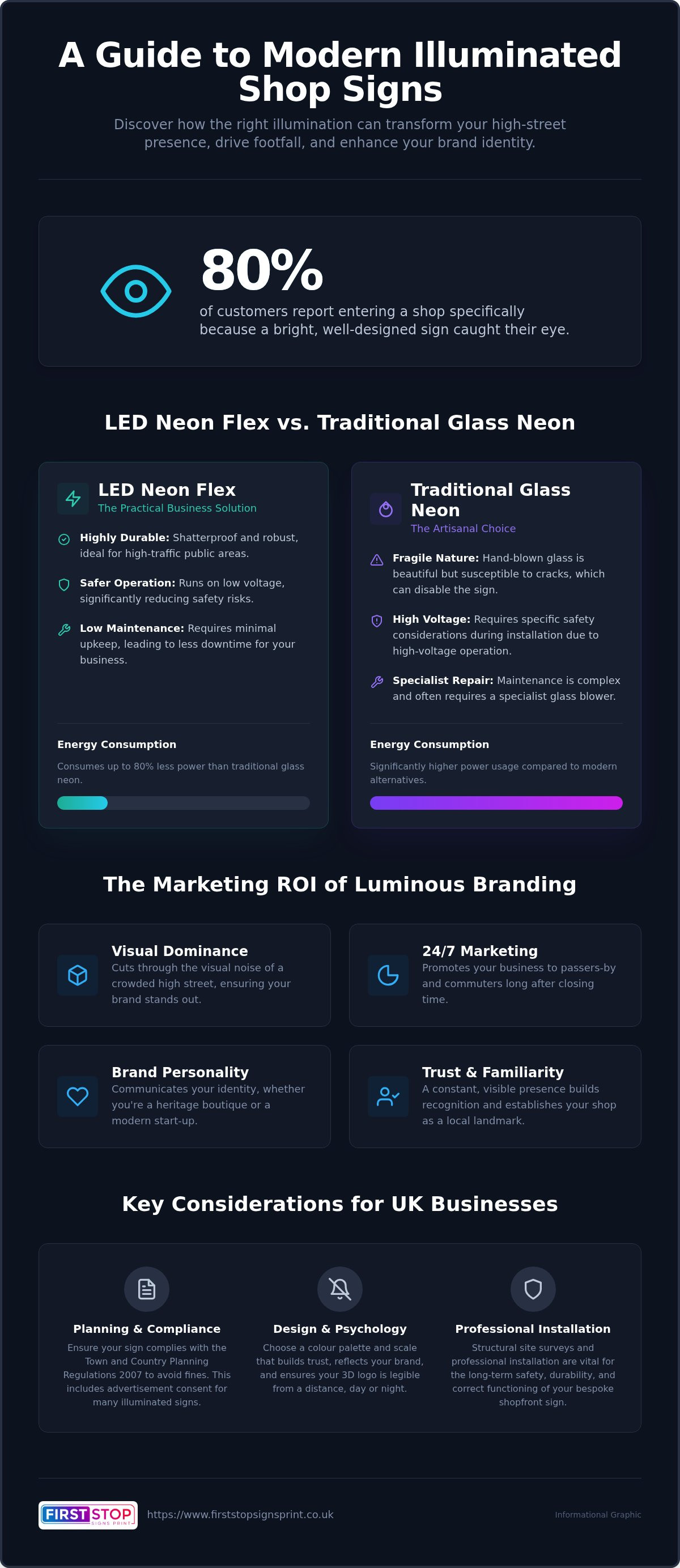
Did you know that 80% of customers report entering a shop specifically because a bright, well-designed sign caught their eye? In the competitive high streets of London and Essex, choosing the right illuminated shop signs uk businesses rely on isn't just about aesthetics; it's about being visible when the sun goes down. You've likely felt the frustration of watching potential footfall walk straight past a dark storefront, or perhaps you're worried that upgrading your old neon will lead to astronomical energy bills and complex council fines.
We understand that the transition from traditional glass neon to modern LED technology can feel overwhelming, especially when trying to stay compliant with the Town and Country Planning Regulations 2007. You want a sign that reflects your brand's 3D logo perfectly without the maintenance headaches of the past. This guide will show you how to achieve exactly that. We'll explore the technical differences between LED and glass, explain how to slash your energy consumption by up to 80%, and provide a clear roadmap for navigating UK planning permissions and advertisement consent fees. From bespoke 3D letters to durable shop sign boards, you'll discover how to make your brand shine safely and efficiently.
Key Takeaways
- Learn how modern luminous branding can increase footfall, with data suggesting that high-impact signage draws in up to 80% more customers.
- Discover the advantages of switching to LED Neon Flex, an energy-efficient alternative that consumes significantly less power than traditional glass tubes whilst offering better durability.
- Navigate the legal landscape by understanding how to comply with the Town and Country Planning Regulations for illuminated shop signs uk.
- Explore the psychology of light and colour to choose a palette that builds trust and ensures your 3D logo is legible from a distance.
- Understand why professional installation and structural site surveys are vital for the long-term durability and safety of your bespoke shopfront.
What are Illuminated Shop Signs and Why are They Essential for UK Businesses?
Illuminated shop signs encompass any commercial display that utilises internal or external light sources to enhance visibility. Whether it is through energy-efficient LED modules, classic neon tubes, or sophisticated trough lighting, the right illuminated shop signs uk businesses select can completely redefine their physical presence. In 2026, we are witnessing a significant "Retro-Cool" resurgence across British high streets. Brands are moving away from generic, functional lighting in favour of bespoke 3D logos that glow with character. This trend is particularly evident in high-traffic areas like London and Essex, where creating an "Instagrammable" storefront is no longer a luxury but a fundamental requirement for drawing in a modern audience.
To see how these luminous solutions can transform a business facade, watch this helpful video:
The Evolution of Luminous Branding
The journey of glowing advertisements in Britain is deeply tied to the History of Neon Signs, which first brought a sense of cinematic energy to our city centres. Whilst traditional neon was once the only option, the digital age has democratised illumination. Modern LED technology has made these high-impact displays accessible for independent retailers, allowing them to compete with larger chains. We have transitioned from basic functional signage to artistic, brand-led 3D structures that serve as a permanent, glowing extension of a company's creative identity.
Why Illumination Works for High-Street Shops
The primary advantage is visual dominance. On a crowded London high street, an illuminated sign allows your business to cut through the surrounding noise whilst competitors fade into the shadows. It is about more than just being seen; it is about signalling brand personality. A well-designed sign communicates whether you are a heritage boutique or a cutting-edge start-up. Because these displays work 24/7, they continue to market your brand to commuters and evening shoppers long after you have locked the doors for the day. This constant visibility builds trust and familiarity, ensuring your shopfront remains a local landmark at all hours.
LED Neon vs Traditional Glass: Understanding the Modern Standard
Choosing the right illuminated shop signs uk owners prefer often involves a decision between heritage charm and modern efficiency. Traditional glass neon consists of hand-blown glass tubes filled with gases like neon or argon. When a high-voltage current passes through the electrodes at each end, the gas glows. It is a beautiful, artisanal process that has defined high streets for a century. However, modern LED Neon Flex has largely overtaken it as the industry standard. This technology uses flexible, silicone-housed LED strips to mimic the look of glass without the fragility. It offers a cleaner, more consistent light that suits the branding requirements of 21st-century businesses.
Traditional Glass Neon: The Artisanal Choice
Glass neon offers an unmatched 360-degree glow. This light radiates in every direction; a quality that remains difficult to replicate perfectly with LEDs. For heritage boutiques or high-end bars in Soho, this authentic feel is often worth the extra investment. But it is fragile. A single hairline crack can render the whole sign useless. Maintenance is complex and usually requires specialist glass blowers to repair, which can lead to longer downtime for your storefront. It also operates at a much higher voltage, which requires specific safety considerations during installation.
LED Neon Flex: The Practical Business Solution
For the majority of high-traffic retail environments, LED is the logical choice. It is shatterproof and runs on low voltage; making it significantly safer for public-facing spaces where customers might be in close proximity to the signage. When looking for durable business signs, LED offers incredible versatility. You can replicate intricate 3D logos and tight scripts that would be nearly impossible to bend in glass. Whilst it provides a 180-degree directional light rather than a full 360-degree glow, the brightness is often more intense and easier to control with dimmers.
Energy consumption is where the two technologies diverge most sharply. Modern LED signs consume up to 80% less energy than their glass counterparts. Whilst a traditional neon sign might have a power draw of around 400 watts, an LED equivalent typically uses around 150 watts. With the power draw for LED flex sitting at roughly 10 to 13 watts per metre, the savings on monthly utility bills are substantial. This is a critical factor for eco-conscious UK businesses facing rising energy costs. Before you commit to a specific design, you should consult the UK Planning Regulations for Signs to ensure your chosen lighting method meets local council standards for brightness and safety.
If you are unsure which technology fits your facade or energy goals, we can help you choose the perfect luminous solution during a professional site survey. Our team ensures that your 3D branding remains bright, safe, and cost-effective for years to come.
The Marketing ROI: How Illuminated Signs Drive Consumer Behaviour
A high-quality sign isn't just a cost; it's a strategic marketing asset that pays for itself through increased visibility. Signage is often viewed as a static capital expenditure, but illuminated shop signs uk businesses invest in are actually active sales tools. When you consider that up to 80% of customers report entering a shop because they were drawn in by its signage, the return on investment becomes clear. By creating a landmark shopfront, you ensure that your brand remains top-of-mind for commuters and locals alike, even when your doors are locked for the night.
The psychology of light plays a massive role in how shoppers perceive your business. Specific colours can influence consumer behaviour amongst your target audience without them even realising it. For example, vibrant red is often used to signal urgency or excitement, making it perfect for seasonal sales or fast-paced retail. Conversely, blue light is associated with trust and reliability, which is why it's a favourite for professional services. Choosing the right hue for your bespoke logo ensures that you're communicating the right brand values whilst cutting through the visual clutter of a busy high street.
In 2026, "Instagrammable" moments are essential for organic growth. A well-placed neon-style sign creates a "neon moment" that customers want to share on social media. This provides your business with free, high-quality reach that traditional advertising can't match. When you're planning your display, it's helpful to consult the UK government's guide to outdoor advertising to ensure your creative vision aligns with national standards for public safety and amenity.
Neon and LED in the Retail Environment
Different industries use illumination to achieve specific atmospheric goals. In a modern barber shop or boutique, a neon-style sign can attract a younger, tech-savvy demographic that values aesthetics. Restaurants often use softer, warmer illumination to create an inviting after-dark atmosphere that encourages diners to stay longer. Window-mounted illuminated signs are also incredibly effective for highlighting specific product promotions, acting as a secondary layer of marketing that catches the eye of passers-by at eye level.
Integrating Illumination with Other Signage
You don't have to choose just one style. Combining halo lighting with 3d letters creates a premium, multi-layered effect that adds depth to your facade. You might also consider using neon accents on a traditional shop sign board to give a heritage brand a modern twist. For those who need a more uniform glow, a professional light box offers a clean, bright surface that is perfect for displaying high-resolution graphics and complex brand colours consistently.
Designing Your Sign: Colour, Scale, and UK Planning Regulations
Designing illuminated shop signs uk businesses can be proud of requires a careful balance between creative vision and practical constraints. Choosing your colour palette is the first step. Whilst you must follow your brand guidelines, you also need to consider luminous efficacy. Some colours, like cool whites and bright yellows, offer significantly better visibility from a distance than deep purples or reds. Sizing and scale are equally vital. To ensure your sign is legible from across a busy Romford or London high street, you must account for the viewing distance and the height at which the sign is mounted. Font selection also plays a massive role in clarity. Script fonts provide that traditional, hand-crafted neon aesthetic, whilst block fonts offer modern clarity and are often easier to read at a glance for passing motorists.
Backing options change the final look of your 3D branding. You can choose clear acrylic for a "floating" effect, coloured boards to match your facade, or "cut to shape" finishes that follow the exact contours of your 3D logo. These choices affect how the light interacts with the building's surface and can help your business stand out even in a crowded retail environment.
Bespoke Logo Replication in Light
We transform your 2D digital files into luminous 3D signs by carefully mapping the path for the LED flex. A critical part of this process is managing "negative space." If the luminous elements are placed too close together, the light bleeds; this makes the logo look like a blurry glow rather than a sharp brand mark. For 2026 durability standards, we use UV-resistant LED flex to ensure your sign doesn't discolour or degrade under the British sun. This attention to detail ensures your logo remains crisp and professional for years.
Navigating UK Planning and Compliance
You'll need to know when planning permission is required before starting your project. Most illuminated signs require "express consent" through a formal application to the local council, especially in conservation areas or on listed buildings. As of April 2026, the application fee for Advertisement Consent in England is £168 per application. To avoid potential fines, you must manage light pollution and brightness levels. Signs with a brightness below 600cd/m² may fall under "deemed consent" if they meet other specific criteria, but anything brighter usually requires formal approval. Every installation must also meet strict electrical safety standards to protect the public and ensure the structural integrity of your facade.
If you're ready to transform your storefront with a compliant and high-impact design, our team can guide you through the entire process. We specialise in creating bespoke illuminated signage solutions that combine technical precision with standout aesthetics.
Professional Installation and Maintenance for UK Shopfronts
Professional installation is the final, most critical step in your branding journey. Whilst a DIY approach might seem cost-effective, the commercial illuminated shop signs uk businesses rely on are complex electrical systems that require expert handling. Our sign installation services ensure that your 3D branding is mounted securely, complying with all UK safety standards. We begin every project with a comprehensive site survey. This allows us to assess the power supply and the structural integrity of your facade, which is vital for the older, characterful buildings found throughout London and Essex.
The choice of mounting technique can transform your sign's visual impact. Flush-to-wall installations provide a clean, integrated appearance that suits modern, minimalist shopfronts. Alternatively, using stand-off spacers creates a sophisticated "halo" effect, adding depth and a premium feel to your logo as light reflects off the wall behind it. These technical choices ensure your investment doesn't just look good; it stays safe and secure in high-traffic retail environments.
The Professional Installation Process
We follow a methodical, three-step approach to ensure every sign is a perfect fit for its environment. This process is designed to be seamless for the business owner, taking the anxiety out of the final fit:
- Step 1: We conduct a thorough site survey to assess electrical access points and the mounting surface, ensuring we have a reliable power source.
- Step 2: Our team selects the correct fixings for your specific facade, whether it's the Victorian brickwork common in London, modern wood panelling, or glass storefronts.
- Step 3: We execute hidden wiring and a professional finish. This ensures a clean, high-end look without unsightly cables distracting from your brand's glow.
Longevity and Maintenance
A well-maintained sign can last for many years, but it requires regular care to maintain its luminous efficacy. Dust and grime build-up on acrylic or LED flex can dim your sign's brightness over time. We recommend a gentle cleaning protocol using soft, non-abrasive cloths and mild cleaning solutions to keep the surface clear. Beyond aesthetics, safety is paramount for any business. You should have your electrical connections and transformers checked annually by a professional to ensure they remain in full compliance with UK safety regulations. If you're ready to upgrade your storefront and improve your night-time visibility, contact our London design team for a bespoke illuminated sign quote today. We take pride in delivering durable, high-impact results that help your business shine.
Brighten Your Business Future with Expert Signage
Your storefront is the most powerful physical representation of your brand. By choosing modern LED technology, you don't just reduce energy consumption by up to 80%; you ensure your business remains visible and vibrant long after the sun sets. We've seen how the right colour palette, scale, and compliant design can drive footfall whilst turning your shop into a local landmark. Investing in high-quality illuminated shop signs uk retailers trust is a strategic move that delivers long-term marketing ROI.
As bespoke 3D sign specialists, we offer a complete end-to-end design and manufacture service. Our team provides professional installation across London and Essex, taking the anxiety out of the planning and fitting process. We're here to ensure your facade is safe, durable, and perfectly aligned with your brand identity. Ready to outshine the competition? Get a bespoke illuminated sign quote for your UK business today. Let's work together to make your brand impossible to miss.
Frequently Asked Questions
Are illuminated shop signs energy-efficient for a small business?
Yes, modern LED signs are highly energy-efficient and ideal for small businesses. They typically consume up to 80% less electricity than traditional glass neon or incandescent alternatives. For instance, a medium-sized LED neon sign often has a power draw of approximately 150 watts, whereas an equivalent glass neon sign could draw 400 watts. This significant reduction makes them a cost-effective choice for illuminated shop signs uk businesses looking to manage utility bills whilst maintaining high visibility.
Do I need planning permission for an illuminated sign in the UK?
Most illuminated signs require "express consent" from your local planning authority. Whilst some small signs under specific brightness levels (usually below 600cd/m²) might fall under "deemed consent," it's always safest to check. Regulations are much stricter in conservation areas or for listed buildings. As of April 2026, the standard application fee for Advertisement Consent in England is £168 per application, so you must factor this cost into your initial project budget.
How long do modern LED neon signs actually last?
Modern LED neon signs are designed for longevity, often lasting between 30,000 and 50,000 hours of continuous use. This translates to several years of reliable service even if left on for 12 hours every night. Unlike traditional glass tubes, LED flex is shatterproof and resistant to the vibrations of a busy high street. Regular maintenance, such as cleaning dust from the acrylic backing, ensures the light remains crisp and bright for the duration of its functional life.
Can I get a custom illuminated sign made from my existing brand logo?
Yes, we specialise in replicating bespoke 3D logos in light. We take your existing digital files and map the LED flex or 3D lettering to match your typography and icon exactly. This process involves careful consideration of "negative space" to prevent light bleed; this ensures your branding remains sharp and legible from a distance. Whether you need a complex graphic or simple script, illuminated shop signs uk businesses use are fully customisable to your specific brand identity.
Do I need a professional to install my illuminated sign?
Professional installation is highly recommended for all commercial signage. Because these signs involve electrical components and structural mounting, an expert ensures the unit is wired safely and fixed securely to your facade. We conduct a site survey to assess the power supply and the material of your building, whether it's brick, wood, or glass. This prevents electrical faults and ensures your sign complies with UK safety standards, providing essential peace of mind for public-facing storefronts.
Are illuminated signs safe to leave on overnight?
Modern LED signs are perfectly safe to leave on overnight. Unlike traditional glass neon, which runs on high voltage and can generate heat, LEDs operate on low voltage and remain cool to the touch. This makes them a fire-safe option for 24/7 marketing. Leaving your sign on throughout the night acts as a permanent advertisement for commuters and late-night footfall, maximising your brand's physical presence without the safety risks associated with older lighting technologies.
Can illuminated shop signs be used outdoors in the UK weather?
Yes, illuminated shop signs are designed to withstand the British weather. We use UV-resistant LED flex and waterproof housings to ensure the components remain protected from rain, wind, and sun damage. For outdoor installations, we select durable materials like high-grade acrylic or metal that won't corrode or discolour over time. These robust construction methods ensure your luminous branding stays bright and professional even in the high-traffic, exposed environments of London and Essex high streets.
What is the difference between a neon sign and a light box?
The primary difference lies in the visual style and light distribution. A neon-style sign uses flexible tubes to create glowing lines; this makes it perfect for script fonts and intricate logos. A light box is a structural container with a flat face where the light shines through a printed graphic or acrylic panel. Light boxes are often better for displaying high-resolution images or complex brand colours consistently, whilst neon offers an artistic, high-contrast aesthetic for your storefront.


