
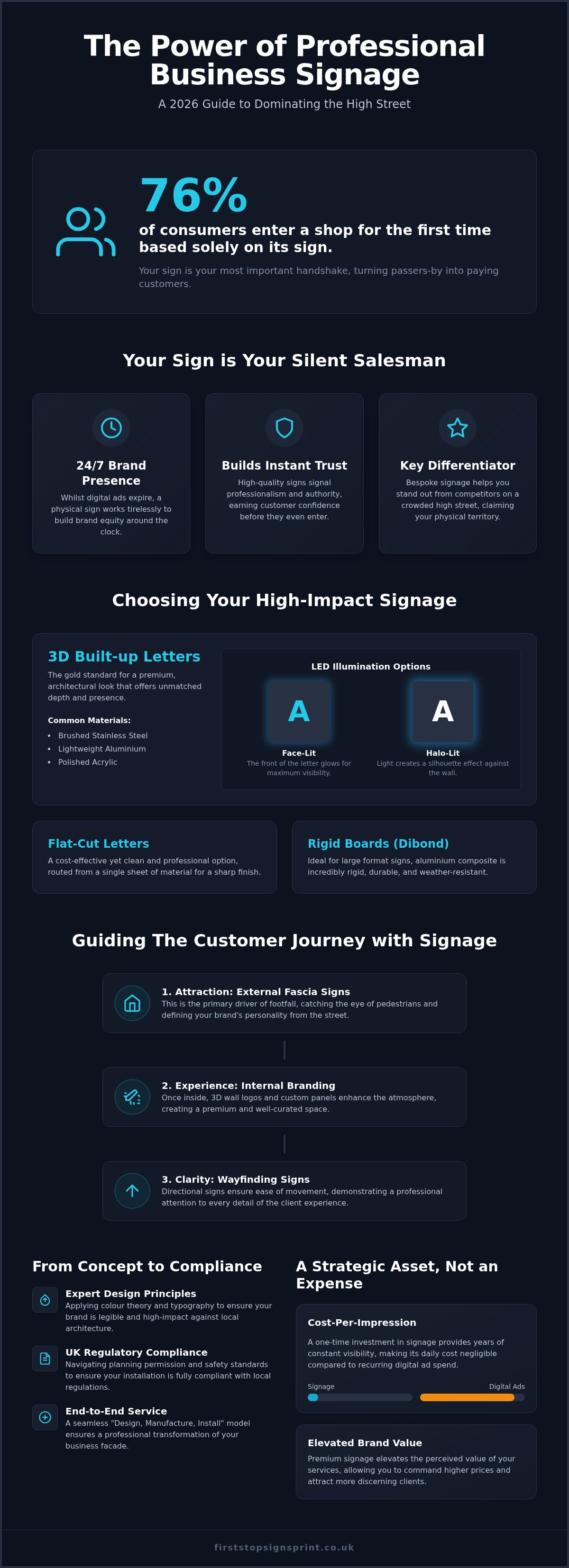
Did you know that 76% of consumers admit to entering a shop they've never visited before based solely on its signage? In the competitive high streets of London and Essex, high-quality business signs are your first and most important handshake. Visibility is your greatest asset. You already know that blending into the background isn't an option if you want to capture the attention of busy passers-by. However, the path to a perfect facade often feels cluttered with worries about local planning permission or the fear of seeing your investment fade under the unpredictable British weather.
This guide shows you how professional, bespoke signage can transform your physical presence and drive measurable footfall to your door. We'll explore the latest 2026 trends in 3D and LED technology, navigate the complexities of UK regulations, and help you choose materials that stay vibrant for years with minimal maintenance. By the end, you'll have a clear roadmap to establishing a dominant brand presence that stands the test of time and makes your business impossible to ignore.
Key Takeaways
- Understand why bespoke physical signage remains a vital local marketing tool for building instant consumer trust in 2026.
- Compare the long-term benefits of 3D letters and energy-efficient LED displays to find the most durable business signs for your specific shop front.
- Learn how to apply expert design principles like colour theory and kerning to ensure your brand is legible and high-impact against the local architecture.
- Navigate the complexities of UK planning permission and safety standards to ensure your installation is fully compliant with local authority regulations.
- Discover the advantages of an end-to-end "Design, Manufacture, Install" model for a seamless and professional transformation of your business facade.
The Strategic Role of Professional Business Signs in 2026
In an era of digital saturation, the physical environment remains the most potent arena for local connection. The Strategic Role of Professional Business Signs isn't merely about displaying a name; it's about claiming your territory in the local market. Whilst online ads vanish the moment a budget runs out, physical business signs provide a permanent, 24/7 presence that builds brand equity every hour of the day. Visibility is currency. If your shop front doesn't command attention, you're effectively invisible to thousands of potential customers walking past your door every week.
Trust is earned through consistency. A generic, flat-printed board might tell customers you're open, but a bespoke, high-impact sign tells them you're an established authority. This "first impression" factor is critical. If your shop front looks professional and permanent, customers instinctively trust your services more. It's a silent salesman that works harder than any flyer or social media post. Differentiation is the key to survival in London's crowded high streets. Moving beyond generic boards allows your brand to breathe. When your physical presence aligns with your digital identity, you create a powerful brand loop. A customer sees your 3D logo in Romford, remembers your Instagram feed, and feels a sense of familiarity that leads to a sale.
Types of Signage and Their Business Impact
Every sign serves a specific purpose in the customer journey. External fascia signs act as the primary driver of footfall, catching the eye of pedestrians and drivers alike. They define your brand's personality before a customer even touches the door handle. Once inside, internal branding like 3D wall panels and custom logos enhance the customer experience, making your space feel premium and well-curated. Finally, wayfinding signs provide the professional touch that ensures accessibility and ease of movement. This shows you care about every detail of the client experience, reducing frustration and building loyalty.
Measuring the ROI of Your Signage Investment
Consider the cost-per-impression. A well-made sign lasts for years, meaning the daily cost of reaching thousands of local people is negligible compared to pay-per-click advertising. High-quality business signs also elevate the perceived value of what you sell. By upgrading from a basic board to illuminated 3D letters, businesses often find they can command higher prices because the brand looks more prestigious. Local case studies in Essex show that shop front transformations don't just change how a building looks; they fundamentally change how much revenue it generates. It's a strategic asset that pays for itself through increased footfall and improved brand perception.
Choosing the Right Materials: From 3D Letters to LED Displays
Selecting the correct materials for business signs is a delicate balance between visual appeal and structural endurance. In the UK, your signage must withstand heavy rain, frost, and high winds whilst maintaining its professional finish. 3D signs have become the gold standard for high-street prestige because they offer a depth that flat boards simply cannot replicate. Whether you choose brushed stainless steel for a law firm or vibrant, polished acrylic for a retail boutique, the material you select speaks volumes about your brand's personality and attention to detail.
3D Signs and Built-up Lettering Explained
Built-up 3D letters are the pinnacle of bespoke signage. These are manufactured by hand to create a hollow "can" structure, giving the letters significant depth and a premium, three-dimensional look. Flat-cut letters, by contrast, are routed from a single sheet of material; they are cost-effective but lack the same architectural presence. Stainless steel, aluminium, and acrylic are the primary material choices. Aluminium is particularly popular for larger displays because it's lightweight and rust-proof. For maximum impact, modern LED illumination is essential. These displays are far more energy-efficient than traditional neon and provide 24/7 visibility. You can choose face-lit effects, where the front of the letter glows, or halo lighting, where the light reflects off the wall to create a sophisticated silhouette around the brand name.
Rigid Boards and Large Format Options
For many businesses, aluminium composite (often known as Dibond) is the preferred choice for long-term external durability. It consists of a polyethylene core sandwiched between two thin aluminium sheets, making it incredibly rigid and resistant to warping. If you need something for shorter-term promotions or indoor events, Foamex or Correx boards provide a lighter, more affordable solution. However, for a permanent shop front, the weatherproofing properties of metal and high-grade acrylic are non-negotiable. Don't forget that window vinyls and digital large format printing play a vital role in completing your shop front's look. They turn every inch of glass into a marketing opportunity without blocking natural light.
Ensuring your display meets UK Regulatory Compliance is a legal requirement for any limited company. This includes displaying your registered name clearly and correctly at your place of business. If you're unsure which material suits your specific location or budget, exploring custom business signs can help you find a solution that balances aesthetics with long-term reliability. A well-chosen material doesn't just look better; it lasts longer and requires far less maintenance over its lifecycle.
Design Principles for High-Impact Custom Signage
Effective design is the bridge between a high-quality material and a successful sale. Whilst generic templates might seem convenient, they often result in "cookie-cutter" displays that disappear into the urban background. Truly impactful business signs require a bespoke approach that considers viewing distance, local architecture, and the psychological impact of colour. A sign that looks perfect on a computer screen often fails on a Romford high street if the kerning, the space between individual letters, isn't precisely calculated for legibility from fifty yards away.
Contrast is your most powerful tool. London's architectural backdrop often consists of red brick or grey stone, so your palette must work with these tones rather than against them. High-contrast combinations, such as white letters on a dark navy fascia or gold on black, ensure instant readability. The "less is more" rule is equally vital. A cluttered board forces the eye to work too hard; a clean design with a dominant 3D logo allows the brain to process your brand identity in a fraction of a second. Integrating 3D elements adds a layer of sophistication by creating shadows and depth that flat graphics simply cannot match.
Typography and Brand Consistency
Not every font translates well into a physical 3D structure. Ultra-thin scripts might look elegant on a business card, but they often lack the structural integrity required for built-up 3D letters. Choosing a typeface with a consistent stroke weight ensures your sign remains legible even when viewed from an angle. Consistency across all touchpoints, from your shop front to your packaging and leaflets, builds a professional image that customers remember. Proportion is also key; your signage must be scaled to the building facade to avoid looking either overwhelmed or aggressively large.
Lighting Strategies for Night-time Visibility
Visibility shouldn't end when the sun goes down. Lighting is what transforms a daytime sign into a 24-hour marketing machine. LED digital sign boards are excellent for businesses that need to change promotions frequently, whilst backlit 3D letters create a premium "halo" effect that feels modern and sophisticated. If you're aiming for a specific "vibe," custom LED neon-flex offers the retro appeal of traditional neon with the durability and low running costs of modern technology. External trough lighting remains a reliable choice for a classic, understated look that illuminates the entire fascia evenly.
Designing for the physical space also means staying within the UK government's advertisement regulations. These rules dictate how large or bright a sign can be in specific areas. By balancing these legal requirements with bold, professional design, you ensure your investment is both safe and strikingly effective.
Professional Sign Installation and UK Regulatory Compliance
Installing business signs isn't a task for the inexperienced. It's a critical structural job that carries significant legal and safety implications. Whilst many online shops provide fixings for DIY attempts, they rarely address the risks of poor mounting or the complexities of British planning law. A sign that isn't secured correctly can become a liability during high winds, potentially leading to property damage or personal injury. Professional installation ensures that the hardware used matches the specific substrate of your building, whether that's historic London brick, modern cladding, or timber.
Beyond physical safety, insurance compliance is a major factor. Most commercial insurers require proof that external fixtures were installed by qualified professionals to maintain your public liability coverage. If a sign falls and you've installed it yourself, your policy might be void. Choosing a professional team means your brand is protected both legally and physically from day one.
The Installation Process: What to Expect
A reliable project begins with a comprehensive site survey. This isn't just about measuring the space; it's about checking the structural integrity of the mounting surface. We look for crumbling masonry or hidden electrical lines that could complicate the process. When it comes to mounting 3D letters or heavy LED displays, we use specialised templates and load-bearing fixings to ensure a perfectly level finish. For any illuminated signage, electrical safety is non-negotiable. All wiring must be concealed and safe, often requiring PAT testing for internal components to meet UK workplace standards. This methodical approach prevents future maintenance issues and ensures your sign stays vibrant and secure for years.
Navigating Planning Permission in London and Essex
Many business owners are surprised to learn that their new shop front might require "Express Consent" from the local authority. Under the Town and Country Planning (Control of Advertisements) Regulations 2007, any sign larger than 0.3 square metres generally requires council approval. If your signage is illuminated or projects over a public pavement, you must check local guidelines before manufacturing begins. In London and Essex, conservation areas have even stricter rules. You might face restrictions on the brightness of LED signs or be required to use specific traditional materials to preserve the local character. Projection limits are also strictly enforced to ensure pedestrians can walk safely without obstruction.
Don't leave your brand's safety to chance. Book our professional sign installation services to ensure your display is perfectly mounted and fully compliant with all local regulations.
Bespoke Signage Solutions with First Stop Signs Print
Choosing a partner for your brand's physical presence requires more than just a printing service; it requires a specialist who understands the journey from a digital concept to a structural reality. At First Stop Signs Print, we provide a complete end-to-end service that removes the stress of coordinating multiple contractors. We don't just ship a product and leave the rest to you. Our team manages the entire lifecycle of your business signs, covering initial design consultations, specialist in-house manufacture, and professional installation across Romford, London, and the Home Counties.
Our workshop specialises in the high-impact solutions that modern high streets demand. Whether you require precision-engineered 3D logos or energy-efficient LED shop sign boards, we use durable materials designed to thrive in the British climate. We understand that a brand's identity shouldn't stop at the front door. By matching your exterior signage with premium labels, bespoke business cards, and leaflet printing, we ensure your visual narrative remains consistent across every customer touchpoint. This holistic approach builds the professional authority and consumer trust we discussed earlier in this guide.
Our Full-Service Branding Approach
We believe that the interior of your premises should be just as impactful as the facade. Our expertise extends into the manufacture of bespoke 3D wall panels and metal wall art, perfect for corporate offices or retail spaces looking to create a premium atmosphere. These elements add tactile depth to your environment, turning a standard office into a branded experience. For retail clients, we coordinate these architectural features with large format digital printing for window displays. This creates a layered, professional look that captures attention from the street and maintains engagement once a customer steps inside. Every element is designed to work in synergy, ensuring your brand presence is dominant and cohesive.
Why Local Matters: Serving the London Business Community
In the fast-paced markets of London, Essex, and Hertfordshire, timing is often as important as quality. Working with a local specialist based in Romford means you benefit from quick turnaround times and a partner who can be on-site within hours. We provide face-to-face consultations to ensure every measurement is perfect and every material choice suits your specific building substrate. We know the local landscape, from the architectural nuances of London boroughs to the specific requirements of councils in Essex and Bucks. This local expertise ensures your project moves from the drawing board to the high street without the delays often associated with national, faceless providers. We take personal pride in every sign we install, acting as a reliable partner for your long-term growth.
Don't settle for generic, cookie-cutter displays that fail to represent your brand's true value. Our team is ready to help you stand out with durable, high-impact visual solutions tailored to your unique needs. Enquire about your bespoke business signs today and take the first step towards a more visible, professional future.
Future-Proof Your Brand with High-Impact Signage
In 2026, your shop front is more than just a physical location; it's a strategic asset that builds brand equity every time a potential customer walks past. We've explored how choosing the right materials, such as built-up 3D letters or energy-efficient LED displays, can dramatically increase footfall whilst maintaining a professional image. Navigating UK regulations and ensuring structural integrity through expert installation are the final steps in protecting your investment for the long term.
At First Stop Signs Print, we specialise in taking the complexity out of this process. Our full design-to-installation service ensures that your vision is manufactured to the highest standards and mounted with precision. As specialists in 3D and LED bespoke manufacturing, we provide expert installation across London and Essex, helping local businesses stand out in a crowded market. Whether you're refreshing a retail unit in Romford or fitting out a corporate office in the City, we're here to help you become visible. Don't leave your first impression to chance when you can invest in durable, professional business signs that work as hard as you do.
Get a Bespoke Signage Quote from First Stop Signs Print and let's build something that makes your brand impossible to miss.
Frequently Asked Questions
Do I need planning permission for my business sign in London?
Most business signs in London require "Express Consent" from the local council if they are illuminated or larger than 0.3 square metres. This falls under the Town and Country Planning (Control of Advertisements) Regulations 2007. Conservation areas have even stricter rules regarding brightness and materials. We recommend checking with your local authority or a professional installer before manufacturing begins to ensure your shop front remains fully compliant with current UK regulations.
How long do 3D LED signs typically last?
High-quality 3D LED signs typically last between 50,000 and 100,000 hours of continuous use. For most businesses operating ten hours a day, this translates to roughly ten years of reliable illumination. LED technology is significantly more durable than traditional neon tubes, which are prone to gassing out or breaking. Regular maintenance, such as cleaning the face of the letters, ensures your display stays vibrant and professional for its entire lifecycle.
What is the best material for an outdoor shop sign in the UK weather?
Aluminium composite and stainless steel are the best materials for the unpredictable UK weather. These materials are rust-proof and resistant to the warping caused by extreme temperature changes or high humidity. For 3D elements, high-grade acrylic offers excellent UV resistance, preventing your brand colours from fading in the sun. Choosing these weather-resistant materials reduces long-term maintenance costs and ensures your business signs remain a permanent fixture on the high street.
How much does professional sign installation cost?
The cost of professional sign installation depends on several bespoke factors, including the height of the display, the building's substrate, and any specialised access equipment required. A ground-level fascia sign is simpler to mount than built-up letters on a third-storey office. We provide on-site surveys to assess these variables and ensure a safe, secure fit. This methodical approach guarantees your signage meets insurance requirements and remains structurally sound during heavy winds.
Can you create a 3D version of my existing company logo?
Yes, we can manufacture a bespoke 3D version of almost any existing company logo. Our design team translates your 2D graphics into structural files for our CNC routing and fabrication machines. We use materials like polished stainless steel or coloured acrylic to bring your brand to life with physical depth. Adding LED halo lighting to a 3D logo creates a sophisticated, premium look that enhances your reception area or shop front immediately.
What is the difference between built-up letters and flat-cut letters?
Built-up letters are manufactured with a hollow "can" structure to create significant physical depth, whilst flat-cut letters are routed from a single sheet of material. Built-up 3D letters are the gold standard for high-impact shop signs because they allow for internal LED illumination. Flat-cut letters are a more cost-effective choice for internal branding or secondary signage. Both options offer a professional finish, but built-up letters provide a more prestigious and architectural presence.
Do you offer same-day signage or printing services in Essex?
Whilst bespoke business signs require a manufacturing lead time, we offer quick turnaround times for digital printing services in Romford and Essex. Items like business cards, leaflets, and flyers can often be produced rapidly to meet tight deadlines. However, high-quality 3D or LED signage involves precision hand-fabrication and structural checks that cannot be rushed. We focus on durability and quality to ensure your investment stands the test of time rather than offering same-day shortcuts.
What lighting options are best for energy-efficient business signs?
LED modules are the most energy-efficient option for modern business signs, consuming significantly less power than traditional neon or fluorescent tubes. For example, an indoor LED poster sign running for ten hours a day has an estimated annual energy cost of £525.60 based on 2026 rates. LED technology also allows for better brightness control, helping you balance high visibility with lower utility bills. They are the reliable choice for businesses seeking 24/7 brand presence.


