
The best food packaging label printers for your business may not be printers you own. If labels peel in chilled storage, ink smudges during handling or specialist stock adds cost, buying a machine can seem like the obvious fix. But for a growing food brand, professional printing may be a more practical route to a polished, consistent finish.
Your labels need to suit the pack, remain legible through storage and handling, and present food information clearly. Getting that balance right means considering more than the printer: materials, print method, production volume and UK labelling requirements all matter. A well-produced label can support a professional presentation, but it cannot replace checks on the accuracy of the information you provide.
This guide will help you weigh in-house hardware against a specialist print service, so you can choose an approach that suits your products and plans for growth. We’ll look at control and running costs, durable label performance, and how design and material choices can support a consistent brand. First Stop Signs Print provides commercial label printing, from design through to production, for businesses in Romford, London, Essex and across the UK.
Key Takeaways
- Compare food packaging label printers with commercial print services by looking beyond the purchase price to ongoing costs and production needs.
- Check how print resolution affects the legibility of small ingredient text, and consider colour consistency when planning your packaging design.
- Include labour, setup time and wasted materials when calculating the true cost of printing labels in-house.
- Match label material and adhesive to storage conditions; ordinary paper can struggle in cold or humid environments.
- Consider how bespoke label printing can support different production scales, from artisan products to larger commercial lines.
Understanding Food Packaging Label Printers: Hardware vs. Services
Food packaging labels do more than decorate a jar or packet. They carry product information, support traceability and help customers recognise a brand on a crowded shelf. A smudged logo, fuzzy small text or inconsistent colour can make even a carefully made product look less professional. The wider role of packaging, from protecting food to communicating information, is outlined in this Food Packaging Overview.
There are two main routes: buy a printer and manage production in-house, or commission a commercial print partner. A desktop machine can suit small batches, frequent design changes and occasional labels. Outsourcing may be a better fit when you need repeatable results across larger runs, consistent brand colours or finished labels produced as part of a wider packaging plan. The right choice depends on volume, design needs and the time your team can devote to printing.
Packaging choices can also include features such as QR codes, which connect printed packaging with digital product information. If you use one, check that it scans reliably at its final printed size and does not crowd essential information. Leave sufficient space around the code and test it on the actual pack before approving the artwork.
Desktop Printers for Small Batch Production
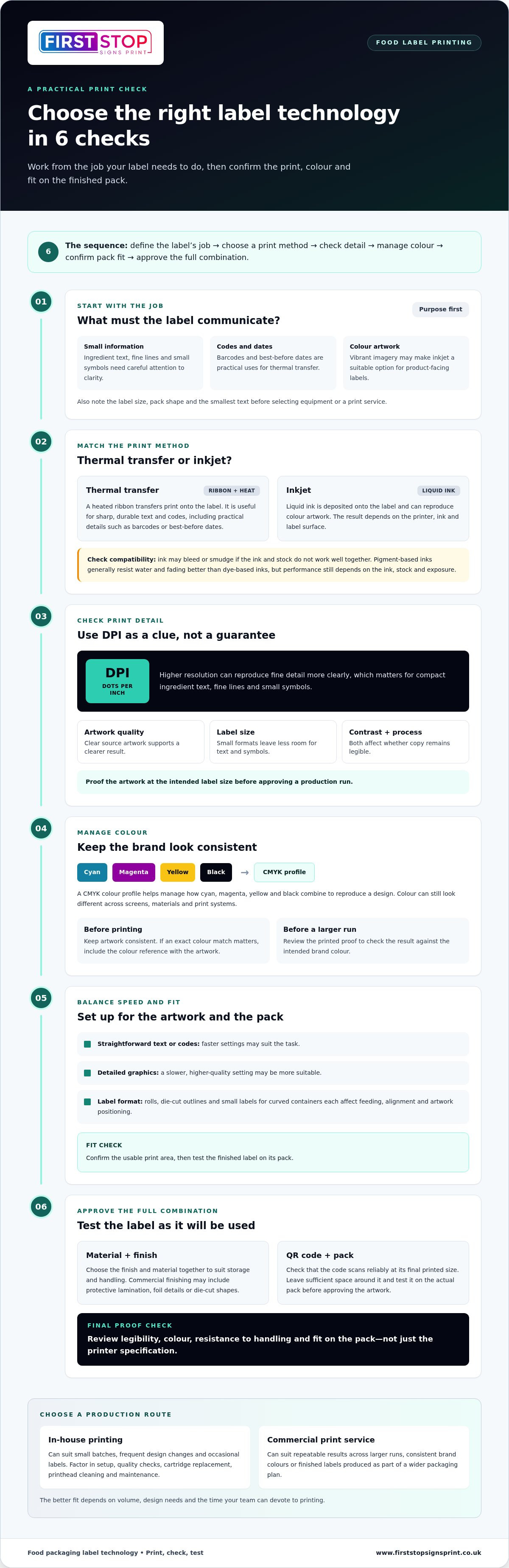
For short runs, compare the print method with the label’s job. Thermal transfer uses a heated ribbon to transfer print onto a label, making it useful for sharp, durable text and codes. Inkjet prints by depositing liquid ink and can reproduce colour artwork, which may suit a small brand testing different designs. The result depends on the printer, ink and label surface, so a sample print is a practical way to assess detail and resistance to handling.
Desktop equipment has limits. Colour can vary from one device or material to another, and ink may bleed or smudge if the stock and ink aren’t compatible. Replacement cartridges, printhead cleaning and maintenance add to the workload. In-house printing offers control, but it also means managing setup and quality checks alongside production. Before choosing a machine, check that it supports the label format you need and can print clearly at the size of your smallest text.
Commercial Grade Label Printing Services
Commercial digital printing can help produce consistent colour and detail across a run. Depending on the project, specialist finishing may include protective lamination, foil details or die-cut shapes. These options can help a label stand out, but choose the finish and material together to suit the product’s storage and handling conditions.
For retail-ready food products, outsourcing can reduce the work involved in maintaining equipment and reproducing artwork accurately in-house. It can also bring support with production and material selection. First Stop Signs Print provides bespoke commercial label printing, from design through to production, including high-volume work. This service can support a small-batch maker developing a product range or a larger food brand aiming for consistent presentation across its products.
Technical Specifications: Choosing the Right Label Technology
Printer specifications affect more than appearance. They influence whether small text stays legible, brand colours look consistent and labels suit the shape of the pack. Compare the finished result you need with the technology’s capabilities, rather than choosing by headline speed or resolution alone.
DPI, or dots per inch, describes print resolution. Higher resolution can reproduce fine detail more clearly, which matters for compact ingredient text, fine lines and small symbols. But DPI alone doesn’t guarantee readable copy: artwork quality, label size, contrast and the print process all play a part. Check a proof at the intended label size before approving a production run.
For colour artwork, a CMYK colour profile helps manage how cyan, magenta, yellow and black combine to reproduce a design. Colours can still look different across screens, materials and print systems. Reviewing a proof and keeping the artwork consistent helps protect a recognisable brand colour from one run to the next. If an exact colour match matters, include the colour reference with your artwork and review the printed result before a larger run.
Speed is a trade-off, not a target in isolation. Faster settings may suit straightforward text or codes, whilst detailed graphics can benefit from a slower, higher-quality setting. Also consider the shape and dimensions of the label: rolls, die-cut outlines and small labels for curved containers place different demands on feeding, alignment and artwork positioning. Confirm the usable print area and test the finished label on its pack.
Inkjet vs. Thermal Transfer for Food Items
Thermal transfer uses a ribbon to apply print and is often used for practical details such as barcodes or best-before dates, including on secondary packaging. Inkjet is suited to colour artwork and may be a choice for product-facing labels with vibrant imagery. Pigment-based inks generally offer better resistance to water and fading than dye-based inks, but performance depends on the ink, stock and exposure. Test the complete combination rather than judging ink alone.
Digital Printing: A Flexible Option for Food Brands
Digital printing can be useful for runs where the setup and flexibility to produce different artwork suit the job. It can also support variable data on compatible workflows, so batch numbers or QR codes can change between labels without redesigning the whole layout. Ask for a proof that checks both colour and small details. For a related look at finish and application, explore professional vinyl sticker printing.
Choosing between food packaging label printers means matching resolution, colour control, speed and format to the pack and production plan. Bespoke commercial printing can help manage those decisions from artwork through to production. If you’re assessing options for your range, explore commercial label printing services from First Stop Signs Print.
In-House Printing vs. Professional Services: The ROI Comparison
A printer’s purchase price is only the start of its cost. To compare in-house production with outsourced label printing fairly, calculate total cost of ownership (TCO) across the period you expect to use the machine. Include the equipment, design or label software, suitable stock, ink or ribbons, maintenance, staff time and material wasted during setup or misprints. Then compare that total with the cost of professionally printed labels for the same volume and specification.
This gives you a practical break-even point. Divide the fixed costs of owning and maintaining the printer by the saving per label compared with outsourcing. The result estimates how many labels you’d need to print before in-house production recovers those fixed costs. If outsourcing costs more per label, there may be no break-even point at your current volume. Revisit the calculation if your order volume, label design or product range changes.
The Real Cost of In-House Hardware
Compare equipment costs using quotes for printers that meet your production requirements, rather than relying on a broad estimate. Check what each option includes and budget for compatible label stock, inks or ribbons, software and maintenance. Different products may also need different stock, leaving part-used rolls that can’t be used for another label size or finish.
There’s a staff-time cost, too. Someone must prepare files, set up the machine, check colour and alignment, handle test prints and keep supplies in stock. Maintenance and printhead issues can interrupt production, with extra impact if labels are needed for a packing run. Include these hours and the cost of delays in your TCO, rather than treating them as free.
Design affects the result as well. Clear hierarchy, legible details and considered colour choices help a label work on the pack and on the shelf. The principles in this guide to professional sign design also show why visual clarity and consistency matter across printed formats.
The Advantages of a Managed Print Service
Outsourcing avoids buying label-printing machinery or managing its software. It can also give your team access to guidance on material choice, adhesive and production methods, helping you match the label to the product and its handling conditions. First Stop Signs Print provides bespoke commercial label printing from design through to production, including high-volume production for growing requirements.
There’s no universal volume at which outsourcing becomes cheaper. Compare like for like: use the same label dimensions, finish and quantity, and include internal labour, waste and maintenance in the in-house figure. In-house printing may suit frequent small runs or changing details. A commercial service may offer stronger value when the priority is repeatable output, larger batches or freeing staff to focus on food production. For businesses weighing up food packaging label printers, bespoke commercial label printing offers a route from design to production without owning the press.
Selecting Materials for Durability and Food Safety
A label that looks good at packing can still fail in storage. Paper may wrinkle, absorb condensation or lose adhesion in a chilled environment, while oils and handling can mark an unprotected print surface. Choose the face material, adhesive and finish as a complete system, based on the product, packaging surface and journey from packing to customer.
Adhesive choice matters as much as the label material. Permanent adhesives are designed to stay attached, removable adhesives are intended to peel away more cleanly, and freezer-grade adhesives are formulated for low-temperature applications. These are broad categories, not a guarantee of performance: application temperature, surface cleanliness, condensation and time in storage all affect the bond.
For food safety, consider where the label sits. If any part of the label or its adhesive could come into contact with food, the material must be suitable for that intended use. Check relevant supplier information and documentation, and keep label claims separate from claims about the food itself. UK requirements depend on the application, so assess the complete packaging arrangement rather than assuming a stock is suitable because it is sold for labelling.
Fridge and Freezer Safe Materials
Polypropylene (PP) and vinyl are often considered for chilled applications because they can offer a more moisture-resistant face than ordinary paper. Neither is automatically right for every pack: match the material and adhesive to the container, temperature range and handling conditions. Temperature changes during delivery can create condensation or stress the adhesive bond, especially if a cold product is labelled in a warm, damp environment.
Run a practical trial before committing to a full batch. Apply sample labels as they’ll be used, then put the packed product through its actual storage and delivery conditions. Check for lifting at corners, bubbles, fading, smudging and damage from oil or moisture. This real-world test is more useful than judging a label from a dry sample alone.
Eco-Friendly and Sustainable Labelling Trends
Compostable, biodegradable and recycled-content label stocks can support sustainability goals, but the claim needs to match the material and the packaging’s disposal route. A compostable label does not make the whole pack compostable, and a recyclable face material may still be affected by its adhesive, ink or laminate. Ask for clear material information and consider how the label fits with the pack’s recycling instructions.
Balance environmental aims with reliable adhesion and legibility, and assess the full packaging format rather than the label stock in isolation. Material selection should account for how the product is packed, stored and disposed of. Bespoke label printing can help bring material and visual choices together. Discuss bespoke label printing with First Stop Signs Print for your food packaging requirements.
Bespoke Food Label Solutions with First Stop Signs Print
A food label needs to fit the product as well as the brand. First Stop Signs Print supports food businesses from design through to production, creating bespoke commercial labels. Based in Romford, the company serves businesses in London, Essex and across the UK.
Requirements vary with the product and production scale. An artisan honey maker may need a distinctive label for a small range of jars, whilst a commercial bakery may need consistent designs across multiple products and larger production runs. In each case, the label’s size, shape, material and finish influence how the artwork appears and performs on its packaging. First Stop Signs Print can support the design and production process around the project’s requirements.
Packaging is one part of a brand’s wider presence. Coordinating its colours, typography and visual style with your business signs can help customers recognise your products both on the shelf and at your premises. The same visual approach can carry through to a food stall, café or retail unit, giving the brand a more consistent presence in person.
Our End-to-End Design and Print Process
A clear design-to-print process helps bring creative decisions and production requirements together. Start with the pack itself: its dimensions, surface, storage conditions and how customers will handle it. Then consider the artwork, label shape, information hierarchy and material. These practical details help shape a bespoke design that is visually strong and suited to its intended use.
First Stop Signs Print provides support from design to production, including high-volume commercial label printing. This gives food brands a single process for developing artwork and producing labels, rather than treating design and print as separate tasks. The team works with businesses across London and Essex, as well as across the UK.
Rather than relying on standard office labels or investing immediately in food packaging label printers, brands can use commercial printing to produce labels tailored to their packaging and production needs. The aim is a polished result that supports a professional presentation, whether you’re building a small product range or scaling up.
Scaling Your Brand Beyond the Label
As your business grows, keep the visual identity consistent across packaging and premises. For example, the look of a product label can inform the presentation of your shop or café, while illuminated shop signs in the UK can contribute to how customers recognise a business from outside. First Stop Signs Print also produces custom business signs, helping food businesses extend their visual presence beyond the pack.
Every project has its own combination of artwork, materials and production requirements. Share your packaging format, product range and planned production needs to request a bespoke quote. Request a bespoke label printing quote from First Stop Signs Print.
Give Your Next Product Range a Stronger Shelf Presence
Your next label decision can do more than solve an immediate printing need. Treat it as a chance to make your packaging work harder as your range evolves, with a consistent look that helps customers recognise your products. Choosing between food packaging label printers starts with a clear view of the role the label must play today and the brand you want it to represent tomorrow.
First Stop Signs Print provides commercial label printing, from design through to production. An end-to-end process can help bring artwork and production together, while your business remains responsible for checking that the food information on the label is accurate and appropriate for the product.
Before requesting a quote, gather your current artwork, the product details that need to appear on the pack and any planned range changes. Include label dimensions, quantity, packaging surface and storage conditions. A clear brief gives the design process a practical starting point and helps keep your identity coherent as you introduce new products.
When you’re ready to plan your next run, get a bespoke food label quote from First Stop Signs Print. Shape your label around your products and give your brand a confident presence wherever customers find it.
Frequently Asked Questions
Do I need a special printer for food labels in the UK?
No specific printer makes a label legally compliant. Choose equipment and materials that can produce clear, durable print for your packaging, but remember that the food business remains responsible for the accuracy and completeness of the information. For example, a printer must reproduce small text legibly, but it can’t check whether an ingredient declaration is correct. Consider the label’s use, surface and storage conditions before selecting a print method.
What is the best material for labels that will be stored in a freezer?
Use a label face material and adhesive intended for freezer conditions, rather than assuming ordinary paper stock will hold. Polypropylene or vinyl may be suitable options, but performance depends on the packaging surface, when the label is applied and whether condensation forms. Test a sample on the actual container through freezing, storage and thawing. Inspect corners and edges for lifting, and check that text and graphics remain readable.
Are home-printed labels safe for direct food contact?
Not automatically. A home printer’s ink, label material and adhesive need to be suitable for the intended food-contact use, and ordinary stationery labels shouldn’t be assumed safe for direct contact. If the label sits on the outside of a sealed jar or packet, that’s different from placing it against unpackaged food. Keep labels off food unless you have documentation that the complete material combination is appropriate for that use.
How do I ensure my food labels comply with UK Natasha’s Law and other regulations?
Start by identifying whether the product is pre-packed for direct sale (PPDS), since Natasha’s Law requires a full ingredients list with allergens emphasised on the label for those foods. Then check current Food Standards Agency guidance and the rules that apply to your product and location. Verify every detail against the recipe and product specification, including changes to ingredients, before approving artwork. Printing quality can support legibility, but it doesn’t establish legal compliance.
Can I print white ink on clear labels with a standard desktop printer?
Usually not. Standard desktop colour printers typically use cyan, magenta, yellow and black inks, without a white ink channel. On a clear label, areas intended to look white may therefore appear transparent, allowing the packaging or product behind them to show through. If your design needs opaque white text or a white background, use a print process that supports white ink or choose a white label stock instead.
What is the difference between a label printer and a professional label printing service?
A label printer is hardware your business operates, so your team handles artwork preparation, stock, machine settings, print checks and upkeep. A professional service manages production for you and can coordinate design and print as one workflow. For example, a small batch of changing date codes may suit in-house printing, whilst a coordinated product range may benefit from professionally produced labels with consistent colour and finish.
How much does it cost to have professional food labels printed?
The cost depends on the job’s requirements, so a useful quote needs details such as label dimensions, quantity, material, finish and whether the artwork is ready to print. Different products in one range may need separate layouts or stocks, which can affect the production brief. Prepare those details, along with any storage or handling needs, to receive a tailored quote rather than relying on a generic price estimate.
Can I get same-day food label printing in London or Romford?
Same-day food label printing shouldn’t be assumed. First Stop Signs Print’s standard turnaround is 5–10 working days after design proof approval, with an express service of 24–48 hours possible for a surcharge. Allow time to prepare and approve artwork before production, and build label approval into your packaging schedule to reduce the risk of a last-minute print requirement.


