
Imagine a high-value client walking into your reception area only to be met with confusing directions or, even worse, office signs that are peeling and look cheap. It's a small detail that makes a massive impact, often suggesting a lack of attention to detail before a single word is spoken. You likely agree that your physical workspace should be a seamless extension of your brand, providing a sense of confidence and clarity for every member of staff and visitor who enters the building.
This professional guide promises to help you master the art of office branding and navigation through expert signage selection and strategic planning. We've designed this resource to solve common frustrations, from inconsistent branding in meeting rooms to the headache of poor wayfinding. We'll explore the latest 2026 trends in bespoke 3D lettering, look at durable material choices that stand the test of time, and explain how a professional installation ensures your office looks cohesive and sophisticated for years to come.
Key Takeaways
- Learn how to conduct a comprehensive visitor journey audit to pinpoint exactly where guests and staff need directional guidance.
- Compare premium materials like 3D acrylic and metal wall art to select the most durable and visually striking options for your brand.
- Implement a logical wayfinding hierarchy and colour-coding system to streamline the flow of movement throughout your building.
- Discover why professional installation is critical for securing office signs and ensuring they remain perfectly aligned on surfaces from glass to brick.
- Master the balance between bespoke 3D branding and functional signage to create a cohesive, high-end professional environment.
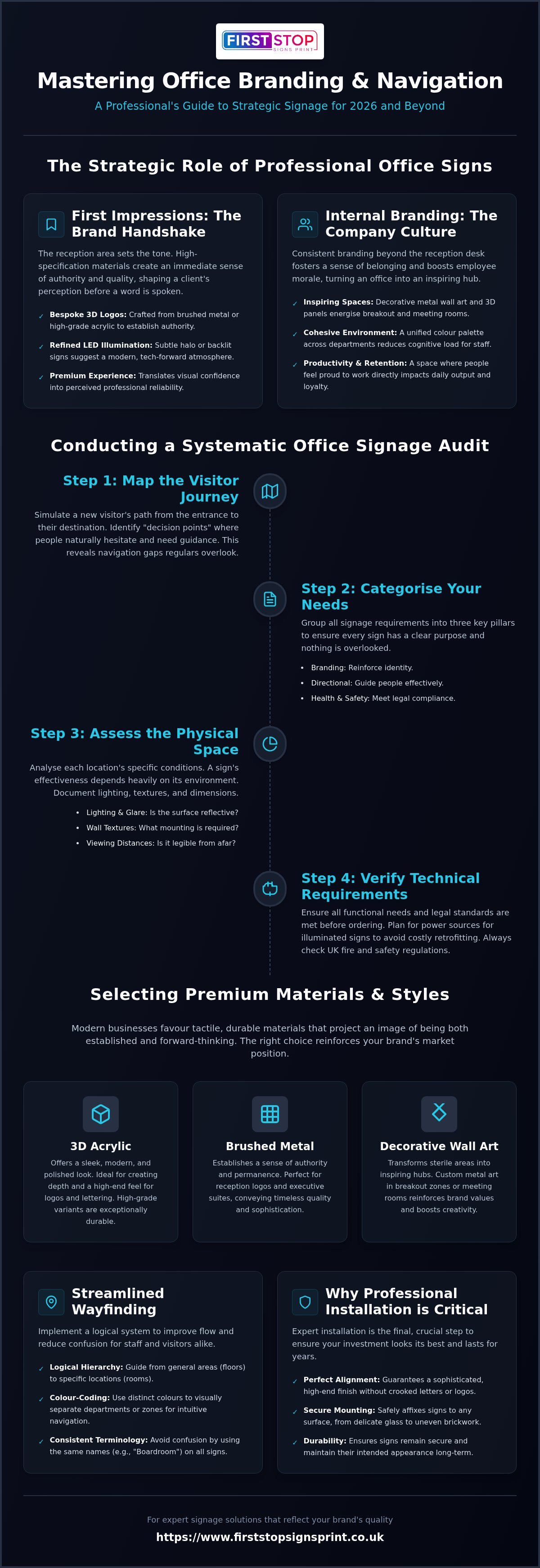
The Strategic Role of Professional Office Signs
Effective office signs represent more than just plastic on a wall. They’re a sophisticated blend of brand identity, legal compliance, and functional wayfinding. The Strategic Role of Professional Office Signs extends far beyond simple identification; it’s about shaping the perception of your business from the very second a visitor crosses the threshold. In 2026, we’re seeing a definitive shift away from flat, generic displays. Modern businesses now favour tactile 3D elements and refined LED illumination that suggests a firm is both established and forward-thinking. High-quality signage acts as a silent ambassador, reinforcing your market position without saying a word.
First Impressions at the Reception Desk
The reception area is your brand’s handshake. It requires the highest specification of materials because it sets the tone for the entire client relationship. A bespoke 3D logo, perhaps crafted from brushed metal or high-grade acrylic, establishes authority immediately. When you add subtle halo lighting or backlit LED signs, you create a modern atmosphere that feels tech-forward and premium. It tells a client that your company invests in quality and pays attention to the finer details. This visual confidence often translates into perceived professional reliability, making the initial wait in a lobby feel like the start of a premium experience.
Internal Branding and Company Culture
Branding shouldn't stop at the front door. Internal office signs play a vital role in building company culture and employee morale. When staff work in a space that visually communicates the company's mission and values, it fosters a stronger sense of belonging. Decorative metal wall art in breakout areas or 3D wall panels in meeting rooms can turn a sterile office into an inspiring hub. Using a cohesive colour palette across different departments ensures the environment feels unified rather than fragmented. This consistency reduces cognitive load for employees, making the office a more comfortable and professional place to spend the working day. It’s about creating a space where people feel proud to work, which directly impacts retention and daily productivity.
Conducting an Office Signage Audit: A Step-by-Step Guide
Before ordering any office signs, you must understand the physical space they'll inhabit. A haphazard approach leads to cluttered walls and confused visitors. Conducting a thorough audit ensures that every sign serves a specific purpose, whether it's reinforcing your brand or guiding someone to the lifts. You should start by categorising your needs into three distinct pillars: branding, directional, and health and safety. This systematic overview prevents the common mistake of purchasing high-specification signs that don't actually fit the functional requirements of your layout.
During your walk-through, pay close attention to lighting and wall textures. A polished acrylic sign might look stunning in a catalogue, but if it's placed directly opposite a bright window, the glare could make it unreadable. Similarly, the mounting method depends entirely on the surface; fixing a heavy 3D logo to glass requires a different technical approach than mounting it on exposed brick. Documenting measurements and viewing distances for every intended location is vital. A sign that's too small for a long corridor is just as ineffective as one that's too large for a cramped doorway.
Mapping the Visitor Journey
Start at the front door. Imagine you’re a new recruit or a potential client arriving for a pitch. By simulating this experience, you’ll quickly spot navigation gaps that regulars simply overlook because they already know the route by heart. Identify "decision points", those specific locations where a person naturally hesitates to look for direction. This is where you should apply the principles of Strategic Wayfinding: Improving Flow and Navigation to ensure a logical progression through the building. Consistency in terminology is also crucial; don't switch between "Boardroom" and "Meeting Room 1" on different floors, as this creates unnecessary friction.
Technical Requirements and Compliance
Function must always meet regulation. In the UK, fire exit and safety signage must adhere to specific legal standards regarding colour, size, and placement. These aren't optional design choices. You also need to check for power sources early in the planning stage if you're considering LED or illuminated displays. Retrofitting wiring for an illuminated shop sign board or a backlit logo can be disruptive and costly if not planned in advance. If you're unsure how to integrate these technical elements, seeking a professional sign installation approach can help you avoid common pitfalls and ensure your office remains both compliant and visually impressive.
Selecting Materials: From 3D Acrylic to Metal Wall Art
Choosing the right materials for your office signs is a decision that balances brand alignment with long-term durability. While many businesses settle for flat vinyl decals, these often lack the physical presence required to make a lasting impression. Acrylic remains a staple for modern workspaces due to its versatility; it can be finished in high-gloss or a sophisticated matte. For a more industrial or timeless feel, metals such as brushed stainless steel or aluminium provide a sense of permanence and weight. In 2026, we're also seeing a rise in biophilic designs that use sustainable wood to bring warmth and texture into corporate environments.
The choice of material dictates how your signage interacts with the environment. High-impact areas like boardrooms benefit from large format digital printing when you want to cover an entire wall with a narrative graphic. However, for a truly premium feature area, 3D wall panels offer a tactile, geometric texture that flat prints simply cannot replicate. These panels create a sophisticated backdrop that absorbs sound and adds a layer of architectural interest to otherwise plain partitions.
The Premium Appeal of 3D Signs
Dimensional signage turns a company logo into a physical architectural feature. Built-up letters create depth and cast shadows that shift as the office lighting changes throughout the day. This dynamic quality is why dimensional branding is the preferred choice for reception areas and lift lobbies. You can select from various finishes, including polished stainless steel for a mirror-like effect or matte acrylic for a contemporary look. To explore these options in more detail, The Ultimate Guide to 3D Lettering provides an in-depth look at how these materials can elevate your professional presence.
Decorative Elements and Metal Wall Art
Vast, plain office walls can often feel sterile and uninviting. Metal wall art serves as a robust and stylish solution for breaking up these large spaces whilst reinforcing your brand's visual identity. Unlike traditional framed prints, which may suffer from glass glare or look dated over time, bespoke metal designs are incredibly durable and easy to maintain. These pieces can incorporate subtle brand motifs or abstract patterns that reflect your company's industry. Using metal ensures your decorative office signs remain a permanent part of the interior design, resisting the peeling or fading often associated with lower-quality decorative alternatives.
Strategic Wayfinding: Improving Flow and Navigation
Creating a logical wayfinding system is about more than just putting names on doors. It's about developing a cohesive language that guides people through your building without them having to ask for help. To achieve this, you must establish a clear hierarchy of information. This starts with primary office signs like lobby directories, moves to secondary signs such as floor-level pointers, and ends with tertiary identification for specific desks or meeting rooms. By organising information this way, you prevent guests from feeling overwhelmed by too many choices at once.
Colour-coding is one of the most effective tools for simplifying complex layouts. Assigning specific colours to different floors or departments allows visitors to identify their location instantly. For instance, a blue theme for the sales department and a charcoal grey for operations creates an intuitive visual shorthand. When selecting fonts, legibility is your priority. Whilst you want to maintain your brand style, a highly decorative script will fail the legibility test from a distance. Stick to clean, sans-serif typefaces with high contrast against the background to ensure every sign is readable for everyone, including those with visual impairments.
Directional Signage Placement
The success of your navigation depends heavily on where you place your signs. Wall-mounted directories and projecting "flag" signs should ideally be installed at an average eye level, typically between 1400mm and 1700mm from the floor. This ensures they're within the natural line of sight for most people. Remember that "less is more" in wayfinding; overcrowding a corridor with too many instructions leads to visual clutter. For a modern twist, consider using floor graphics. These are particularly effective in large open-plan spaces where wall space is limited, providing a clear path that visitors can follow naturally.
Meeting Room and Desk Identification
Standardising your internal nameplates creates a professional, organised look that reinforces your attention to detail. Using interchangeable inserts is a practical solution for rooms with changing functions or desks used by different team members throughout the week. This flexibility ensures your office signs remain accurate without the need for constant full replacements. For a deeper dive into the aesthetics of these systems, The Art of Sign Design offers excellent insights into balancing function with British business style. Inclusive design is also a legal and moral necessity; incorporating tactile elements or Braille into your room IDs ensures your office is accessible to all staff and visitors. If you're ready to upgrade your building's navigation, you can request a bespoke wayfinding consultation to ensure your layout is as efficient as possible.
Bespoke Installation: Bringing Your Vision to Life
The most beautifully designed office signs are only as effective as their final installation. Even a premium 3D logo can lose its impact if it's mounted crookedly or shows unsightly fixings. Professional installation is particularly critical for built-up letters and illuminated displays where weight and electrical safety are primary concerns. A professional team understands that every surface requires a different technical approach. Mounting a heavy metal logo onto a modern glass partition demands specialised, invisible adhesives, whilst securing 3D wall panels to an aged brick wall in a converted London warehouse requires heavy-duty mechanical anchors.
Precision alignment is the hallmark of a high-quality fit-out. When installing individual 3D letters, installers use custom-made templates to ensure the spacing and leveling are millimetre-perfect. This attention to detail prevents the "DIY look" that can undermine a brand's authority. By choosing a signage partner that manages the entire project from initial design to the final screw, you ensure that the technical constraints of the installation are considered long before the manufacturing begins. This end-to-end management reduces the risk of onsite surprises and ensures the final result matches the original digital proof perfectly.
Why Professional Fitting Matters
Attempting to install complex signage without the right tools often leads to permanent damage to office walls. Plasterboard, in particular, is easily compromised if the wrong fixings are used for heavy items. Beyond aesthetics, safety is a non-negotiable factor. Professionally installed LED signs ensure that all wiring is safely concealed behind the sign or within wall cavities, complying with UK safety standards. This doesn't just look cleaner; it also protects your investment. Signs that are anchored correctly will withstand the vibrations of a busy office and the rigours of daily cleaning, providing significantly better long-term value than those fitted with temporary solutions.
The First Stop Signs Print Approach
We provide local expertise across London, Essex, and Hertfordshire, understanding the unique architectural challenges found in both modern city offices and suburban business parks. Our team is committed to a seamless process that doesn't disrupt your daily operations. We often schedule installations during quieter periods to ensure your staff can continue their work without distraction. If you're ready to transform your workspace with a professional finish, you can Explore our bespoke office signage and installation services to see how we bring your vision to life with precision and care.
Transform Your Workspace with Expert Signage
Organising your professional environment requires a balance between aesthetic appeal and functional clarity. By conducting a thorough signage audit and implementing a structured wayfinding hierarchy, you can eliminate visitor confusion whilst reinforcing your brand's core values. Whether you choose the architectural depth of 3D letters or the modern glow of LED displays, the quality of your office signs serves as a permanent testament to your business's professionalism. High-quality materials and thoughtful placement turn a standard workspace into an inspiring hub for staff and clients alike.
First Stop Signs Print provides an end-to-end design and manufacturing service tailored to your specific requirements. As specialists in 3D and LED bespoke designs, our team ensures your vision is translated into a durable, high-impact reality. We offer expert installation across London and Essex, managing every technical detail from precision alignment to secure mounting on any surface. This professional approach removes the anxiety of installation and guarantees a flawless finish that reflects your brand's excellence.
Ready to elevate your business presence with a cohesive signage strategy? Request a bespoke quote for your office signs today and let us help you create a workspace that truly inspires confidence.
Frequently Asked Questions
What are the most durable materials for office signs?
Stainless steel, aluminium, and high-grade acrylic are the most durable materials for professional office signs. These materials resist fading and physical wear, making them ideal for busy corporate environments. Stainless steel offers a timeless, industrial feel, whilst acrylic provides a modern, clean finish. Choosing robust materials ensures your signage remains a permanent part of your workspace's interior design without needing frequent replacement or maintenance.
Do I need planning permission for internal office signs in the UK?
Internal office signs typically don't require planning permission in the United Kingdom. However, if your office is located within a listed building or a conservation area, you should check with your local council before installing large-scale permanent fixtures. Additionally, if an internal sign is highly visible from the street and significantly alters the building's external appearance, it might fall under stricter regulations. It's always best to verify specific local guidelines for peace of mind.
How much does a bespoke 3D logo sign cost to install?
The cost of installing a bespoke 3D logo depends on several technical factors, such as the sign's dimensions, the chosen materials, and the complexity of the mounting surface. Heavy metal logos or those requiring integrated LED wiring involve more specialised labour than lightweight acrylic lettering. Because every project is unique, we recommend requesting a bespoke quote to get an accurate estimate based on your specific office layout and design requirements.
Can you create custom office signs that match my exact brand colours?
We can certainly create custom office signs that match your exact brand colours using precise RAL or Pantone matching systems. Consistency is vital for professional branding, so we ensure that your physical signage aligns perfectly with your digital assets and printed marketing materials. Whether you require a matte finish or a high-gloss acrylic, the final product will reflect your corporate identity with absolute precision and visual impact.
What is the typical turnaround time for custom office signage?
The turnaround time for custom office signage varies depending on the complexity of the design and the materials selected for production. Once the final artwork is approved, the manufacturing process begins in our UK facility. Lead times are influenced by factors like bespoke metal fabrication or intricate LED wiring requirements. We focus on providing a thorough, high-quality service and will provide a clear timeline during the initial consultation to help you plan your office fit-out.
Do you provide signage installation services in Central London?
Yes, we provide comprehensive signage installation services across Central London, as well as Greater London, Essex, Hertfordshire, and Buckinghamshire. Our local teams are experienced in working within various commercial environments, from modern skyscrapers to traditional office blocks. We manage the entire process, ensuring that your signs are fitted securely and professionally with minimal disruption to your daily business operations or staff productivity.
How do I choose between LED and non-illuminated office signs?
Choosing between LED and non-illuminated office signs depends on the lighting conditions and the desired impact of the space. LED illumination is ideal for reception areas where you want to create a high-end, tech-forward first impression. Non-illuminated signs are often more practical for wayfinding in well-lit corridors or for identifying individual meeting rooms. Think about the ambient light in your office and whether you want the sign to act as a focal point.
Are 3D wall panels suitable for high-traffic office corridors?
3D wall panels are highly suitable for high-traffic office corridors because they are designed for both aesthetic impact and physical durability. These panels add a sophisticated texture to long, plain walls whilst often providing subtle acoustic benefits. When professionally installed, they are robust enough to withstand the daily rigours of a busy workplace. They offer a premium alternative to traditional flat wall graphics, turning a functional transit area into a branded feature.


