
Did you know that 76% of consumers enter a shop or business they've never visited before solely because its signage caught their eye? In a competitive 2026 market, your physical presence serves as your most powerful handshake. However, finding the right partner amongst hundreds of sign companies isn't always straightforward. You want a sign that reflects your brand's quality whilst ensuring it doesn't fade or crack within eighteen months because of poor material choices.
We understand the frustration of managing multiple contractors or worrying about a £2,500 fine for failing to meet UK planning regulations. You deserve a seamless process that takes you from initial design to professional fitting without the headache. This guide will help you identify a sign company that offers full-service management and expert local knowledge. We'll examine the technical standards of 2026, from LED efficiency to current planning permission fees. By the end, you'll know exactly how to secure a durable, high-impact sign that stays compliant and drives footfall to your door.
Key Takeaways
- Learn how professional shop fronts influence consumer behaviour and provide a measurable return on your marketing investment.
- Understand the critical criteria for evaluating sign companies, including the importance of in-house manufacturing and a verified 3D portfolio.
- Discover why bespoke materials like stainless steel and polycarbonate offer superior durability compared to budget online templates.
- Navigate the complexities of UK Advert Consent and safety standards to protect your business from potential council fines.
- Gain insights into the benefits of end-to-end management, ensuring your signage is expertly designed, produced, and fitted by local specialists.
Why Your Choice of Sign Company Dictates Your Business ROI
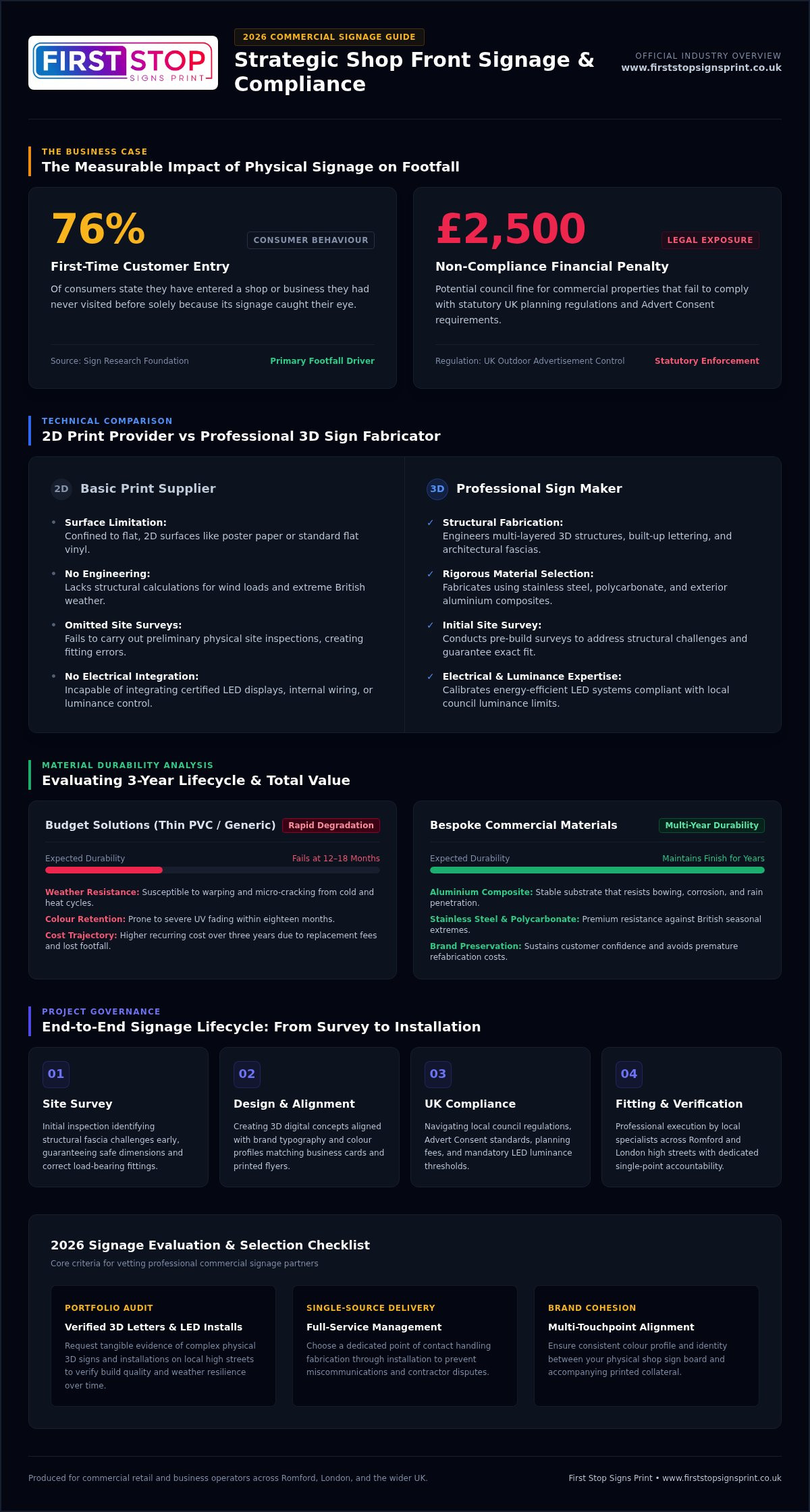
Your shop front is a financial asset. Selecting the right partner amongst various sign companies determines whether your investment yields a high return or becomes a recurring expense. Research by the Sign Research Foundation shows that 76% of consumers enter a business they've never visited before solely because of its signage. High-quality displays act as a silent salesperson, working 24/7 to build trust. To understand how these physical assets function within a marketing strategy, it's helpful to look at commercial signage principles, which highlight the role of communication in the physical environment.
To better understand the different styles available for your business, watch this helpful video:
The Difference Between a Printer and a Sign Maker
Many businesses mistakenly treat sign fabrication as a simple printing job. While a basic printer handles 2D surfaces like paper or vinyl, a professional sign maker deals with 3D structures and electrical components. Choosing materials like stainless steel or polycarbonate requires engineering knowledge to ensure your 3D letters survive the British weather. A professional partner always starts with a site survey. This identifies structural challenges early, ensuring your shop sign board fits perfectly and remains safe for the long term.
Visibility as a Competitive Advantage in 2026
UK high streets are crowded. To cut through the noise, businesses need more than just a name above the door. 3D signs and LED displays provide a depth and professional finish that flat graphics can't match. These elements improve night-time visibility and safety. We define brand visibility as the strategic use of physical design to ensure a business is instantly recognisable and memorable within its local landscape.
Opting for "cheap" solutions often results in higher costs over three years. A budget sign made from thin PVC might warp or fade within 12 months, leading to replacement fees and lost footfall. In contrast, bespoke materials like aluminium composite maintain their finish for years. Brand consistency is equally vital. Your physical 3D logo must match the colours and fonts on your business cards and flyers. When your signage and printed marketing materials align, you build a cohesive brand that customers trust.
Essential Criteria for Evaluating Professional Signage Providers
Selecting the right partner from the hundreds of available sign companies requires a methodical approach. You need to verify that a provider isn't just a middleman but a specialist with a tangible track record. Start by requesting a physical portfolio that showcases complex 3D letters and LED installations. If you're based in Romford or across London high streets, check for testimonials from local businesses. Seeing a firm's work on a nearby shop front provides immediate proof of their craftsmanship and how their materials withstand the British weather over time.
Technical Capabilities and Material Expertise
Ask whether the provider can handle intricate 3D signs and built-up letters. These require precision engineering to ensure they look premium and stay secure. A specialist should also be proficient in LED digital sign boards, which demand specific electrical expertise and knowledge of luminance thresholds. Beyond the shop front, your brand needs a unified look. It's often more efficient to partner with a team that can also produce matching business cards and flyers, ensuring the colour profile remains consistent across every physical touchpoint of your business.
End-to-End Project Management
Managing a signage project involves more than just bolting a board to a wall. You need a partner who handles everything from the initial sign design to the final fitting. Having a dedicated point of contact prevents the communication breakdowns that often occur when using multiple contractors. A full-service firm will also be familiar with the UK outdoor advertisement control guide, which is essential for staying on the right side of local council regulations and avoiding costly legal errors.
In-house manufacturing is a significant advantage for your timeline. It gives the provider total control over the production process and material quality. If a company outsources, you're at the mercy of a third party's schedule and shipping delays. Additionally, verify their installation accreditations. Fittings at height require teams certified in IPAF and PASMA to operate machinery safely. Ensure they hold substantial public liability insurance, which is a standard requirement for commercial projects in Essex and North London. This protects your business and the public during the installation process. If you're ready to discuss your project with a qualified team, you can view our professional signage services to see how we can help your brand stand out.
Bespoke Signage vs. Online Templates: Calculating Long-Term Value
When searching for sign companies, it's tempting to choose the perceived speed and low entry cost of an online template. However, generic designs frequently lead to brand invisibility. If your shop front looks identical to the one next door, you've lost your primary competitive advantage. A bespoke approach allows for unique 3D logos, specific textures, and custom lighting effects that a flat, template-based print simply cannot replicate. Professional design builds immediate customer trust; it signals that you're a permanent, high-quality fixture in the community rather than a temporary pop-up.
The durability gap between bespoke materials and budget alternatives is significant. Professional fabricators use stainless steel, powder-coated aluminium, and high-grade polycarbonate that maintain their finish for up to a decade. In contrast, budget PVC or correx signs often warp, crack, or fade within 24 months. When you factor in the cost of replacing a cheap sign twice in three years, the initial "saving" quickly vanishes. Adhering to technical benchmarks established by the British Sign & Graphics Association ensures your installation is structurally sound and safe for the public, protecting your investment from the start.
The "Hidden" Costs of DIY Signage
DIY signage often carries burdens that aren't apparent on a checkout screen. You might spend hours trying to make a standard template fit the unique architectural features of your building, only to find the final result looks unprofessional. There's also the risk of signs rattling or detaching during a typical UK winter because they weren't engineered for specific wind loads. Furthermore, non-compliant signage can lead to council enforcement notices and fines, turning a "bargain" into a legal headache that damages your reputation.
Bespoke Engineering for High-Impact Results
Expert sign makers don't just work on your exterior fascias. Bespoke engineering extends to your interior environment, where 3D wall panels and metal wall art create an immersive brand experience. These tactile elements keep customers in your premises longer and reinforce your brand's perceived value. While your permanent 3D fascia serves as the anchor of your business, you can utilise high-quality sign printing for temporary promotions or seasonal window graphics. This hybrid approach ensures you stay agile with your marketing whilst maintaining a premium, durable physical presence amongst the visual noise of a busy high street.
Navigating Installation and UK Planning Regulations
Choosing between various sign companies often comes down to who can handle the red tape. While many providers are happy to ship a product to your door, few take responsibility for the complex legalities of the UK high street. In 2026, local authorities in London boroughs and Essex towns are more vigilant than ever regarding "Visual Amenity" and "Public Safety". Displaying an advertisement without the required consent is a strict criminal offence. It can lead to a magistrates' court fine of up to £2,500. This makes the installation phase just as critical as the initial design.
Planning Permission and Local Authority Rules
Most commercial signs fall under a legal procedure known as Advert Consent. While some smaller signs enjoy "deemed consent", most illuminated shop fronts or digital displays require a formal application. This is especially true in conservation areas or for listed buildings. If your premises is Grade I or Grade II listed, you'll always require Listed Building Consent, even for signs that would otherwise be exempt. A professional partner helps organise this paperwork, ensuring your height and illumination levels stay within legal limits. For instance, LED signs must typically stay within specific luminance thresholds to avoid distracting drivers or causing light pollution in residential parts of Romford and North London.
Professional Sign Fitting and Maintenance
Professional installation is a non-negotiable requirement for your business insurance. Attempting a DIY fitting carries significant risks, including structural failure during high winds or electrical hazards from poorly wired LEDs. Our teams are certified in IPAF and PASMA, meaning they're qualified to operate cherry pickers and mobile towers safely on busy pavements. Following the BS 559:2023 safety standards ensures your sign remains a permanent asset rather than a liability.
Once your exterior is secure, don't forget that your interior branding needs the same level of precision. You can explore our guide on reception signs uk to see how professional fitting transforms your lobby or office space. To keep your investment looking new, we recommend a long-term maintenance plan. Regular cleaning and electrical checks prevent the "flicker" often seen in neglected high street displays, preserving your brand's perceived value. If you want to ensure your business stays compliant and looks its best, you can book your professional sign installation with our expert team today.
Partnering with First Stop Signs Print for Your UK Business
Finding a reliable partner amongst various sign companies is about more than just finding a supplier; it's about finding a team that takes responsibility for your brand's physical presence. First Stop Signs Print bridges the gap between creative design and technical fabrication. We act as a dedicated solution provider, ensuring that the high-impact visuals we design are engineered to last. Whether you require halo-lit 3D letters, vibrant LED signs, or a complete shop front overhaul, we manage the entire lifecycle of your project in-house. This control allows us to maintain strict quality standards whilst meeting the tight timelines often required by London and Essex businesses.
Local Knowledge, National Quality
Our operational base in Romford, Essex, is perfectly situated to serve Greater London and the Home Counties with precision. We understand the specific high street challenges and local council expectations across these areas. This local expertise is invaluable when you're trying to select the right sign board for shop premises, especially in areas with strict planning controls. We're proud to support the British business community by using premium materials like stainless steel and durable polycarbonate, ensuring your signage remains a long-term asset rather than a short-term expense.
Start Your Visibility Journey Today
Our process is built around clarity and results. We begin with a comprehensive site survey to assess structural requirements and visibility angles. We don't believe in one-size-fits-all templates; we take your 3D logo concept and transform it into a technical blueprint for our fabrication workshop. Once your sign is manufactured, our certified installation teams handle the fitting, ensuring full compliance with safety standards and your business insurance requirements.
Beyond the exterior shop front, we support your brand's growth through a full suite of professional printing services. We offer high-quality label printing, bespoke packaging, and essential business stationery like business cards and flyers. Maintaining consistency across your 3D wall panels, interior metal wall art, and printed marketing materials is the most effective way to build customer trust. When your physical presence is cohesive, your business becomes more memorable. If you're ready to elevate your brand and ensure your business is seen by the right people, you can Contact First Stop Signs Print for a bespoke quote and speak with our expert team today.
Elevate Your High Street Presence with Professional Signage
Your physical storefront is the most direct way to communicate your brand's value to the local community. Selecting the right partner amongst the various sign companies in the UK ensures that your first impression is both professional and permanent. We've explored how bespoke engineering, high-quality materials like stainless steel, and strict adherence to UK planning regulations protect your long-term return on investment. A sign isn't just a decoration; it's a strategic asset that works for you every day.
By choosing a local specialist, you gain a partner who understands the specific challenges of London and Essex high streets. Whether you need halo-lit 3D letters or energy-efficient LED technology, we provide a full design-to-installation service that removes the stress of managing multiple contractors. Don't settle for "brand invisibility" with generic templates when you can have a custom solution that drives footfall and builds customer trust.
Ready to transform your shop front? Get a Professional Signage Quote Today and let us help you stand out with confidence. Our team in Romford is ready to bring your vision to life with precision, expertise, and care.
Frequently Asked Questions
How do I choose the right sign company for my small business?
Select a partner that manages design, manufacture, and installation in-house to ensure total accountability. Verify their physical portfolio for 3D and LED work to confirm their technical expertise. Choosing local sign companies with experience in Romford or London ensures they understand the specific architectural styles and local council expectations. A company with in-house capabilities can also provide matching marketing materials, ensuring your branding remains consistent across every physical touchpoint.
Do I need planning permission for a new shop sign in the UK?
Most commercial signage requires Advert Consent from your local council, although some smaller signs fall under "deemed consent" rules. If your business is located in a conservation area or a listed building, you'll always need formal permission before installation. A professional partner helps you navigate these regulations and organise the necessary paperwork. This ensures your shop sign board meets specific height and illumination limits to avoid potential enforcement notices.
What is the difference between 3D letters and flat fascia signs?
3D letters, often called built-up letters, offer a premium aesthetic and depth that flat fascia signs simply can't provide. While flat signs are a cost-effective choice for basic branding, 3D signs are more durable and allow for sophisticated LED illumination. This added dimension makes your business far more visible from various angles on a busy high street. It signals a level of permanence and quality that flat, 2D graphics often struggle to convey.
How long does it take for a sign company to manufacture and install a sign?
Manufacture and installation typically take between two and four weeks, depending on the complexity of your design. Standard shop front boards might be ready sooner, but bespoke 3D logos or illuminated letters require more intricate fabrication time. Partnering with a company that handles production in-house is vital for your timeline. It eliminates delays caused by third-party shipping and ensures you have a reliable schedule for your business launch or rebrand.
Are LED signs energy-efficient for 24/7 business use?
Modern LED technology is incredibly energy-efficient and perfectly suited for 24/7 business use. These low-voltage systems consume significantly less power than traditional neon or fluorescent tubes, which helps lower your commercial energy bills. Many sign companies now integrate smart timers or sensors to manage illumination automatically. This ensures your premises stay visible and professional throughout the night whilst staying compliant with local council light pollution guidelines and sustainability goals.
Can a sign company help with my interior branding as well as outdoor signs?
Yes, a specialist sign maker can transform your interior with 3D wall panels, metal wall art, and bespoke reception signs. Creating a seamless brand experience from the exterior shop front to the interior office or retail space builds immediate customer trust. A full-service partner can also handle your broader printing needs, such as high-quality labels and packaging. This ensures that your brand's colours and fonts are identical across every physical touchpoint.
What materials are best for outdoor signs in the UK climate?
Stainless steel, powder-coated aluminium, and high-grade polycarbonate are the best materials for the UK's unpredictable climate. These options resist rust and UV damage, ensuring your sign doesn't fade or crack after a few seasons. Budget materials like thin PVC or correx often warp in the winter, leading to frequent replacement costs. Using aluminium composite (ACM) for a shop sign board provides a rigid, professional finish that lasts for years with minimal maintenance.
How much does professional sign installation cost in London?
Professional installation costs depend on the size of the sign, the height of the fitting, and the specific access equipment required. Projects on busy London high streets often need permits for pavement access or the use of cherry pickers. Expert teams certified in IPAF and PASMA ensure the installation is safe and fully insured. You should always request a bespoke quote that includes a site survey to identify these logistical factors before the project begins.


