
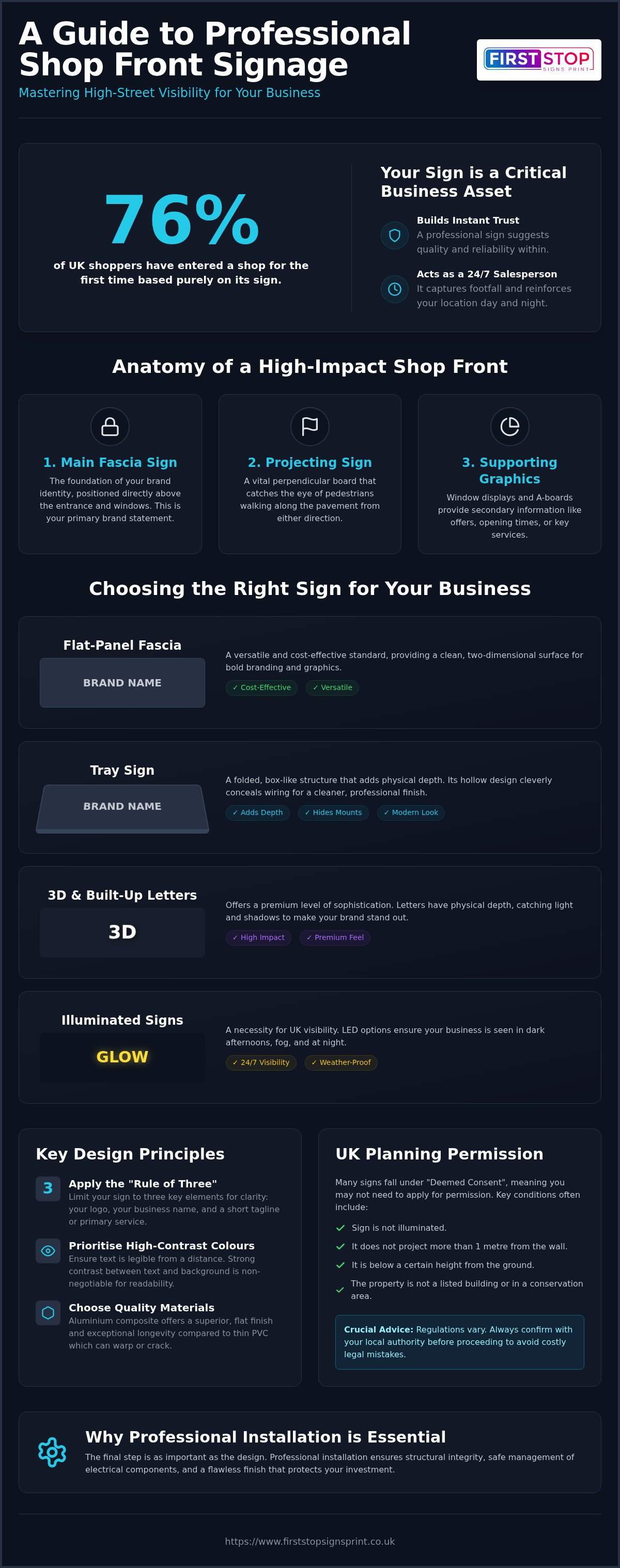
Did you know that 76% of UK shoppers have stepped into a shop for the very first time purely because of the quality of its signage? Investing in a professional sign board for shop fronts isn't just about naming your premises. It's about capturing that split-second attention of a passer-by before they've even seen your products. In the busy high streets of 2026, your sign is your most hardworking salesperson.
We understand that the process can feel overwhelming. You might be worried about complex UK planning permission laws or simply unsure which materials will survive the weather whilst remaining legible from across the street. It's natural to feel cautious when your brand's physical identity is on the line. We're here to replace that uncertainty with professional clarity and expert guidance.
This guide will help you master the art of high-street visibility with a comprehensive look at selecting, designing, and installing professional shop sign boards. We'll explore the latest 2026 materials, break down the technical jargon, and provide a step-by-step plan to ensure your business stands out with confidence and style.
Key Takeaways
- Discover why a bespoke sign board for shop fronts is your most critical visual anchor and how it shapes immediate consumer trust.
- Identify the practical differences between flat-panel fascia and tray signs to choose the right balance of depth, aesthetics, and durability.
- Learn to apply the "Rule of Three" and high-contrast colour theory to ensure your brand remains legible and striking from a distance.
- Gain clarity on UK planning permission by understanding when "Deemed Consent" applies and how to avoid costly legal mistakes with local authorities.
- Understand why professional installation is essential for structural integrity and the safe management of complex electrical components in modern signage.
What is a Shop Sign Board and Why Does Your Choice Matter?
A sign board for shop fronts serves as more than just a nameplate; it's the primary visual anchor of your physical presence. Whilst digital marketing captures clicks, physical signage captures footfall. It acts as a 24/7 silent salesperson that defines your brand's authority on the high street. For a comprehensive overview of signage and its historical role in commerce, one can see how these structures have evolved from simple wooden planks to sophisticated, illuminated displays. Your choice of signage determines whether a passer-by feels invited or indifferent.
The psychology of first impressions is powerful. Research indicates that 76% of UK shoppers have entered a store for the first time purely because of the impact of its sign. This isn't accidental. Humans make split-second judgements based on visual cues. A weathered or poorly designed sign suggests a lack of care in the products or services offered inside. Conversely, a crisp, professional board builds immediate trust. It tells the customer you're established, reliable, and proud of your business.
Viewing your signage as a marketing expense is a common mistake. In reality, it's a structural asset. Unlike a social media advertisement that disappears once the budget runs out, a high-quality sign board remains in place for years. It provides a consistent return on investment by constantly reinforcing your location to local residents and commuters. It's an investment in your brand's equity that pays dividends every time someone walks past your door.
The Anatomy of a Professional Shop Front
A cohesive shop front relies on several layers of visibility. The fascia is the main sign board for shop identities, positioned directly above the window. It's the foundation of your brand. However, pedestrians walking directly under the fascia often miss it. This is where projecting signs become vital. These perpendicular boards catch the eye of people walking along the pavement from either direction. To complete the look, window graphics and A-boards act as the supporting cast, providing specific information about offers or opening times without cluttering the main brand message.
The Impact of Quality Materials on Brand Perception
The materials you choose speak volumes before a customer even reads your name. Using thin, unweighted PVC might save money initially, but it often ripples in the heat or cracks in the frost. This fragility can subtly damage your brand reputation. We recommend aluminium composite for its exceptional longevity and flat, professional finish. For businesses wanting a premium feel, 3D letters or logos add depth and shadow. These elements transform a flat surface into a high-impact architectural feature that distinguishes your shop from the two-dimensional signs of your competitors.
Types of Sign Boards: Finding the Right Fit for Your Business
Choosing the right sign board for shop fronts involves balancing aesthetic impact with practical durability. Flat-panel fascia signs remain a versatile and cost-effective standard for many high-street businesses. They provide a clean, two-dimensional surface perfect for high-resolution graphics and bold branding. However, tray signs made from folded aluminium are increasingly popular for modern retail. These create a box-like structure that adds depth and, crucially, provides a hollow space to hide unsightly wiring or mounting brackets. This results in a much cleaner, more professional finish on your building's exterior.
3D Signs and Built-Up Lettering
To truly elevate your presence, 3d letters offer a level of sophistication that flat graphics cannot match. There is a distinct difference between flat-cut letters, which are simple shapes cut from a sheet, and built-up letters, which have fabricated returns to give them physical depth. You might choose acrylic for vibrant, brand-accurate colours or stainless steel for a sleek, contemporary finish. These elements can be used to create a bespoke 3D logo that catches shadows and light, making your brand literally stand out from the facade in any weather.
Illuminated Options for Night-Time Visibility
In the UK, where winter afternoons grow dark early and fog is a common visitor, illumination isn't a luxury; it's a necessity. LED signs ensure your business remains visible 24/7, even in poor weather. Halo lighting is a sophisticated choice for premium brands. It mounts letters slightly off the fascia, creating a soft, prestigious glow behind each character. For maximum impact, internal LED illumination makes the entire face of the letter shine brightly. If you prefer a traditional look, trough lights provide an elegant way to illuminate a flat fascia board from a slim rail positioned above.
Before finalising your choice, it is wise to consult the UK government's guide for advertisers. This document outlines the general rules for different types of signage, ensuring your chosen style meets local standards. Selecting a high-quality sign board for shop fronts is a decision that impacts your business for years. If you are feeling unsure about which material or lighting style best suits your specific location, our team can help you select the ideal signage configuration for your shop.
How to Design a High-Impact Shop Sign Board
Designing a high-impact sign board for shop success starts with visual restraint. We recommend following the "Rule of Three": focus exclusively on your brand name, your logo, and your primary service. If you attempt to include phone numbers, websites, or a list of five different products, you'll likely confuse the customer. A sign is a beacon, not a brochure. It's also vital to scale your design to the architecture of your building. A sign that's too small looks like an afterthought, whilst one that's too large can overwhelm the shop front. Aligning your board with the structural centre of the facade ensures the installation feels balanced and professional.
Maximising Legibility and Contrast
Contrast is the most critical factor in high-street visibility. High-contrast colour palettes, such as yellow on black or white on deep blue, provide the best long-distance reading. Avoid using "fancy" script fonts for your primary name. Whilst they may look elegant on a business card, they often fail the legibility test from across a busy road. You must also calculate font size based on the speed of passing traffic. For pedestrians, a letter height of 10cm is usually sufficient, but for motorists, you'll need significantly more scale. Crucially, use negative space to your advantage. A cluttered sign is a forgotten sign; leaving room around your logo allows the eye to focus on what matters.
Integrating Your Brand Identity
Consistency is the hallmark of a professional business. Your physical presence should act as a seamless extension of your online brand. High-quality sign printing ensures that your brand colours remain accurate across different materials and lighting conditions. When choosing between a 3D logo and a flat graphic, think about the message you want to send. A 3D logo suggests premium quality and structural permanence, whilst a flat graphic can feel modern and minimalist. Even when integrating modern LED elements, you can protect your brand's heritage by choosing soft halo lighting instead of aggressive, flashing displays. To ensure your design meets all regulatory requirements, always consult the official UK guidance on outdoor advertisements before proceeding to production.
UK Planning Permission and Legal Requirements for Shop Signs
Installing a new sign board for shop fronts involves more than just aesthetics; you must navigate the UK's Advertisement Consent regulations. Most standard signs fall under "deemed consent" rules. This means you don't need to submit a formal application if you stay within specific size and height limits. For instance, non-illuminated signs up to 1.55 square metres with characters no taller than 0.75 metres often don't require express permission. You must also ensure no part of the sign is higher than 4.6 metres from the ground or the bottom of the first-floor window. If your sign exceeds these parameters, the standard application fee for advertisement consent in England is £462 as of 2026.
The rules change significantly if your business is located in one of London's many Conservation Areas or within a Listed Building. In these zones, the local planning authority maintains much tighter control over the visual landscape. Even a modest illuminated sign will likely require a full application, as deemed consent often doesn't apply to lighted displays in heritage areas. Listed buildings require a separate "Listed Building Consent" for any physical changes, including the mounting of a sign board. Failing to obtain this permission is a criminal offence, so it's vital to verify your building's status before any drilling begins.
The 5 Standard Conditions for All UK Signs
Regardless of whether you need express consent, every sign in the UK must comply with five national standards. These rules are designed to protect the public and the character of the local neighbourhood. Every sign must be kept clean and tidy at all times. It must be maintained in a safe condition that doesn't pose a structural risk to pedestrians. You must always obtain the permission of the landowner or the person entitled to grant such permission. Crucially, your sign must not obscure official road signs or interfere with traffic signals. Finally, if a sign is removed, the site must be left in a safe condition that doesn't disfigure the building.
Illumination and Brightness Regulations
If you choose an illuminated sign board for shop visibility, you must adhere to strict brightness limits measured in candelas per square metre. These regulations prevent light pollution and ensure your sign doesn't distract motorists on busy London roads. Flashing or moving LED displays are strictly prohibited in many residential and heritage zones. We always recommend a quick consultation with your local council's planning department before installing high-intensity LEDs. This proactivity prevents the risk of being ordered to remove a costly installation later. If you're feeling unsure about the local restrictions in London, Essex, or Hertfordshire, we can manage the installation and compliance process for you to ensure total peace of mind.
Professional Installation: Why the Finish Matters
Even the most striking sign board for shop fronts will fail to impress if it’s hung crookedly or shows visible, unpainted fixings. Whilst the temptation to handle the fitting yourself might be strong, the risks of DIY installation far outweigh the initial savings. Large fascia boards are heavy, wind-resistant structures that require specialist handling. A structural failure doesn't just damage your building; it poses a significant liability risk to the public on a busy high street. Professional installers ensure that every board is perfectly aligned and securely anchored, providing a level of finish that reflects the quality of your brand.
Maintenance is equally vital for protecting your long-term investment. To keep your sign board for shop fronts looking pristine, we recommend a gentle cleaning every six months with non-abrasive soap and water. This prevents the build-up of urban grime and traffic pollution common in London and the Home Counties. Periodically checking the fixings and seals ensures that moisture doesn't penetrate the electrical components, which helps to extend the life of your LED systems for many years.
The Installation Process Explained
Our process begins with a comprehensive site survey. We don't just measure the physical space; we evaluate the substrate of the building. Fitting a sign to aged London brick requires different fixings than mounting onto modern metal cladding or traditional timber. Using the wrong anchors can lead to the sign loosening over time due to thermal expansion or wind vibration. Once the substrate is verified, our team handles the complex electrical wiring required for LED signs, ensuring all connections are weatherproof and hidden from view. The final stage involves rigorous testing of the illumination and a final safety check to guarantee the board meets all structural standards.
Why First Stop Signs Print is Your Local Partner
We pride ourselves on being more than just a manufacturer. As specialists in bespoke business signs across London, Essex, and Hertfordshire, we offer a complete end-to-end service. From the initial design phase through to the final bolt in the wall, we take full responsibility for the quality and longevity of your signage. Our in-house manufacturing team uses only premium materials, ensuring your brand stands out with clarity and prestige. If you’re ready to transform your high-street presence, get a bespoke quote for your shop sign board today and let us help you become the most visible business on the block.
Transform Your Business with High-Impact Signage
A high-quality sign board for shop fronts is your most powerful tool for building trust and capturing footfall in a competitive market. We've explored how balancing striking 3D design with legibility ensures you're noticed, whilst navigating UK planning laws protects your investment from legal setbacks. Success on the high street requires more than just a name; it demands a visual anchor that communicates quality before a customer even steps through your door.
At First Stop Signs Print, we're proud to be your local experts for bespoke 3D and LED signage. We provide an end-to-end design and manufacturing service, followed by professional installation across London and Essex. Our team is dedicated to making the entire process seamless, ensuring your brand remains visible and prestigious for years to come. Don't leave your first impression to chance when you can work with a partner who understands the local landscape and the technical requirements of modern signage.
Ready to stand out on the high street? Request Your Bespoke Shop Sign Quote from First Stop Signs Print today and take the first step towards a more visible future. We're here to help your business shine.
Frequently Asked Questions
Do I need planning permission for a shop sign board in the UK?
Most standard shop signs fall under "deemed consent" and don't require formal planning permission. However, you must stay within specific size limits and height restrictions to qualify. If your shop is in a conservation area or a listed building, you will almost certainly need express Advertisement Consent. It's always safer to check with your local council's planning department before installation to avoid potential fines or being forced to remove the signage later.
How much does a professional shop front sign cost?
The cost varies significantly based on materials, size, and illumination requirements. A basic flat-panel fascia board is a budget-friendly option, whilst bespoke 3D letters or LED-illuminated tray signs represent a larger investment. Complex installations or signs requiring premium materials like stainless steel will also influence the final price. We provide bespoke quotes tailored to your specific needs, ensuring you receive a high-quality sign board for shop visibility that fits your budget.
What is the best material for a long-lasting outdoor shop sign?
Aluminium composite, often known as Dibond, is widely considered the best material for durability and value. It's lightweight, weather-resistant, and won't warp or rust like timber or thin PVC. For a more premium finish, stainless steel or high-grade acrylic are excellent choices for built-up lettering. These materials withstand the British weather whilst maintaining their colour and structural integrity for many years, making them a wise choice for any permanent high-street installation.
How long does it take to manufacture and install a bespoke sign?
The timeline typically ranges from two to four weeks from the final design approval to the day of installation. This period allows for precision manufacturing of bespoke elements, such as 3D logos or LED wiring. More complex projects involving structural changes or local council consent may take slightly longer. We manage the entire end-to-end process in-house, which helps us maintain strict quality control and ensure your installation is completed as efficiently as possible.
Can I have an illuminated sign if my shop is in a conservation area?
Yes, it's possible, but it usually requires express Advertisement Consent from your local planning authority. Councils in conservation areas often prefer subtle lighting, such as halo-lit 3D letters or slim trough lights, rather than aggressive internal illumination. Flashing or moving LED displays are typically prohibited in these zones. We specialise in designing signs that meet these strict heritage standards whilst ensuring your business remains visible and attractive to evening passers-by.
What is the difference between a fascia sign and a tray sign?
A fascia sign is typically a flat panel mounted directly onto the shop front, making it a cost-effective and versatile option. In contrast, a tray sign is made from folded aluminium to create a three-dimensional box structure. This "tray" provides a hollow space behind the face, which is perfect for hiding electrical wiring and LED components. Tray signs offer a cleaner, more premium appearance and are the preferred choice for modern high-street businesses.
How do I choose the right size for my shop sign?
Your sign should be scaled to the architectural proportions of your shop front. It must be large enough to be legible from across the street but shouldn't overwhelm the building's features. We recommend aligning the board with the structural centre of the facade for a balanced look. For planning purposes, remember that non-illuminated signs under 1.55 square metres often fall under deemed consent, making this a popular size for many independent retail units.
Should I choose 3D letters or a flat-panel sign?
This depends on your brand identity and budget. A flat-panel sign is excellent for modern, minimalist designs and high-resolution digital graphics. However, choosing 3D letters or a bespoke 3D logo adds depth and shadow, creating a more prestigious and established feel. 3D elements also offer better opportunities for creative illumination. Many successful businesses combine both, using a flat-panel background with built-up lettering to achieve a high-impact, professional sign board for shop fronts.


