
Your shop front windows are arguably the most valuable marketing real estate you own, yet they're often the most underutilised. It's easy to feel overwhelmed by the technical side of window graphics, especially when you're trying to choose between frosted finishes for privacy or perforated films that let you see the street. You might worry about the graphics fading in the unpredictable UK weather or, worse, failing to meet strict glass safety manifestation regulations that could lead to legal headaches.
We understand that you want a professional, high-impact presence that increases footfall without sacrificing the natural light in your meeting rooms. This guide is designed to help you master the art of choosing, designing, and installing professional displays that boost your brand visibility whilst ensuring your workplace remains fully compliant. We'll walk you through the essential 2026 material trends, explain the exact height requirements for safety markings, and show you how to create a visual impact that lasts for years.
Key Takeaways
- Learn how to use professional window graphics to balance high-street brand awareness with functional privacy for your internal meeting rooms.
- Identify the technical differences between frosted, perforated, and cut vinyl to ensure you choose the right material for your specific lighting requirements.
- Discover the essential UK manifestation heights and legal safety requirements under Document N to keep your business premises fully compliant.
- Master the 'Three-Second Rule' for design to ensure your shop front captures the attention of potential customers instantly.
- Understand why professional surface preparation and de-greasing are the secrets to a long-lasting, bubble-free installation.
Understanding Window Graphics and Their Strategic Value
Window graphics are often misunderstood as mere decorative stickers. In reality, they're sophisticated, high-performance vinyl films designed to withstand the elements whilst transforming glass into a powerful communication tool. For businesses across London and Essex, your windows represent the most cost-effective advertising space you own. Unlike digital ads that require a recurring budget, a one-off investment in glass branding works for you day and night. It's an asset that never sleeps.
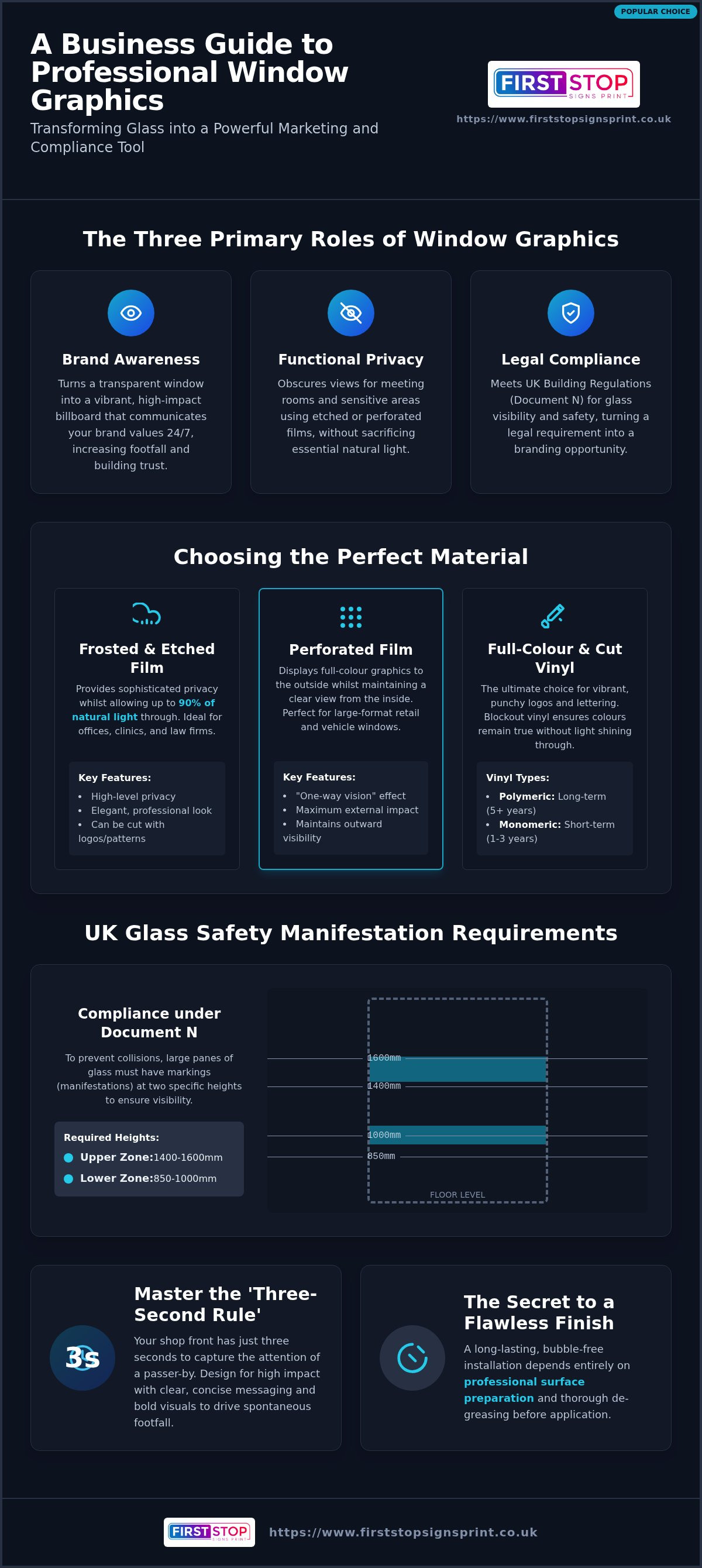
These installations serve three primary strategic roles:
- Brand Awareness: Turning a transparent pane into a vibrant, high-impact billboard.
- Functional Privacy: Using etched or perforated window films to obscure views without blocking natural light.
- Legal Compliance: Meeting UK Building Regulations, specifically Document N, regarding glass visibility.
Choosing between internal and external application is a balance of longevity and impact. External graphics offer a matte finish and eliminate glass reflections, making them easier to read in bright sunlight. However, internal applications are protected from the harsh UK weather and potential vandalism, often lasting significantly longer in high-traffic areas.
The ROI of High-Street Visual Presence
In busy commercial hubs like Romford or central London, competition for attention is fierce. Professional window graphics drive spontaneous footfall by capturing the interest of passers-by who might otherwise walk straight past. Your shop front doesn't stop working when you lock the doors; it continues to communicate your brand values 24/7. A polished, well-branded facade builds immediate psychological trust. It tells customers you're established, professional, and attentive to detail.
Retail vs. Office: Different Goals for Different Spaces
The strategy for a retail unit differs vastly from a corporate office. Retailers focus on promotion, using bold colours and seasonal offers to entice shoppers. Integrating these with 3D logos or LED signs creates a cohesive brand experience that stands out. In contrast, office spaces prioritise privacy for meeting rooms and internal branding to boost employee morale. Here, manifestations are vital. These aren't just safety markers; they're opportunities to reinforce your identity whilst complying with health and safety laws. Aligning your strategy with your wider custom business signs ensures a seamless visual narrative across your entire premises.
Choosing the Perfect Material: Frosted, Perforated, or Cut Vinyl?
Selecting the right substrate for your window graphics requires a balance between aesthetics and technical endurance. The primary decision often lies between monomeric and polymeric vinyl. Monomeric films are a cost-effective choice for short-term retail promotions or seasonal sales lasting up to three years. For permanent branding, polymeric vinyl is the superior option. It's designed to resist shrinkage and can handle the expansion and contraction caused by the UK's fluctuating temperatures without peeling at the edges. This ensures your investment looks as crisp in year five as it did on day one.
Frosted and Etched Films for Sophisticated Privacy
Frosted film is a staple for London law firms and medical centres because it provides high-level privacy without plunging the interior into darkness. It allows roughly 90% of natural light to pass through whilst completely obscuring the view from the street. We can plot bespoke patterns, geometric lines, or your company logo directly into the film. This approach is also the most elegant way to meet UK manifestation regulations, turning a safety requirement into a design feature.
One-Way Vision (Contra Vision) Explained
Perforated film is a clever solution for businesses that want maximum branding on the outside without losing their view of the street. These films feature thousands of tiny holes; from the exterior, the human eye focuses on the printed image, but from the inside, it looks like a slight tint. It's a popular choice for large-format shop windows and commercial vehicles. Keep in mind that the "one-way" effect relies on light levels. If your office is brightly lit at night whilst the street is dark, the transparency can reverse.
Full-Colour Printed Vinyl and Cut Lettering
When your design demands vibrant, punchy colours that don't fade, blockout vinyl is the go-to material. It prevents light from shining through the graphic, ensuring your brand colours remain true even on south-facing windows. For a more minimalist, high-end look, individual cut-vinyl lettering offers a clean finish that doesn't block the glass at all. You can easily integrate these larger displays with vinyl sticker printing for smaller door decals or opening hours to create a unified brand presence. If you're ready to upgrade your shop front, our team can help you select the ideal vinyl material for your specific location.
How to Design High-Impact Window Displays for Maximum Visibility
Designing for glass is a unique challenge because your canvas is transparent and reflective. On a busy UK high street, you have roughly three seconds to capture a pedestrian's attention. This "Three-Second Rule" means your message must be punchy, legible, and instantly recognisable. To achieve this, your window graphics should focus on a single, clear focal point, whether that's a bold seasonal promotion or your company logo. Cluttering the glass with too much information often leads to visual fatigue, causing potential customers to look away before they've processed your brand.
Effective design relies heavily on negative space. By leaving parts of the glass clear, you allow the design to "breathe" and ensure the graphics don't block too much natural light for those inside. It's also vital that your display doesn't clash with your existing business signs. The windows should act as a supporting act to your main fascia, reinforcing the brand identity through consistent colours and imagery rather than competing for dominance.
Technical precision is just as important as the creative side. When scaling your artwork for large-format digital printing, always work with vector files or high-resolution imagery (at least 300dpi at half-scale). This prevents pixelation, ensuring that even the largest decals look sharp and professional from a distance. If your files aren't up to scratch, the final print will appear blurry, which can subtly damage the perceived quality of your services.
Typography and Colour Theory for the High Street
Glass reflections can be a design killer. To combat this, choose high-contrast colour palettes. White or bright yellow lettering often stands out better against the dark interior of a shop than darker shades like navy or black. When it comes to font selection, sans-serif typefaces are usually the best choice for distance legibility. A good rule of thumb for the "Readability Test" is to allow at least 25mm (1 inch) of letter height for every 3 metres (10 feet) of viewing distance to ensure your message carries across the street.
Incorporating Brand Elements and 3D Effects
You don't have to stick to flat, two-dimensional designs. We often recommend using a bespoke 3D logo as the centrepiece of your window to create a sense of depth and premium quality. By layering different types of vinyl or using shadow effects in the print, you can make elements of the graphic appear to pop off the glass. This approach ensures your window graphics maintain brand consistency across all your print services, from your business cards to your main shop board, creating a professional and unified physical presence.
Preparing and Installing Your Graphics: A Step-by-Step Guide
The most stunning design will fail to impress if the installation is sloppy. Achieving a professional finish requires more than just a steady hand; it demands the right toolkit and a clinical approach to cleanliness. Before you begin, ensure you have a felt-edged squeegee, a fine-tip craft knife, a lint-free microfibre cloth, and a dedicated de-greasing agent. These tools are the difference between a high-impact display and a bubbly, peeling mess that detracts from your brand's credibility.
One of the most important decisions you'll make is choosing between the "Wet Method" and the "Dry Method" for application. The wet method involves spraying the glass with a mild soap-and-water solution, which allows you to slide the graphic into the perfect position before squeegeeing out the fluid. This is the safest approach for large-format window graphics or complex designs. The dry method is faster but unforgiving; once the adhesive touches the glass, it's difficult to move without stretching the vinyl. For smaller decals or experienced installers, the dry method provides an instant bond that's ready for immediate exposure to the elements.
Surface Preparation: The Secret to Longevity
Ammonia-based glass cleaners are the enemy of vinyl adhesive. They can cause "outgassing," which leads to permanent bubbles forming under the film weeks after installation. Instead, use a simple mix of water and isopropyl alcohol to strip away oils and dirt. Temperature also plays a vital role. If the glass is too cold, the adhesive won't "wet out" properly; if it's too hot, the vinyl will become overly soft and difficult to handle. Always use masking tape to mark your horizontal and vertical centre points before peeling the backing paper.
The Installation Process: A Professional Approach
The "hinge method" is the industry standard for large graphics. By taping the top edge of the graphic to the window, you create a stable pivot point. You can then flip the graphic up, remove the backing paper in sections, and use overlapping squeegee strokes to apply the vinyl from the centre outwards. This technique effectively pushes air to the edges, preventing trapped pockets. Once applied, use your craft knife to trim the vinyl 2mm back from the window frame to prevent the edges from catching and lifting over time.
Professional Removal and Maintenance
Signage is an investment that requires gentle care. Clean your graphics using only soft cloths and pH-neutral solutions. When it's time for a refresh, use a heat gun or a hair dryer to soften the adhesive before peeling the vinyl back at a 45-degree angle. This prevents the glass from scratching and minimises residue. For complex multi-window projects or high-level displays across London and Essex, it's often more efficient to book our professional sign installation services to guarantee a flawless, long-lasting result.
Navigating Compliance and Manifestation Regulations in the UK
Compliance isn't just a box-ticking exercise; it's a legal obligation that protects your staff and visitors. Under the Workplace (Health, Safety and Welfare) Regulations 1992 (Regulation 14) and Document N of the Building Regulations, any large expanse of transparent glass in "critical locations" must be made apparent. This is to prevent people from walking into the glass and causing injury. Whilst these rules are mandatory, they don't have to be a burden. In fact, many businesses use these requirements as an excuse to install creative window graphics that serve both safety and marketing purposes.
The legal responsibility for ensuring these markings are present falls on both the building owner and the occupier. Failure to comply can lead to significant liability if an accident occurs on your premises. However, these safety markers, known as manifestations, provide a perfect canvas for subtle branding. Instead of plain frosted dots, you can use your company logo or custom patterns to meet the requirements whilst reinforcing your professional identity.
Manifestation Rules for London Offices and Shops
UK regulations are very specific about where and how these markings should be placed. Manifestation markings must be installed at two distinct levels to ensure they're visible to people of all heights, including children and wheelchair users. The first band must be between 850mm and 1000mm from the floor, whilst the second must sit between 1400mm and 1600mm. If you're using a continuous band or broken lines, they must be at least 50mm high. If you prefer to use a logo or a decorative sign, it must be at least 150mm high to meet the safety standard. Contrast is equally vital; the graphics must be easily seen against the background in all lighting conditions, whether it's a bright summer morning or a rainy London afternoon.
Planning Permission and Local Authority Rules
Most window graphics fall under "Deemed Consent," meaning you don't usually need formal planning permission for internal displays or standard shop front branding. However, rules change if your business is located in a conservation area or a listed building, which is common in parts of Essex and central London. In these heritage locations, local authorities often have strict guidelines regarding the colour, size, and material of external signage to preserve the character of the street. It's always best to check with your local council before committing to a large-format installation. If you need a compliant and high-impact solution that meets all local and national standards, contact First Stop Signs Print today to discuss your project.
Ready to Redefine Your High-Street Presence?
Your business windows are far more than just glass partitions; they're a dynamic canvas that can drive growth and ensure safety. By choosing the right high-performance materials and adhering to UK manifestation heights, you transform a simple shop front into a compliant, high-impact marketing asset. Whether you're prioritising privacy for a London office or looking to stop traffic on an Essex high street, the right strategic approach ensures your brand stays visible 24/7.
At First Stop Signs Print, we specialise in bringing these visions to life. From high-quality digital large-format printing to expert sign installation across London and Essex, we handle the technical details so you can focus on your customers. Our bespoke design services can even integrate your window graphics with 3D or LED signage for a truly multi-dimensional brand presence.
Don't let your glass go to waste in 2026. Elevate your business presence with bespoke window graphics from First Stop Signs Print and start turning every passer-by into a potential client. We're ready to help you make a lasting impression.
Frequently Asked Questions
Do I need planning permission for window graphics on my shop front?
Generally, most internal window graphics fall under "Deemed Consent" and don't require formal planning permission. However, if your business is located in a conservation area or a listed building in Essex or London, specific restrictions often apply to external displays. It's best to check with your local council if you're planning a full-window wrap or an illuminated display. Standard decals or seasonal promotions rarely face these legal hurdles.
What is the difference between frosted and etched window film?
Frosted film provides a uniform, sandblasted appearance, whilst etched film mimics the look of glass that's been chemically treated. In modern signage, these terms are often used interchangeably because both provide privacy whilst allowing natural light to enter. We can cut intricate designs into either material to showcase your branding. Frosted film is generally preferred for its clean, contemporary finish in corporate office environments across the UK.
How long do professional window graphics typically last in the UK?
Professional graphics typically last between three and seven years depending on the vinyl quality and environmental exposure. Polymeric vinyls are designed to withstand the UK's damp climate and fluctuating temperatures without peeling or shrinking. If applied to the exterior, they may fade slightly faster due to UV exposure. High-quality prints with UV-stable inks maintain their vibrancy for several years, especially with regular, gentle maintenance.
Can window graphics be applied to the inside of the glass?
Yes, graphics can be applied to the inside, which is often called "second surface" application. This protects the vinyl from weather damage and potential vandalism. However, because the graphic is behind the glass, reflections can sometimes make it harder to see from the street. If you choose this method, we recommend using high-contrast colours to ensure your branding remains visible under the varying lighting conditions of the high street.
What are window manifestations and are they legally required?
Window manifestations are safety markings applied to glass to prevent people from walking into it. They are a legal requirement in the UK under Document N of the Building Regulations for full-height glass doors and partitions. These markings must be placed at specific heights: 850mm to 1000mm and 1400mm to 1600mm from the floor. They can take the form of dots, squares, or even your bespoke company logo.
Will window graphics damage my glass when they are removed?
Professional-grade vinyl won't damage your glass if it's removed correctly using heat and a dedicated adhesive remover. We use high-quality films that are designed to peel away cleanly without scratching the surface. If the graphics have been in place for many years, a small amount of residue might remain, but this is easily cleared with the right cleaning agents. Your glass will return to its original, clear state.
How do I clean my windows once the graphics have been installed?
You should wait at least two weeks after installation before cleaning your windows to allow the adhesive to fully cure. Once set, use a soft microfibre cloth and a pH-neutral, ammonia-free soap solution. Avoid using squeegees with sharp metal edges or abrasive sponges that could scratch the vinyl surface. Gentle, regular maintenance ensures your window graphics stay bright and free from the grime typical of busy London streets.
Can I install large-format window graphics myself or do I need a professional?
Whilst small decals are manageable for DIY enthusiasts, large-format window graphics usually require professional installation to avoid bubbles and misalignment. A professional installer has the tools and experience to handle complex surfaces and ensure a flush finish. Misaligned graphics look unprofessional and can reflect poorly on your business. For projects across London and Essex, our team ensures your signage meets all safety regulations whilst looking perfectly polished.


