
Imagine walking into your warehouse on a damp Monday morning only to find your premium product labels curling at the edges or peeling off entirely. It's a frustrating, costly sight that instantly undermines your brand's hard-earned reputation. You've likely dealt with inconsistent colours across different batches or felt overwhelmed by technical jargon surrounding adhesives and finishes. We understand that a label is more than just a sticker; it's a vital touchpoint for your customers and a crucial part of your operational efficiency.
Finding a reliable partner for commercial label printing uk shouldn't be a gamble. You deserve durable labels that enhance your brand perception whilst meeting strict legal requirements. This guide will help you master the complexities of bespoke printing, from ensuring colour consistency to staying ahead of the 2026 Extended Producer Responsibility (EPR) mandatory labelling rules. We'll break down the terminology and material choices you need to create high-impact, compliant packaging. By the end of this article, you'll have the clarity to choose the right finishes and a print partner that treats your brand with the precision it deserves.
Key Takeaways
- Master the essentials of commercial label printing uk to ensure your brand maintains consistent colours and professional durability across all product lines.
- Learn how to select the perfect combination of materials, such as hard-wearing vinyl or polypropylene, and specialist adhesives to prevent peeling in damp environments.
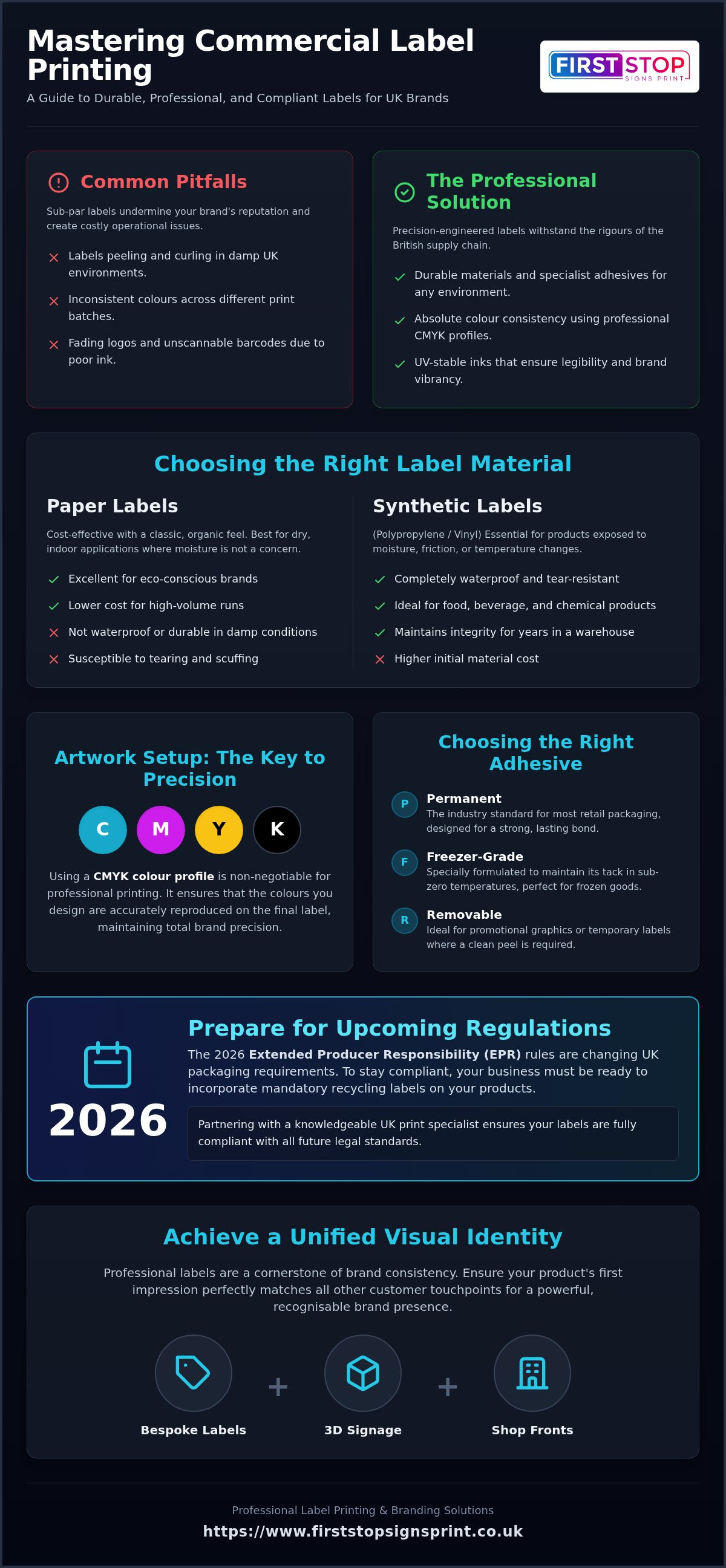
- Discover the technical requirements for artwork setup; we explain why CMYK colour profiles are non-negotiable for achieving total brand precision.
- Prepare your business for upcoming 2026 regulatory shifts, including the mandatory recycling labels required under the latest Extended Producer Responsibility (EPR) rules.
- Understand the benefits of integrated branding by matching your bespoke labels with physical assets like 3D signs and shop fronts for a unified visual identity.
What Is Commercial Label Printing and Why Does It Matter for UK Brands?
Commercial label printing uk is far more than just producing stickers. It represents a high-volume, precision-engineered approach to branding that ensures every product leaving your facility carries your message with absolute clarity. Whilst a basic sticker might suffice for a temporary file, commercial-grade labels are designed to withstand the rigours of the British supply chain, from damp warehouses to high-traffic retail shelves. It's the difference between a product that looks like a DIY project and one that commands authority on the shelf.
When we ask What is a label? in a professional context, we're discussing the primary bridge between your brand and your customer. For British brands, this visual touchpoint builds vital trust on the high street. There's a powerful synergy when your product labels perfectly match your other branding assets, such as your business signs. This consistency signals professional reliability and makes your brand instantly recognisable to consumers in busy environments like London, Essex, or Romford.
The Strategic Advantage of Bespoke Labels
Custom labels allow your products to stand out in the most competitive retail spaces. In a crowded London boutique or a bustling Essex marketplace, a generic, off-the-shelf sticker suggests a lack of care. Bespoke labels allow for unique shapes, premium textures, and exact colour matching that elevate your product to a luxury positioning. This quality directly impacts how customers perceive your brand's value. Choosing a "one-size-fits-all" solution often leads to wasted marketing budget, as labels that peel or fade quickly ruin the first impression you've worked so hard to create. We focus on creating solutions tailored to your specific environment to ensure your brand remains visible and respected.
Commercial vs. Consumer Printing
The technical gap between consumer-grade printing and commercial production is vast. Professional systems use UV-stable inks and industrial adhesives that standard home printers simply cannot replicate. For UK logistics, shipping labels must remain legible despite friction, moisture, and temperature shifts. Commercial-grade printers ensure your barcodes scan every time and your logo remains vibrant through the post. Bespoke commercial printing is the intersection of durability and brand aesthetics. By partnering with a specialist who understands the demands of the UK market, you ensure your labels don't just look good on day one, but remain intact and professional until they reach the final customer's hands.
How to Choose the Right Label Materials and Finishes
Selecting the right material is the foundation of any successful branding project. In the UK, environmental factors often dictate your choices more than aesthetics alone. A label that looks stunning in a dry studio may fail miserably in a damp Essex warehouse or under the intense UV exposure of a London shop window. Professional commercial label printing uk services focus on matching the substrate to the product's journey, ensuring your brand stays visible and intact regardless of the conditions.
Paper vs. Synthetic: The Great Debate
Paper labels remain a favourite for dry, indoor applications. They're cost-effective and offer a classic, organic feel that suits eco-conscious brands perfectly. However, paper has a limited lifespan when exposed to moisture. For the food, beverage, and chemical sectors, synthetic materials like polypropylene or vinyl are essential. These waterproof options don't just survive; they thrive in the condensation-heavy environments typical of UK cold storage. Whilst paper might last six months in a standard office, a high-quality vinyl label can maintain its integrity for years in a typical warehouse setting.
The adhesive you choose is just as critical as the face material. Permanent adhesives are the standard for most retail packaging, but if your product requires refrigeration, you'll need freezer-grade glue that doesn't lose its tack at sub-zero temperatures. Conversely, removable adhesives are perfect for promotional window graphics where a clean peel is required. Ensuring your label stays firmly attached is vital for meeting UK government labelling requirements, as mandatory safety information must remain legible throughout the product's life.
Finishing Touches: Matt, Gloss, and Beyond
The finish you select influences consumer behaviour more than you might think. Matt finishes are currently a favourite amongst luxury and organic brands; they suggest a tactile, premium quality that feels sophisticated and understated. Gloss lamination, on the other hand, provides a protective shield against scuffs and scratches, making it ideal for high-traffic retail environments where products are handled frequently.
If you're looking to truly stand out, premium options like spot UV or foil stamping can add a layer of depth that commands attention on a crowded shelf. These techniques allow you to highlight specific parts of your logo or design, creating a multi-dimensional effect. If you're unsure which combination fits your brand best, you can always speak with our experts to find the perfect match for your specific application.
Step-by-Step: How to Design Labels for Commercial Success
Designing for commercial label printing uk requires a shift in mindset from digital aesthetics to physical precision. A design that looks vibrant on a backlit smartphone screen may appear dull or illegible when translated to a physical substrate. Successful labels balance eye-catching graphics with technical specifications that ensure every millimetre of the print run is perfect. Small errors in file setup lead to expensive delays; getting the foundations right is the only way to protect your marketing budget.
Every professional design must account for "bleed" and "quiet zones." Bleed is the extra 3mm of artwork that extends beyond the trim line; it ensures that if the cutting blade shifts slightly, you won't end up with an unsightly white edge. Similarly, the quiet zone is a safe area inside the cut line where vital text and logos should sit. Keeping your content away from the edges prevents important information from being accidentally trimmed during the high-speed finishing process.
Compliance is just as critical as creativity. Your labels must adhere to specific UK food labelling regulations or hazardous material standards depending on your industry. By the end of 2026, for example, non-wholemeal wheat flour producers must ensure their labels reflect mandatory folic acid fortification. Failure to include legally required information, such as allergen warnings or the new 2026 "Recycle" or "Do Not Recycle" EPR markings, can lead to fines and forced product recalls.
Setting Up Your Digital Files
Crisp text and sharp imagery require a minimum resolution of 300 DPI (dots per inch). Anything lower will result in pixelation that makes your brand look amateurish. Use vector graphics for logos and icons; unlike raster images, vectors can be scaled to any size without losing quality. Before sending files to your UK printer, follow this quick checklist:
- Convert all text to "outlines" or "curves" so fonts don't disappear.
- Embed all high-resolution images within the document.
- Check that all black text is "100% K" to avoid muddy, over-saturated lettering.
- Ensure the file is saved as a print-ready PDF with crop marks included.
Colour Consistency and Brand Identity
Maintaining identical colours across your entire brand is non-negotiable. Whilst your screen uses RGB light, commercial presses rely on CMYK inks. If you need a perfect match between your labels, your vinyl sticker printing, and your shop signage, we recommend using Pantone matching. This universal colour system ensures your "brand red" looks exactly the same in Romford as it does in London. Partnering with a local specialist in Essex allows for physical colour proofing, which is far more reliable than trusting a faceless online portal to guess your brand's true palette.
Scaling Your Production: Rolls, Sheets, and Volume
Scaling your production is a pivotal moment for any growing brand. The format you choose, be it rolls or sheets, depends entirely on your application method and order volume. For many businesses, the transition to commercial label printing uk involves moving from hand-applied stickers to automated systems that require precision engineering. Selecting the wrong format at this stage can lead to costly delays or equipment malfunctions that stall your entire supply chain.
Roll Labels vs. Sheet Labels
Roll labels are the industry standard for automated machine application. If you're scaling up to hundreds or thousands of units per hour, rolls are non-negotiable. It's vital to choose the correct core size and winding direction to match your labelling machinery; otherwise, your labels might come off the roll upside down or fail to fit the machine's spindle. Sheet labels remain a cost-effective choice for boutique products or limited edition runs where hand-application adds a personal touch. They're easier to store in small offices but lack the speed and efficiency of roll-fed systems during high-volume production.
Digital vs. Flexographic Printing
Digital printing has revolutionised the market by making low-volume bespoke runs affordable. It removes the "set-up cost" myth by eliminating the need for expensive printing plates. This allows brands to manage multiple SKUs, such as different flavours or seasonal variations, without a massive upfront investment. When your volume reaches hundreds of thousands of identical units, transitioning to flexographic printing offers greater efficiency and lower per-unit costs for massive runs. Modern digital presses in the UK now rival flexo for quality, meaning you don't have to sacrifice brand aesthetics whilst your business is in its growth phase.
High-volume printing for national distribution requires meticulous scheduling. We've seen many brands face "out-of-stock" packaging crises because they didn't account for production lead times during peak seasons. Planning your print runs at least four to six weeks in advance ensures your supply chain remains uninterrupted and your products stay on the shelves. If you're ready to scale your operations and need a reliable partner to manage your inventory, you can start your high-volume print project with us today. By coordinating your label production with your broader branding needs, you ensure a seamless transition as your business grows from a local favourite to a national presence.
Why Partner with a UK Specialist like First Stop Signs Print?
Choosing a partner for commercial label printing uk is about more than just finding the lowest price per unit. It's about finding a team that understands the unique pressures of the British high street and the logistical challenges of the Home Counties. Whilst large, international print farms offer automation, they often lack the personal oversight required to catch a bleed error or a colour mismatch before it hits the press. We position ourselves as a "solution provider," ensuring your visual identity is as sharp on a product label as it is on your main shop front. Working with a local expert means you're not just a number in a queue; you're a partner whose quality we take personally.
Integrated Branding Solutions
A label shouldn't exist in a vacuum. To build a truly cohesive brand, your product packaging must speak the same visual language as your physical premises. We specialise in ensuring your bespoke labels perfectly match your light box signage and 3D logos. This level of integration is only possible when you have a single point of contact for all your commercial print and sign needs. Consider a local London brand we recently supported. By matching their premium matt-finish labels to their bespoke shopfront signs, they achieved a unified luxury presence that helped them scale from a single market stall to multiple permanent locations in under eighteen months. Consistency builds trust, and trust drives growth.
Expert Support and Reliable Delivery
Proximity matters. Operating out of Romford allows us to provide rapid support to businesses across London and Essex, drastically reducing the shipping delays associated with overseas production. This local focus also helps reduce the environmental impact of your supply chain, aligning with the growing demand for sustainable business practices in the UK. When you work with us, you aren't just uploading a file to a faceless portal. Our experienced craftsmen perform professional artwork checks on every run, providing peace of mind that your resolution, bleed zones, and colour profiles are correct before the first label is printed.
We've spent years supporting UK businesses through every stage of their journey, from initial start-up runs to high-volume commercial scaling. Whether you're navigating the new 2026 EPR labelling standards or simply need a reliable partner who answers the phone, we're here to help you become more visible in the physical space. Don't leave your brand's first impression to chance. Secure your bespoke commercial label quote today and let's build something that stands out together.
Future-Proof Your Brand with Professional Labelling
Mastering the technicalities of labelling is a strategic investment in your brand's physical presence. You've seen how the right material choice protects your reputation in the damp UK climate and how precise design ensures your products stay compliant with 2026 EPR regulations. By aligning your product labels with your wider signage and physical branding, you create a cohesive identity that customers instantly recognise and trust.
Choosing a partner for commercial label printing uk shouldn't be a source of stress. Our UK-based production in Romford ensures fast turnarounds; whilst our expert artwork verification catches small errors before they become costly mistakes. As specialists in both signage and commercial print, we understand how to make your brand visible from the shop front to the customer's doorstep.
Ready to take the next step in your business journey? Get a bespoke commercial label quote from First Stop Signs Print today. We're here to help you move from start-up to scale-up with the precision and quality your brand deserves.
Frequently Asked Questions
What is the minimum order quantity for commercial labels in the UK?
We offer flexible minimum order quantities to support both local start-ups and established national brands. Whilst traditional flexographic printing requires large volumes, our digital commercial label printing uk service allows for much smaller runs without expensive setup fees. This flexibility means you can test new product variations or seasonal promotions without committing to thousands of units. We recommend speaking with our Romford-based team to find the most cost-effective volume for your specific project.
How do I know if I need waterproof vinyl or standard paper labels?
Your choice depends entirely on where your product will be stored and used. Choose waterproof vinyl or polypropylene if your labels face condensation in refrigerators, oils in kitchens, or UV exposure on a London high street. Standard paper labels are an excellent, cost-effective choice for dry, indoor environments where durability isn't the primary concern. We'll help you assess your product's lifecycle to ensure you don't overspend on materials or risk labels peeling off in damp conditions.
Can you match my labels to my existing shop front signage colours?
Yes, achieving total brand consistency across all your physical assets is one of our core specialities. We use Pantone colour matching to ensure your product labels align perfectly with your existing 3D signs, shop fronts, or vehicle graphics. This integrated approach prevents the mismatched look often seen when using multiple disconnected suppliers. By managing your commercial label printing uk and signage under one roof, we guarantee a unified visual identity that builds customer trust.
How long does professional label printing usually take?
Turnaround times typically range from three to seven working days depending on the complexity and volume of your order. Because we produce everything locally in Romford, we can often offer faster delivery than international competitors who face shipping delays. For high-volume commercial runs, we recommend planning your schedule four to six weeks in advance to ensure your supply chain remains uninterrupted. We'll always provide a firm delivery date once your artwork is verified and approved.
What are the UK regulations for food labelling that I need to follow?
UK food labelling is governed by the FIC Regulation, which mandates clear allergen information and nutritional data. By late 2026, you must also comply with new Extended Producer Responsibility (EPR) rules, requiring "Recycle" or "Do Not Recycle" markings on all packaging. Also, non-wholemeal wheat flour producers must reflect mandatory folic acid fortification by the end of 2026. We provide expert artwork checks to help ensure your designs meet these evolving British regulatory standards.
Do you offer design services if I only have a basic logo?
We provide a comprehensive end-to-end service that includes professional design support for businesses at any stage. If you only have a basic logo, our team can help develop a full label layout that balances aesthetics with technical requirements like bleed zones and quiet areas. We'll ensure your final design isn't just visually striking but also meets all UK print standards. This expert oversight prevents costly errors and ensures your brand looks professional from day one.
What is the difference between permanent and peelable adhesives?
Permanent adhesives are designed to stay fixed for the entire life of the product and are the standard for retail packaging. They're difficult to remove and often leave a residue if forced. Peelable or removable adhesives are perfect for temporary promotions, price stickers, or window graphics where you need a clean, residue-free removal. We'll help you choose the right tack level based on your substrate, whether it's glass, plastic, or textured cardboard, to ensure perfect adhesion.
Are your label materials sustainable or recyclable?
We offer a growing range of eco-friendly materials, including recyclable papers and biodegradable synthetics. The 2026 EPR regulations are driving a significant shift towards sustainable labelling in the UK, and we're committed to helping our clients transition to these greener options. From choosing water-based inks to selecting materials that don't interfere with the packaging's recyclability, we provide practical solutions that reduce your environmental impact whilst maintaining the high-impact visual quality your brand requires.


