
What should you look for in a gin label printing company? The proofing process is a good place to start. A clear brief and a chance to review the design before production help you check that your artwork, wording and colour references are presented as intended.
This guide covers what to prepare, how to compare different printing workflows and what to look for in proofing and communication. It also explains how to plan around artwork reviews and production timing.
At First Stop Signs Print, design and printing are carried out in-house at our Romford workshop. Every custom order receives a free digital proof, with unlimited revisions before sign-off. Our standard turnaround is 5-10 working days after proof approval. By the end of this guide, you’ll have a practical checklist for briefing a project and assessing whether a supplier’s process suits your needs.
Key Takeaways
- Build a gin label brief that balances brand identity, legibility and where the bottle will be seen.
- Prepare your artwork in a suitable format and review the proof carefully before approving production.
- Compare each gin label printing company by its brief support, proofing process, production location, delivery and communication.
- Gather brand assets, final copy, colour references and project timing to help prevent avoidable delays.
- First Stop Signs Print handles design and printing in-house, with a free proof and unlimited revisions before sign-off.
What should a gin label printing company help your brand achieve?
A bottle label identifies the brand and helps make the product recognisable. It also shapes a customer’s first impression of the gin. A distinctive design can catch the eye, but it still needs to be clear and readable where the bottle will be seen, whether on a shop shelf, behind a bar or at a tasting.
Start your brief by deciding what customers should notice first: the brand name, the gin style or a particular visual feature. Then consider how the remaining information should sit alongside it. A crowded layout can weaken the design, while an attractive label that is difficult to read may not communicate the product clearly.
Choosing a gin label printing company involves more than finding a label option in a general online catalogue. A project-focused process connects your brand goals and artwork with the practical details needed to prepare the job. Give the printer a clear picture of what the label needs to achieve, not just how you want it to look.
What makes a gin label brief different from a general print brief?
A gin label brings together the brand, the bottle and the product’s place in the market. Consider your intended audience and sales environment. A bottle presented as a small-batch gift may need a different visual emphasis from one designed for a busy bar or a broad retail shelf. The style should support the gin’s character rather than compete with it. If you’re refining the story behind the product, this overview of the history and production of gin can provide background on the drink and its different styles.
Separate creative direction from production information in your brief. Creative preferences might include mood, imagery, typography and the impression you want customers to take away. Production information should describe the bottle and intended use, the quantity required and your project timing. This gives the printer useful context instead of relying on broad descriptions such as “premium” or “modern”.
Which label decisions should the brand settle first?
Gather your logo, brand colours, final wording and visual references before the design stage. If you have a precise colour expectation, include a Pantone, RAL or CMYK reference. These references make your intended colours clearer, but the final appearance can vary with the materials and print process. Review the proof rather than relying on a screen image alone.
Also decide who is responsible for checking the label wording and regulatory suitability. Requirements can depend on the product and where it will be sold. Before approving the final artwork, verify current UK guidance with an appropriate authority, such as the Food Standards Agency or GOV.UK. Treat print approval and regulatory sign-off as separate checks. The brand remains responsible for ensuring its label is suitable for sale.
How a gin label printing company turns your brief into print-ready artwork
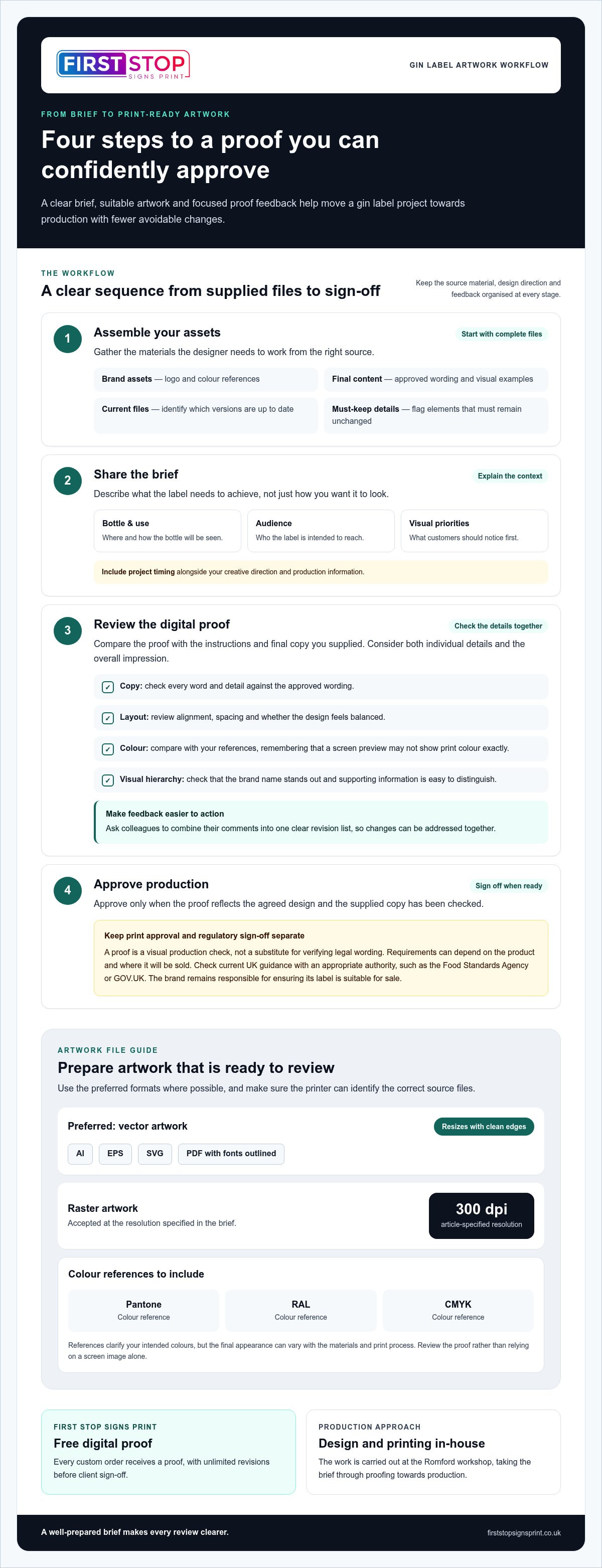
A well-organised artwork process moves from your brand materials to a clear proof, then into production after you approve the design. Sharing complete files and focused feedback early helps keep decisions clear and reduces avoidable changes later. At First Stop Signs Print, design and printing are carried out in-house at our Romford workshop, taking your brief through proofing towards production.
- Assemble your assets. Gather your logo, colour references, final wording and visual examples that show the look you’re aiming for.
- Share the brief. Explain the bottle’s intended use, the audience and the visual priorities, alongside the artwork files you have.
- Review the digital proof. Check the layout and supplied details carefully, then send any requested changes in a clear list.
- Approve production. Sign off only when the proof reflects the agreed design and the supplied copy has been checked.
What artwork files should a gin brand prepare?
Vector artwork is preferred because it can be resized while retaining clean edges. Suitable formats include AI, EPS, SVG and PDF with fonts outlined. Raster files are accepted at 300 dpi. Include the original logo files where possible, rather than relying on a small image copied from a website or document.
Bring your artwork together with colour references and final copy. Make clear which files are current and identify any elements that must remain unchanged. This helps the designer work from the right source material and avoids confusion between an old logo, an updated version and a visual reference. If you’re preparing a custom label project, a conversation about custom label printing can help you set out the brief clearly.
How to review a digital label proof
A digital proof lets you assess how the supplied design details come together before production. Check the brand name and wording against your approved copy, then review alignment, spacing, colour references and visual hierarchy. Consider the overall impression as well as individual details: does the eye reach the brand name first, and is the supporting information easy to distinguish?
- Compare every word and detail with the final copy you supplied.
- Check that key elements are aligned and the layout feels balanced.
- Review colours against the references in your brief, bearing in mind that a screen preview may not show print colour exactly.
- Ask colleagues to combine their comments into one clear revision list, so changes can be addressed together.
Every custom order with First Stop Signs Print receives a free digital proof, with unlimited revisions before client sign-off. Use the review stage to refine the design, resolve inconsistencies and confirm that the proof matches your instructions. A proof is a visual production check, not a substitute for verifying legal wording. Consult UK government spirit drink labelling guidance for current requirements, and complete the relevant checks before approving the artwork.
How to compare gin label printing companies without relying on guesswork
Compare the process, not just a supplier’s headline claims. A broad online catalogue may provide a self-service route based on standard choices, while a custom order can involve discussion of your brief, artwork handling and proof revisions. Neither approach is right for every brand. The best fit depends on how much support your project needs and how you prefer decisions to be managed.
Use the same criteria for each option, and separate clearly stated details from assumptions. A product image or general description doesn’t tell you which material, finish, equipment or label format will be used for your order. Focus on details that are confirmed and on how well the process supports your launch or replenishment plan.
| What to compare | What to look for |
|---|---|
| Brief support | Can you submit a custom brief and artwork, or is the process mainly self-service? |
| Proofing | Is a digital proof provided, and how are revisions and final approval handled? |
| Production location | Is design and printing carried out in-house, or does the company describe another workflow? |
| Delivery and timing | Does the stated delivery coverage and turnaround suit your launch or stock schedule? |
| Communication | Is there a clear route for sharing feedback and receiving updates? |
Which supplier details matter for a bespoke gin label order?
Look at how artwork enters the process, how comments are returned and what counts as approval to print. A clear sequence helps everyone understand when the design is still being refined and when production can begin. Consider whether you prefer placing an order through an online catalogue or having design and printing handled in-house.
Delivery coverage and timing matter too. First Stop Signs Print delivers across the UK, with a standard turnaround of 5-10 working days after proof approval. When comparing timeframes, note when each one starts rather than treating all estimates as equivalent. This helps you plan around a launch date or a planned replenishment.
How to assess proofing, colour and communication
Check whether a proof is supplied before production and whether you can request changes before sign-off. First Stop Signs Print provides a free digital proof for every custom order, with unlimited revisions before approval. Include Pantone, RAL or CMYK references in your brief to communicate your intended palette, then check how the proof reflects it.
Judge each gin label printing company by the clarity of its process, rather than assumptions about specifications. For further visual principles that can support clear layouts, see this UK guide to sign design. The Gin Guild’s resources for gin producers can also provide useful industry context as you shape your brand presentation.
How to prepare a gin label printing brief that avoids preventable delays
A useful brief gives your printer enough context to understand the project without requiring you to guess at technical specifications. Bring together the brand information, approved wording and timing first. Then describe the bottle and how the gin will be presented, so the design can be considered in its real setting rather than as an isolated graphic.
A gin label project checklist for the first enquiry
Before sending your brief to a gin label printing company, gather the essentials and mark what’s final and what’s still open to discussion:
- Brand assets: supply the current logo files, brand colours and any approved typography or visual guidance.
- Final wording: provide the copy you intend to use, clearly identifying any text that is still being checked.
- Colour references: include Pantone, RAL or CMYK references if you have them, alongside examples of colours that should be avoided.
- Visual references: share images or examples that communicate the mood, style or level of detail you have in mind.
- Audience and purpose: describe who the gin is for, where it will be presented and the impression the label should create.
- Project timing: state your planned launch or replenishment date and flag any milestones that affect approval.
Include useful packaging context, such as a description of the bottle and where the label will be viewed. Don’t invent dimensions or assume a particular label format if you don’t have confirmed specifications. A clear description helps frame the conversation, while the project brief can establish the production details. If your brand identity extends to other applications, professional vinyl sticker printing for UK businesses may also help maintain a consistent visual presence.
Name files clearly and identify the latest version of each asset. If several people are contributing, agree who will consolidate comments and approve the final design. One considered set of feedback is easier to action than conflicting notes sent at different stages.
What happens after the brief is submitted?
At First Stop Signs Print, every custom order receives a free digital proof before production. Review it against your approved wording and design direction, resolve any outstanding copy checks, and gather feedback before sign-off. Our in-house design and printing workflow at the Romford workshop takes the project from brief and proof towards production, with unlimited revisions before you approve the design.
Allow time for that review stage when planning. The standard turnaround is 5-10 working days after proof approval. Express service is available in 24-48 hours for a surcharge. Submitting final copy and organised assets at the outset, then returning consolidated feedback promptly, helps keep decisions clear without rushing proofing.
Have a custom gin label project in mind? Share your label printing brief with First Stop Signs Print to start shaping the artwork and production process.
Why work with First Stop Signs Print for gin label printing?
A gin label needs to do more than look distinctive on screen. It should present your brand clearly on the bottle and support a consistent impression wherever customers encounter it. First Stop Signs Print provides commercial label printing for custom projects, with design and printing carried out at our Romford workshop. This in-house workflow takes your brief through a design proof and approval towards production.
When comparing a gin label printing company with a broad self-service catalogue, the process matters as much as the finished artwork. A custom order gives you the opportunity to share the context behind the design, review a proof and refine it before approving production. That’s useful when details such as the balance of the brand name, supporting copy and colour references need to work together.
A direct, in-house route from design proof to production
Design and printing are carried out in-house at our Romford workshop. This gives your project a direct route from the information in your brief to the proof you review and the production stage that follows approval. The digital proof is a practical checkpoint, letting you see how the supplied design details have been brought together before the job proceeds.
Every custom order receives a free digital proof, with unlimited revisions before your sign-off. Use each review to check the design against your instructions and give clear feedback on any refinements you need. Revisions apply to the proofing stage before approval, so check the design carefully before authorising production. This gives you a defined approval point and the opportunity to confirm that the proof reflects the agreed design.
Turnaround and delivery for UK gin brands
Planning a launch or replenishment is easier when you know when the stated turnaround begins. Our standard turnaround is 5-10 working days after design proof approval. Build in time to review the proof and provide any revisions before sign-off, rather than counting the production timeframe from your first enquiry.
Express service is available in 24-48 hours for a surcharge. UK-wide delivery supports brands ordering from outside Romford, while design and printing are handled at our workshop. These details give you a practical basis for planning your project.
To develop a custom gin label, prepare your artwork, final copy, colour references and timing, then start a printing enquiry with First Stop Signs Print. We’ll take the project from your brief through proofing, with your approval before production begins.
Take the next step towards a label that feels unmistakably yours
Before moving into production, decide what you want someone to understand or feel at first glance. That intention can help keep design choices consistent, from how your brand name stands out to the mood your bottle creates on a shelf or at a bar.
A good working relationship with a gin label printing company should make it easier to turn that intention into a clear result. Bring your idea, artwork and priorities together, then use the process to shape a practical path from concept to approval. You don’t need every creative detail settled before you begin. A well-defined starting point gives the project room to develop while keeping the brand’s purpose in view.
Discuss your custom gin label project with First Stop Signs Print and take the first step towards presenting your brand with confidence. A label that gives the story behind the gin a clear place to be seen can help your bottle make a considered impression.
Frequently Asked Questions
How do I choose a gin label printing company in the UK?
Choose a gin label printing company with a process that suits your project and a clear approval stage before production. If you’re launching a new brand, you may value support shaping the layout. For an established design, artwork handling and clear communication may matter more. Compare how the process handles changes, production timing and delivery, and base your decision on stated details rather than assumptions about the finished label.
What artwork files should I send to a gin label printer?
Send vector artwork where possible, such as AI, EPS, SVG or a PDF with fonts outlined. These formats help preserve crisp edges when artwork is resized. Raster files are accepted at 300 dpi. Include the latest logo, colour references and final copy, and label which version is current. If you’re sending a PDF, check that fonts display as intended and that the document contains the complete artwork rather than a low-resolution preview.
Can a printing company help refine my gin label design?
Yes. First Stop Signs Print carries out design in-house, and every custom order includes a digital proof to review before production. Refinement might involve adjusting the balance between the brand name and supporting details, improving spacing or aligning the layout with your visual references. Give feedback that identifies the element and the change you want, such as “increase space above the product name”, rather than broad comments like “make it feel better”.
How long does gin label printing take?
First Stop Signs Print’s standard turnaround is 5-10 working days after design proof approval. Express service is available in 24-48 hours for a surcharge. For a launch, work backwards from the date stock needs to be ready, allowing time for your team to check wording and return proof feedback. The turnaround begins after approval, so delays in reviewing or revising the proof can affect your schedule.
What should I check on a gin label proof before approving it?
Check the proof against the final copy and your brand assets, not just the overall look. Read every line carefully, confirm the brand and product names, and inspect spacing, alignment and the order in which information stands out. If several people need to approve the design, gather their feedback together before sending revisions. This reduces the risk of conflicting changes and helps make the final sign-off deliberate.
Can label colours be matched to Pantone or CMYK references?
Yes, Pantone and CMYK references can communicate colour expectations, and RAL references may also help describe a target shade. Include the exact reference in your brief and identify where it applies, especially if the design uses several related colours. A digital proof helps you review the composition, but a screen can display colour differently from printed output. Treat the reference as a clear target rather than assuming every viewing device will look identical.
Do UK gin labels need to meet specific labelling requirements?
Yes, drinks labels can be subject to requirements covering product information and presentation, and the details depend on the product and its market. Check the current GOV.UK guidance for spirit drink labelling and seek appropriate advice if you’re unsure how it applies to your gin. Complete this compliance review separately from checking the artwork’s spelling, layout and colours. Print approval alone doesn’t establish that label wording meets legal requirements.


