
What belongs on a vape juice bottle, and what needs to appear elsewhere on the packaging? The vape juice label requirements uk can be difficult to fit into a compact, readable design. For nicotine-containing e-liquids, the prescribed addiction warning is one key requirement, alongside product information that must be presented clearly.
Settle the applicable requirements before approving artwork. Start with the product and its packaging, then give each required detail enough space to remain legible. Branding and marketing copy come second, especially when the available area is limited.
This practical 2026 guide outlines the main rules to consider, helps distinguish packaging details from information that may belong in a leaflet, and explains how to prepare a clear print brief. Check current requirements before final approval, so the artwork can move into label printing with fewer avoidable revisions.
Key Takeaways
- Start with the product’s composition, packaging and UK market destination to identify which rules apply.
- Use the vape juice label requirements uk checklist to distinguish information required on packaging from details that may belong in a leaflet.
- Check the rules for nicotine-free liquids separately. Other product-safety or chemical-hazard requirements may still be relevant.
- Plan artwork around legibility, contrast and a clear hierarchy, giving required copy priority over decorative elements.
- Prepare a print brief with approved artwork, dimensions, variants, quantity and intended packaging use before production.
UK vape juice labelling: what the rules aim to do
Vape juice labelling requirements cover the information and warnings presented with an e-liquid product. They help consumers identify what they are buying and understand relevant risks, while giving sellers a standard to work to. The vape juice label requirements uk are not one checklist that applies identically to every product. The details depend on composition, packaging and the UK market where the product is sold.
The Tobacco and Related Products Regulations 2016 (TRPR) are central to the UK framework for e-cigarettes and nicotine-containing refill containers. Northern Ireland also has relevant EU-derived requirements under the Windsor Framework. Check current guidance for the market where the product will be sold. A general overview of electronic cigarettes can explain the product category, but it is not a source for determining current labelling duties.
This overview introduces the framework, rather than giving legal advice or confirming that a particular product complies. Requirements and official guidance can change, so verify the rules for the product and destination market before approving artwork or selling it.
Which products and businesses should check the rules?
Manufacturers, importers, own-label brands and retailers all need to understand the rules before a product reaches customers. Responsibilities can depend on a business’s role and the product’s route to market. Do not assume that a supplier’s existing artwork settles every question for your brand or sales territory.
Distinguish the e-liquid from the device used to vape it, the refill container that holds the liquid, and the wider packaging presented for sale. These components may be subject to different requirements. A bottle of nicotine-containing liquid, for example, should not automatically be treated as having the same labelling requirements as a device or nicotine-free mixture. Identify the product and packaging first, then check the rules that apply to that combination.
Why bottle labels are only part of the compliance picture
A small container label may not be the only place to check. Review the container, its unit packaging, any outer packaging and any accompanying leaflet as separate parts of the product presentation. Depending on the product and the applicable provision, information may need to appear on packaging or in accompanying materials. A leaflet is not a substitute for packaging information unless current official guidance allows that approach.
Review the bottle, box and leaflet together, because a complete compliance check depends on where each required detail must appear. This helps prevent a common artwork problem: shrinking text to squeeze information onto a bottle when the rules specify another location, or overlooking a component because the main label looks complete. Once the applicable requirements are verified, a clear hierarchy helps keep mandatory copy legible and branding in its proper place.
What information must nicotine-containing vape juice packaging show?
For nicotine-containing e-liquid, review each packaging component against the rules rather than assuming the bottle label carries every detail. Plan the required warning and product particulars as distinct artwork elements. The UK Government’s E-cigarette Regulations guidance is a useful starting point. Check current requirements for the product and market, including any rules applicable in Northern Ireland.
Mandatory nicotine warning and product particulars
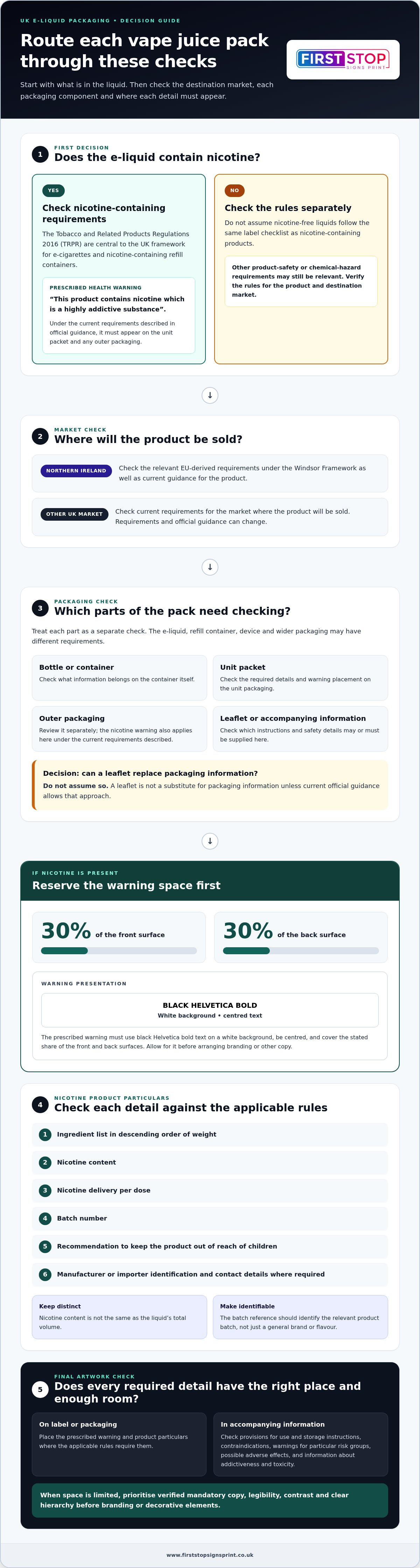
The prescribed health warning is: “This product contains nicotine which is a highly addictive substance”. Under the current requirements described in official guidance, it must appear on the unit packet and any outer packaging. It also has specific presentation rules: black Helvetica bold text on a white background, centred, and covering 30% of the front and back surfaces. Reserve this space before arranging branding or other copy.
Check the remaining particulars against the product and applicable rules. Packaging must provide the ingredient list in descending order of weight, nicotine content and nicotine delivery per dose, a batch number, and a recommendation to keep the product out of reach of children. Include the required manufacturer or importer identification and contact details where the rules require them.
Keep wording accurate and consistent across packaging components. For example, do not confuse nicotine content with the liquid’s total volume, and make sure a batch reference identifies the relevant product batch rather than a general brand or flavour. The vape juice label requirements uk also set product limits, but those product specifications do not replace the need to check required label particulars.
Information supplied on the leaflet or accompanying packaging
A leaflet or other accompanying information may carry details that need more room than the bottle label allows. Check the applicable provisions for required instructions for use and storage, contraindications, warnings for particular risk groups, possible adverse effects, and information about the product’s addictiveness and toxicity. Do not assume that putting information in a leaflet removes an obligation to show it on the packaging.
- On the label or packaging: plan the prescribed warning and product particulars for the locations required by the applicable rules.
- In accompanying information: organise detailed directions, storage guidance and relevant safety information where the rules allow or require them.
- Across the pack: check that manufacturer or importer details appear in the required place, with contact information where applicable.
Before approving a print file, compare the final artwork and leaflet copy with current official guidance. Keep required text distinct from optional brand messaging, and check that it remains legible at the final size. Once the copy and layout are approved, professional label printing can turn the verified artwork into finished labels.
Do nicotine-free vape juices and UK nations follow the same label rules?
Not necessarily. The vape juice label requirements uk depend partly on whether the liquid contains nicotine and where it will be sold. Nicotine-free e-liquid is exempt from the nicotine addiction warning required for nicotine-containing products, but that does not mean every other labelling duty disappears. The ingredients, intended use and classification of the mixture may bring other product-safety or chemical-hazard rules into play.
Nicotine-containing versus nicotine-free e-liquid
Nicotine content affects which e-cigarette-specific requirements apply. A product containing nicotine may fall within requirements under the Tobacco and Related Products Regulations 2016 (TRPR), including the prescribed health warning and product information. Removing nicotine changes the assessment, but “nicotine-free” is not a complete compliance check. Do not copy a label across formulations without reviewing it.
For a nicotine-free mixture, assess the formulation and its hazard classification. If the mixture is classified as hazardous, chemical classification and labelling rules may require hazard information on the packaging. The assessment depends on the ingredients and their concentrations, so a generic checklist cannot determine the legal position of an individual product. Check current rules and official guidance before finalising the label copy.
Great Britain and Northern Ireland
Great Britain means England, Scotland and Wales. TRPR is central to its e-cigarette framework. Northern Ireland has a distinct route for relevant product rules, including EU-derived requirements that continue to apply there under the arrangements governing Northern Ireland. Do not assume that a label prepared for Great Britain automatically covers products placed on the Northern Ireland market.
The MHRA publishes e-cigarette guidance and administers relevant product notification processes. Use its current material alongside the applicable Great Britain or Northern Ireland guidance, and confirm the position for the product type and destination market. Rules can change, so use the outline below as a prompt for verification, not as a legal decision about a particular formulation.
| Product type or market | Likely framework to consider | Verification action |
|---|---|---|
| Nicotine-containing e-liquid, Great Britain | TRPR requirements for nicotine-containing e-cigarette products, plus any other applicable rules. | Check current MHRA guidance and identify which particulars belong on each packaging component. |
| Nicotine-free e-liquid, Great Britain | Nicotine-specific warning exemption, with other product-safety or chemical-hazard duties potentially relevant. | Review the formulation and hazard classification before finalising warnings and label information. |
| Products for Northern Ireland | Applicable Northern Ireland requirements, including relevant EU-derived product rules. | Check current Northern Ireland guidance as well as MHRA information for the product category. |
Use this comparison to set the right review path, not to approve artwork by assumption. Record the product’s nicotine status, formulation and intended UK market before signing off the copy. This gives the artwork team a clear basis for separating required information from optional branding, while leaving regulatory interpretation with the responsible business and its current official sources.
How to prepare clear, compliant vape juice label artwork
Good artwork starts with verified copy, not a crowded template. Before designing, identify the product and its intended market, then check current rules for its composition and packaging. Let the vape juice label requirements uk shape the layout from the outset, so required text stays clear and readable rather than being squeezed in after the branding is finished.
Use this sequence to move from requirements to print approval:
- Confirm the product and market. Record whether the liquid contains nicotine, its product variant and whether it is intended for Great Britain, Northern Ireland or both.
- Verify the applicable rules. Check current official guidance for the product and market. Review any restrictions on claims and presentation before writing promotional copy.
- Map the information. List the required wording for each packaging component, including any accompanying leaflet, and separate it from optional brand identity or flavour descriptions.
- Proof every version. Compare artwork text with approved product records and inspect it at its intended printed size for readability, contrast and omissions.
- Approve the print file. Sign off the final artwork only after the copy, layout and packaging use have been checked together.
Map the required information before designing
Create a checklist for each packaging component and product variant. Reserve space first for verified warnings and particulars, then arrange brand elements around them. Keep a clear hierarchy so essential information is easy to find, with strong contrast between text and background. Avoid relying on colour alone to distinguish important copy. Check legibility at the final printed size, not just on an enlarged design on screen.
Proof the artwork before sending it to print
Check spelling and compare ingredient details, nicotine information, batch fields and manufacturer or importer particulars with the approved records. Proof each flavour or strength separately. A shared template can save design time, but copied artwork may retain the wrong ingredient list, strength or batch field. Inspect the final proof for missing text, weak contrast, crowded areas and unintended changes introduced during revisions.
Plan label production around approved artwork
Prepare a concise print brief that identifies the product, label dimensions, approved artwork version and intended packaging use. Include the number of variants and required quantity so the production file is unambiguous. Complete regulatory verification and artwork approval before production begins. Clear files and an organised brief help translate approved information into a professionally printed label, without treating print production as a compliance review.
Once the wording and artwork are approved, explore label printing for your business as the next step from a checked brief to finished labels.
From verified vape label copy to professionally printed labels
Once the applicable rules have been checked and the label wording approved, a complete print brief helps carry that information into production accurately. It gives the artwork and production teams one clear reference for what is being printed, how the label will be used and which version is current. This is a practical production handover, not a legal review or confirmation that the vape juice label requirements uk have been met.
What to include in a label-printing brief
Make the brief specific enough to prevent guesswork. Include the final approved artwork and identify its version or approval date. If several files exist, mark clearly which one is authorised for production. This helps prevent an earlier draft with outdated wording or details from being used by mistake.
Include the information needed to match the labels to the product and packaging:
- Artwork: the approved production file, with a clear version reference.
- Dimensions: the required label measurements and the packaging component it is intended for.
- Variants: the number of product versions and how each should be identified, such as by flavour or nicotine strength.
- Quantity: the required amount for each variant, rather than only a combined total.
- Application: how and where the label will be used, such as on a bottle or outer pack.
- Variable fields: instructions for information that changes between versions or batches, including which details are supplied separately.
For example, if two liquids share a design but have different ingredient lists or nicotine information, identify each artwork file and its corresponding product clearly. Do not rely on filenames alone if the relationship between a version and its product is unclear.
Make the transition from compliance review to print straightforward
Before approving the final file, complete the legal and copy checks for the intended product and market. Keep a dated record of the approved artwork alongside the product details it represents. This makes it easier to trace which copy was used for each variant and manage later artwork changes deliberately.
First Stop Signs Print’s commercial label printing is the production stage: verified information is supplied in an organised brief and prepared as printed labels. A clear hierarchy and legible artwork help required details remain visible, while accurate version control reduces avoidable confusion during the handover. The regulatory decision remains with the responsible business, not the printer.
Have your approved artwork and packaging details ready? Discuss your commercial label printing requirements and outline the brief for your labels.
Move from approved artwork to your next print run
Use verified copy as the foundation for a confident production handover. Keep the final artwork, product details and print brief together, so each version has a clear reference point and future updates can be managed carefully. The vape juice label requirements uk may change, so include a check of current official guidance in your artwork review whenever a product or market changes.
Once the wording and design are approved, professionally printed labels bring the brief into production. First Stop Signs Print provides label printing alongside bespoke design and production services, helping businesses prepare artwork for print without confusing production with legal approval.
Ready to take the next step? Discuss your bespoke label printing requirements and start shaping a clear brief for your labels. With the details organised and artwork approved, you can move forward with confidence.
Frequently Asked Questions
Is a nicotine warning required on every vape juice label?
No. The prescribed nicotine addiction warning applies to nicotine-containing e-liquids, not automatically to every vape juice label. A nicotine-free product may still need other information or hazard labelling, depending on its formulation and applicable rules. Also distinguish the bottle label from the unit pack and outer packaging: check which components need to carry the warning rather than assuming a single sticker covers the whole requirement.
What exact wording must the nicotine warning use in the UK?
The prescribed wording is: “This product contains nicotine which is a highly addictive substance”. Do not paraphrase it, add promotional wording inside the warning or assume a familiar older design is still suitable. Check current official requirements for the product’s destination market and reproduce the text exactly in the approved artwork. Compare the final file with the verified source to catch any copy changes made during design or proofing.
Do nicotine-free vape juices need hazard labels?
Possibly. A nicotine-free liquid may still require hazard labelling if its ingredients and concentrations mean the mixture is classified as hazardous under applicable chemical rules. Removing nicotine does not establish whether another ingredient triggers a hazard classification. Base the decision on the specific formulation and relevant safety data, not on a “0mg” claim or a label used for a different blend. Verify the classification before deciding which warnings belong on the pack.
Can a QR code replace information required on vape packaging?
Do not assume a QR code can replace required printed information. A code may provide supplementary details, but it will not necessarily satisfy rules that require information on product packaging or in an accompanying leaflet. Check the provision for each item before moving it online. Consider practical access too: a customer should not need a smartphone, internet connection or functioning link to read information that must be supplied with the product.
Do vape juice labels need an expiry date or best-before date?
TRPR requirements include a batch number, but they do not set a general expiry-date requirement for every e-liquid label. That does not settle every product’s obligations: other applicable rules, product characteristics or a seller’s claims may affect what information is appropriate. Do not invent a date or treat it as a substitute for batch identification. Check current requirements for the formulation and keep any date information consistent with product records.
Are vape juice labelling rules different in Northern Ireland?
They can differ, so check requirements for Northern Ireland separately from those for Great Britain. Relevant EU-derived product rules continue to apply in Northern Ireland under the arrangements governing the Windsor Framework. Before supplying a product there, check current MHRA information and applicable Northern Ireland guidance for its type and composition. Do not assume a label prepared for Great Britain meets every requirement for the Northern Ireland market.
Who is responsible for checking a vape juice label before sale?
The business placing a product on the market should ensure its own responsibilities are met. Responsibility can depend on whether it manufactures, imports, sells under its own label or retails another brand. A retailer should not treat a supplier’s artwork as proof that every duty is covered. Set a documented review before sale, matching the final label to the product formulation, destination market and current rules. Printing prepares approved artwork, but does not provide legal approval.


