
A sustainable label that peels away inside a chilled display or contaminates a recycling stream does far more harm to your business than good. You already recognise that packaging must reflect genuine environmental responsibility, but sorting through compostable films, recyclable stocks, and the legal scrutiny of the UK Green Claims Code is rarely straightforward. Sourcing high-performance eco-friendly product labels UK brands can depend on shouldn't force you to choose between structural durability, vibrant print finishes, and strict regulatory compliance.
In this 2026 commercial buying guide, you'll discover how to choose certified, high-performance sustainable labels that protect your compliance record and elevate your brand reputation. We demystify the material choices across jars, bottles, and postal boxes, examine how specialised adhesives perform in humid or cold environments, and outline the packaging regulations shaping the UK market this year. Here is everything you need to partner with the right commercial print specialist and specify packaging that stands out for all the right reasons.
Key Takeaways
- Understand how upcoming 2026 British packaging mandates and the CMA Green Claims Code directly impact your labelling specifications.
- Compare post-consumer recycled paper, rustic kraft, and certified compostable stocks to pinpoint the ideal eco-friendly product labels UK retailers demand.
- Discover why adhesive chemistry and wash-off formulations are critical to keeping glass and rigid packaging fully recyclable.
- Apply a practical five-step commercial framework to audit surface tension, transit exposure, and storage temperatures before placing an order.
- Learn how partnering with a dedicated UK print manufacturer unlocks bespoke shapes and precise digital colour matching without prohibitive tooling costs.
Why Sustainable Product Labels Matter for UK Businesses in 2026
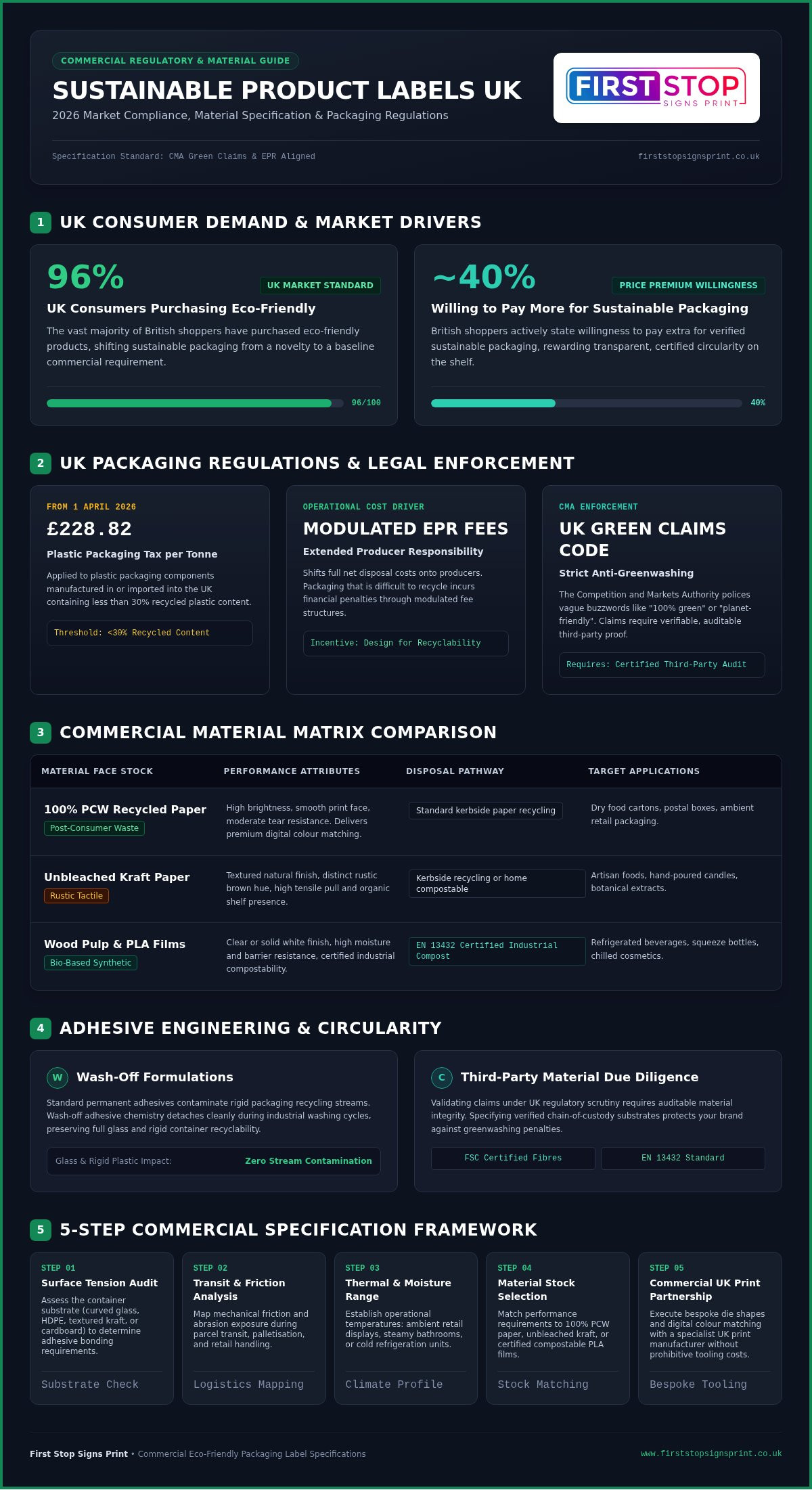
Modern retail shelves place immense scrutiny on packaging. British shoppers no longer view sustainable materials as a novelty; they treat them as a baseline commercial expectation. Recent research reveals that 96% of UK consumers have purchased eco-friendly products, whilst nearly 40% actively state they will pay more for sustainable packaging. Using certified environmental preference ecolabels allows forward-thinking brands to demonstrate genuine circularity right at the primary point of sale, proving that high visual appeal does not require virgin plastics.
Major high street retailers and grocery chains across Britain are steadily removing unrecyclable composite substrates from their supply chains. If your packaging relies on non-separable laminates or conventional oil-based films, listing opportunities will shrink. High-grade eco-friendly product labels UK manufacturers produce preserve shelf appeal while satisfying stringent supply-chain audits.
To see how commercial producers bring physical label stocks and finishes together for modern retail displays, watch this short breakdown:
Meeting UK Consumer Demand for Transparent Sustainable Packaging
Tactile textures build immediate trust. A natural, textured paper surface communicates authentic craftsmanship far faster than glossy synthetic stocks. British shoppers seek out direct recycling instructions on-pack to avoid contamination at home. Adding concise, certified disposal guidance onto your eco-friendly product labels UK packaging informs consumers, builds long-term loyalty, and eliminates purchasing hesitation in the aisle.
Navigating UK Packaging Waste Regulations and the Green Claims Code
Regulatory scrutiny in Britain has shifted from gentle guidance to direct enforcement. The Competition and Markets Authority (CMA) actively polices misleading claims under the UK Green Claims Code. Broad buzzwords like "100% green" or "planet-friendly" without rigorous third-party verification risk severe reputational fallout and legal sanctions.
Packaging compliance also ties straight into operational costs:
- Extended Producer Responsibility (EPR): EPR regulations shift the net disposal costs of domestic packaging directly onto producers, using modulated fees that penalise materials that are difficult to recycle.
- Plastic Packaging Tax: Rates sit at £228.82 per tonne from 1 April 2026 for plastic packaging components containing less than 30% recycled content.
- Third-Party Material Due Diligence: Utilising verified substrates, such as FSC-certified fibres or industrial compostability standards like EN 13432, provides the auditable trail required to validate your marketing statements.
Comparing Eco-Friendly Label Materials: Recycled, Kraft, and Compostable Stocks
Selecting the right stock means balancing tactile brand presentation with strict performance criteria. A cosmetic jar kept in a steamy shower requires vastly different barrier properties than an unboxing seal placed on a dry cardboard carton. To specify reliable eco-friendly product labels UK packaging demands, you must understand how distinct sustainable face stocks behave under daily commercial use.
| Material Stock | Key Performance Attributes | Disposal Pathway | Best Commercial Applications |
|---|---|---|---|
| 100% PCW Recycled Paper | High brightness, smooth print face, moderate tear resistance | Standard kerbside paper recycling | Dry food cartons, postal boxes, ambient retail packaging |
| Unbleached Kraft Paper | Textured natural finish, distinct rustic brown hue, strong tensile pull | Kerbside recycling or home compostable | Artisan foods, hand-poured candles, botanical extracts |
| Wood Pulp & PLA Films | Clear or solid white, excellent barrier to oils and surface moisture | Industrial composting (EN 13432 certified) | Chilled deli containers, refrigerated beverages, bathroom cosmetics |
Recycled Paper vs Unbleached Brown Kraft: Aesthetic and Practical Differences
Post-consumer waste (PCW) recycled paper delivers a crisp, bright base ideal for accurate four-colour digital printing. Brand palettes remain vibrant, and fine regulatory typefaces remain legible. Brown kraft paper provides a textured, earthy surface that instantly signals raw, artisan authenticity. Because kraft absorbs ink differently, bold vector graphics and deep monochromatic typography produce the strongest visual impact. If you want sample swatches to test print clarity across different finishes, you can explore tailored label printing options to evaluate face stocks directly on your containers.
Plant-Based Bioplastics and Wood Pulp Films for Moisture Resistance
Ditching oil-based polymers doesn't mean sacrificing barrier integrity. Polylactic acid (PLA) and cellulose films derived from managed wood pulp match the clarity and splash resistance of standard polypropylene. These stocks protect packaging from label wrinkling caused by refrigeration condensation or essential oil migration.
Disposal channels dictate your legal on-pack wording under the official UK Green Claims Code. Clear bio-films certified under EN 13432 break down cleanly within municipal commercial composting facilities, but they won't degrade properly in standard home garden compost bins. Explicitly stating whether your eco-friendly product labels UK packaging carries an industrial or domestic composting profile keeps your brand fully transparent and legally compliant.
The Adhesive and Ink Factor: Ensuring True Recyclability Across the Supply Chain
A recyclable face stock solves only half of the packaging puzzle. Standard solvent-based acrylic adhesives often form sticky, insoluble residues during paper re-pulping, gumming up commercial recycling screens and downgrading recycled paper quality. Genuine circularity demands that the adhesive and ink work in harmony with the underlying container. Specifying certified eco-friendly product labels UK businesses use means evaluating how these chemical layers behave once the empty package enters a recovery facility.
Adhesive Types: Wash-Off, Water-Soluble, and Certified Compostable Solutions
Modern adhesive formulations target specific end-of-life recovery routes without sacrificing high initial tack:
- Alkali Wash-Off Adhesives: These release cleanly from glass bottles and PET containers in warm commercial wash baths (around 65°C to 80°C). The label lifts away in one piece, leaving pristine containers ready for refilling or high-purity recycling.
- Water-Soluble Adhesives: These dissolve entirely in standard municipal repulping systems, preventing the sticky agglomerations known as "stickies" in paper mills.
- Certified Compostable Adhesives: Formulated with natural rubber or modified biodegradable resins, these adhesives decompose safely alongside PLA or cellulose face stocks without leaching toxic chemicals into soil.
Application conditions still matter. High tack remains vital. A water-soluble adhesive designed for an ambient dry-fill cereal carton will fail on a beer bottle submersed in an ice bucket. Commercial label manufacturers calibrate adhesive viscosity to ensure robust adhesion during transit and retail display whilst preserving clean separation at processing plants.
Sustainable Ink Technologies and Non-Toxic Print Finishing
Traditional print processes rely heavily on UV-curable inks with photo-initiators, or high-VOC solvent inks that release greenhouse gases and complicate de-inking stages. Modern sustainable production relies instead on low-VOC eco-solvent formulations, water-based inks, or vegetable-based pigments. These options bind tightly to uncoated kraft and recycled stocks while facilitating effortless pigment separation during re-pulping operations.
Finishing treatments require similar care. Applying a conventional glossy polyester lamination instantly turns a fully recyclable paper label into non-recyclable composite waste. Where moisture resistance or abrasion protection is non-negotiable, water-based barrier varnishes provide defence without trapping the paper fibres in non-separable plastic. For brands evaluating extreme industrial outdoor durability against circular retail packaging, reviewing our guide to professional vinyl sticker printing helps clarify when durable synthetic adhesives are strictly necessary versus when sustainable paper alternatives are the better fit.
How to Choose the Right Eco-Friendly Labels: A 5-Step Commercial Framework
Selecting reliable labelling requires an engineering mindset, not guesswork. If your adhesive detaches under condensation or your face stock cracks along container contours, your packaging fails on shelf. Follow this five-step procurement methodology to ensure your eco-friendly product labels UK orders hit every performance metric:
- Audit Container Substrates: Map the physical properties of your packaging surface, including texture, surface energy, and material rigidity.
- Define Exposure Conditions: Profile environmental stresses throughout transport and retail, from cold storage condensation and humidity to direct sunlight and scuffing.
- Select Delivery Formats: Choose between machine-ready rolls or flat sheets based on your operational labelling setup.
- Standardise Compliance Graphics: Integrate precise recycling disposal directives and verified certification badges that comply with UK labelling rules.
- Conduct Prototype Testing: Run practical trials to evaluate bond strength, ink rub resistance, and real-world temperature resistance before committing to large print runs.
Matching Label Stocks to Packaging Surfaces: Glass, Cardboard, and Tin
Different packaging materials present distinct bonding challenges. Smooth glass bottles offer high surface energy, allowing wash-off adhesives to anchor firmly yet detach during commercial washing. Tight-radius cosmetic jars demand flexible face stocks; stiff papers will fight the curve and lift along the edges. Porous, textured corrugated cardboard boxes absorb adhesive quickly, requiring higher coat weights to prevent labels dropping off during postal transit. When labelling aluminium tins, specify high-tack bio-based formulations that resist natural metal surface oxidation.
Roll Labels vs Sheet Labels: Deciding on Commercial Application Method
Your application method dictates the format you order from your print manufacturer. Sheet labels work well for short-run promotional batches, seasonal product drops, or boutique artisan items applied by hand. They keep upfront setup minimal and provide flexibility across varied SKUs.
Commercial bottling and automated packing lines demand continuous roll labels. When ordering rolls, you must specify four mechanical criteria:
- Core Diameter: Ensure internal cardboard cores (commonly 25mm, 38mm, or 76mm) match your labelling machine spindles.
- Winding Direction: Align the orientation of the printed graphic so it feeds onto the container right-side-up.
- Outer Roll Diameter: Keep roll thickness within the clearance limits of your applicator housing.
- Backing Liner Release: Select siliconised glassine release liners that peel away cleanly at line speed without tearing.
Bulk roll production delivers substantial unit savings and speeds up production lines. To configure the ideal format, stock, and finish for your filling line, contact our commercial printing team to review technical specifications and request trial stock samples.
Sourcing Bespoke Commercial Eco-Labels with First Stop Signs Print
Working with an automated web-to-print portal often leaves commercial packaging buyers stuck with rigid template sizes and zero technical feedback. First Stop Signs Print operates as a hands-on UK commercial printing manufacturer, bridging the gap between bespoke craftsmanship and high-capacity digital production. Whether you run an independent boutique brand in Essex or manage multi-channel supply chains across the country, our production facility delivers certified, high-grade eco-friendly product labels UK retailers can rely on for visual clarity and durable application.
Tailored Production: Custom Dimensions, Finishes, and Flexible Batch Sizes
Unusual container profiles shouldn't lock you into paying astronomical tooling setup fees. Our modern digital cut-to-shape production lines plot custom contours without requiring expensive physical cutting dies. You get complete creative freedom over your silhouette, whether you need arch labels for luxury cosmetic droppers, wrap-around bands for hexagonal honey jars, or minimal geometric seals for unboxing cartons.
Production flexibility remains central to our setup. We support short initial trial batches to validate your packaging concepts on shelf, alongside high-volume commercial production runs. By combining premium textured recycled stocks, rustic unbleached kraft papers, and non-toxic aqueous protective varnishes, we ensure your finished labels communicate high-end quality without compromising ecological integrity.
Seamless Ordering and Expert Technical Guidance for UK Brands
A failed print run costs valuable launch time. That's why our experienced team conducts thorough pre-flight technical checks on every artwork file before it reaches the presses. We inspect:
- Barcode and QR Code Scannability: Ensuring high contrast against textured background fibres.
- Micro-Typography Legibility: Verifying regulatory text remains pin-sharp on complex ingredient lists.
- Colour Profile Reproduction: Calibrating high-resolution digital print systems for consistent brand colour matching across every single batch.
Commercial clients enjoy rapid turnaround times, with the convenience of local collection from our Romford facility or dependable tracked delivery across London, Essex, and the wider UK. For retail enterprises aiming to unify their on-shelf branding with striking physical storefronts, our print specialists also manufacture bespoke business signage solutions to ensure complete visual cohesion across your business. Contact our specialist print workshop today to discuss your packaging dimensions, request physical material sample swatches, and secure a tailored quote for your commercial labelling run.
Elevate Your Product Packaging with Compliant British Print
Aligning packaging aesthetics with environmental responsibility is now an essential standard across modern British retail. Meeting statutory expectations under the UK Green Claims Code doesn't mean compromising on sharp graphics or reliable shelf durability. By matching post-consumer recycled stocks or compostable films with wash-off adhesives calibrated for your specific container, you safeguard material circularity while driving consumer trust.
Specifying high-performance eco-friendly product labels UK brands rely on requires a production partner that understands the technical details of substrates, adhesives, and finishing varnishes. At First Stop Signs Print, we combine specialist digital printing with precise cut-to-shape technology at our dedicated UK commercial printing facility. Serving London, Essex, and national businesses, our team provides end-to-end substrate consultation and dedicated trade customer support to ensure your labels perform flawlessly from bottling line to retail shelf.
Order your custom eco-friendly product labels from First Stop Signs Print today and let our experienced team help you showcase your brand with sustainable packaging that truly stands out.
Frequently Asked Questions
Can eco-friendly product labels withstand moisture and refrigeration in chilled storage?
Yes, sustainable labels can handle refrigeration when paired with the right face stocks and adhesives. Certified wood pulp films and polylactic acid (PLA) stocks resist condensation, splashing, and oil penetration just like conventional synthetic films. Pairing these materials with moisture-tolerant, chill-grade adhesives prevents edge lifting and wrinkling inside refrigerated display units or cold transit vehicles.
What is the practical difference between compostable and recyclable packaging labels?
Recyclable labels are formulated to enter municipal kerbside collections alongside cardboard boxes or glass containers, breaking down safely during the re-pulping or cullet recovery stages. Compostable labels break down naturally into organic biomass under specific conditions, usually requiring commercial facilities governed by EN 13432 standards. Placing compostable materials into standard recycling bins contaminates clean processing streams.
Do water-based or vegan printing inks fade faster than conventional print inks?
Modern digital water-based and low-VOC eco-solvent inks offer lightfastness and scratch resistance that rival traditional petroleum-based inks. They provide intense pigment loading and sharp typographic clarity on paper substrates. Unless your packaging sits in constant direct outdoor UV exposure for extended months, eco-solvent and aqueous inks will maintain colour fidelity across typical retail shelf lifespans.
Are brown kraft paper labels suitable for food packaging and cosmetic containers?
Brown kraft paper works exceptionally well for dry goods, artisan bakery boxes, luxury coffee bags, and ambient cosmetics. It delivers an unmistakably rustic, tactile finish. Because uncoated kraft absorbs liquid over time, products containing free oils or those stored in steamy bathrooms perform better when protected with an aqueous barrier varnish.
What UK regulations govern environmental claims made on retail product labels?
The UK Competition and Markets Authority enforces the Green Claims Code, requiring all environmental statements to be fully substantiated, accurate, and transparent. Businesses must avoid vague terms like "eco" without clear qualification. If you market eco-friendly product labels UK consumers interact with, your packaging must carry verifiable material credentials and unambiguous disposal instructions.
Can I order custom die-cut shapes for eco-friendly product labels without extra tooling costs?
Yes, modern digital label printing utilizes digital cut-to-shape plotters that follow vector artwork lines directly. This allows you to produce arch shapes, geometric container seals, and bespoke contours without buying expensive metal dies. It keeps upfront development affordable for both short trial batches and large commercial runs.
How do wash-off adhesives improve glass bottle and jar recycling rates in the UK?
Wash-off adhesives detach cleanly in warm commercial washing baths without leaving sticky chemical residue on the glass surface. This preserves the purity of recycled glass cullet and enables beverage or preserve manufacturers to sterilise and refill returned jars directly. Standard acrylic glues often require harsh chemical stripping that complicates circular reuse programmes.


