
A world-class craft recipe counts for nothing if your bottle arrives at the table with a soggy, wrinkled label sliding into an ice bucket. You've poured months into perfecting your brew, so watching condensation ruin your vibrant artwork or lift edges in cold storage is deeply frustrating. Add the pressure of staying compliant with UK beverage standards, and getting your packaging right can quickly feel overwhelming. Mastering professional beer bottle label printing requires striking a dependable balance between visual shelf appeal and the physical durability demanded by British pubs and retail shelves.
In this 2026 buying guide, you'll discover how to choose the ideal substrates, protective finishes, formats, and regulatory specifications for your bottles. We'll examine moisture-resistant stocks that eliminate bubbling, explain how to align your artwork with mandatory UK Trading Standards, and help you choose between sheet labels and machine-ready rolls to keep your bottling line running smoothly.
Key Takeaways
- Discover how durable synthetic substrates like polypropylene and waterproof vinyl prevent peeling, bubbling, and water damage in chillers or ice buckets.
- Learn how protective laminations and specialised embellishments shield vibrant branding from transit scuffs whilst driving shelf appeal.
- Determine whether economical sheet labels or automated roll formats best suit your current bottling line capacity and volume goals.
- Master mandatory UK Food Information Regulations to structure legal typography and allergen declarations seamlessly within your creative beer bottle label printing.
- Understand the distinct advantages of short-run digital production and sample proofing to guarantee precise colour reproduction before committing to large volumes.
Choosing the Right Substrate: Waterproof Vinyl, Polypropylene, and Textured Papers
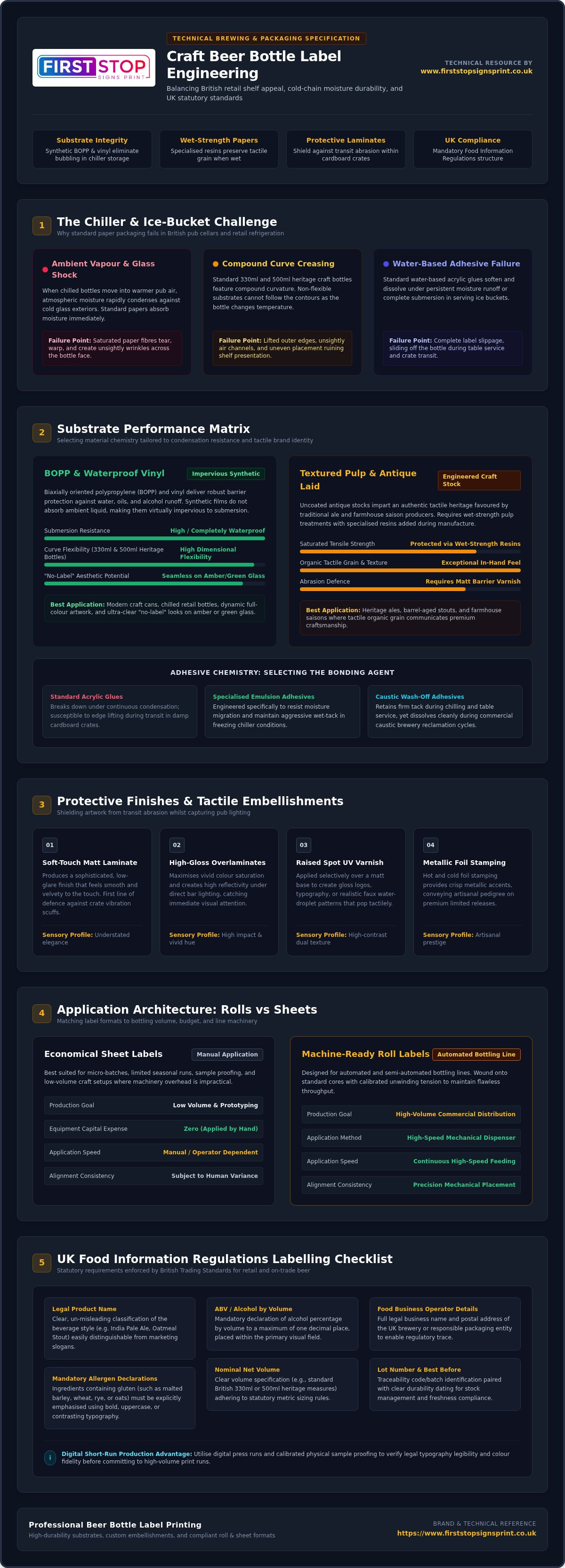
Refrigerators and ice buckets pose severe physical challenges for craft brewers. When a cold bottle moves into warm air, ambient moisture condenses rapidly on the glass exterior. Standard paper stickers quickly absorb this moisture, leading to wrinkled graphics, torn edges, and slipping adhesives. Selecting the correct substrate forms the bedrock of professional beer bottle label printing, dictating whether your bottles retain their pristine shelf appeal or deteriorate in the chiller.
To see how professional packaging designers balance creative visual themes with physical print substrates in practice, watch this practical walkthrough:
Synthetic Polypropylene and Vinyl for Moisture Resistance
Biaxially oriented polypropylene (BOPP) and waterproof vinyl deliver exceptional protection against water, oils, and alcohol runoff. These synthetic films do not absorb ambient liquid, making them virtually impervious to submersion. Their dimensional flexibility prevents bubbling or creasing across the compound curves of standard 330ml and 500ml heritage bottles. Clear vinyl options provide a clean, modern "no-label" aesthetic directly on amber or green glass. For broader technical guidance on film performance in punishing conditions, explore our guide to professional vinyl sticker printing.
Uncoated Craft Paper and Antique Textured Stocks
Textured pulp and antique laid stocks impart an authentic, tactile heritage favoured by traditional ale and farmhouse saison producers. Unlike glossy synthetics, standard papers weaken quickly under condensation. To survive cold chains, these stocks require wet-strength pulp treatments, incorporating specialised resins during paper manufacture to retain tensile strength when saturated. Applying a protective matte barrier varnish seals the paper surface against scuffing without deadening its organic, tactile grain.
Adhesive Chemistry: Permanent, Removable, and Freezer Grades
Substrate performance relies entirely on adhesive chemistry. Standard water-based acrylic glues often break down under direct ice exposure, causing edges to lift during transit in damp cardboard crates. In contrast, specialised emulsion adhesives resist moisture migration and preserve tack at low temperatures. Modern package labeling systems also accommodate sustainable brewery operations; specialised wash-off adhesives maintain high wet-tack during chilling yet dissolve cleanly during commercial caustic wash cycles, supporting cost-effective bottle reclamation.
Premium Finishes and Embellishments to Elevate Craft Beer Branding
Standing out on crowded taproom shelves demands more than colourful illustrations. A customer often handles a bottle before deciding to buy it, making tactile quality just as influential as visual appeal. Custom embellishments turn standard packaging into a memorable sensory experience, catching ambient pub lighting and encouraging repeat purchases. Enhancing your beer bottle label printing with precision embellishments also provides structural protection, shielding your brand assets from scuffs during transit across the UK.
Spot UV Varnish and Matt versus Gloss Overlaminates
Protective laminates act as the first line of defence against abrasion when glass bottles vibrate against each other inside cardboard crates. Velvet soft-touch matt lamination produces a low-glare, sophisticated surface that feels remarkably smooth in hand. In contrast, high-gloss overlaminates amplify colour saturation and catch direct retail lighting. Applying a raised spot UV varnish over a matt base introduces compelling contrast, allowing gloss logos, typography, or water-droplet patterns to pop against subdued backgrounds.
Metallic Foil Stamping and Underprinted Metallic Effects
Metallic detailing conveys artisanal pedigree when applied with restraint. Traditional hot and cold foil stamping delivers crisp accents in gold, silver, or rich copper. An equally versatile technique involves printing directly onto a bright silver metallic substrate using semi-translucent inks. This underprinting method allows you to generate a full spectrum of shimmering metallic colours across your artwork without purchasing separate bespoke foils, keeping production lean whilst maintaining visual depth.
Embossing and High-Build Tactile Textures
Tactile embellishments invite customers to engage with your packaging physical form. Consider these tactile finishes to refine your bottle presentation:
- Multi-level debossing and embossing: Presses artwork into heavy paper stock, raising brand crests and vintage seals with tangible physical depth.
- High-build screen varnish: Lays down a thick, tactile layer of clear resin to add dimensional grip, ideal for textured hop vines or bold house typography.
- Harmonised bottle pairing: Balances tactile label elements with dark amber glass and matching crown caps to complete an intentional, cohesive presentation.
Whilst integrating intricate tactile elements requires careful planning around tooling dies, the shelf impact pays dividends in consumer perception. To balance creative embellishments with strict UK mandatory labelling regulations, you can partner with First Stop Signs Print to review custom finishes on your digital production runs.
Roll Labels versus Sheet Labels: Deciding Between Manual and Machine Application
Choosing between sheets and rolls dictates your packaging line speed, labour costs, and overall application accuracy. While sheet printing satisfies pilot experimental brews, growing bottling volumes quickly turn hand-peeling into an expensive bottleneck. Deciding on the proper format for your beer bottle label printing requires balancing your production run size with the mechanical requirements of your packaging setup.
Sheet Labels for Pilot Batches, Collabs, and Limited Editions
Flat sheet labels suit short, one-off artisan runs of under 500 units. They eliminate machine calibration setup time and let you test limited seasonal recipes or taproom collaborations economically. When applying sheets by hand, use a simple bottle jig to ensure consistent height across the glass. Applying labels starting from the centre line and smoothing outward with a soft felt squeegee eliminates trapped air pockets and prevents skewed, wonky alignment.
Roll Labels for Semi-Automated and High-Speed Packaging Lines
Continuous rolls become essential once your bottling line scales past several hundred bottles per session. Benchtop semi-automatic or inline automated label applicators boost packaging throughput from dozens of bottles per hour to hundreds with pinpoint placement. Automated dispensing applies heavy web tension, requiring robust glassine or synthetic backing liners to prevent web snaps during high-speed runs. On twin-panel designs, you can either alternate front and back labels consecutively on a single roll or run dual spools simultaneously depending on your machine configuration.
Machine Compatibility: Wind Directions and Core Dimensions
Ordering roll labels requires strict mechanical alignment with your equipment. Mismatched roll configurations can stall a packaging day entirely. Before approving production proofs, ensure your artwork matches these machinery criteria:
- Core diameter: Most UK semi-automatic label applicators use 38mm or 76mm internal cardboard cores, whereas smaller benchtop dispensers may require 25mm cores.
- Unwind direction: Commercial reels follow industry orientation codes (typically #1 to #8). Applicators usually require labels unwinding either "left-edge off" or "right-edge off" so they meet the rotating bottle upright.
- Gap sensor calibration: Ensure your printer maintains a standard 3mm gap between die-cut labels and provides clean liner transparency so optical gap sensors trigger reliably.
Matching core dimensions and unwind directions correctly keeps your line running at full speed whilst giving you full confidence that your artwork aligns with UK mandatory beer labelling regulations on the line.
Essential Artwork Setup and UK Mandatory Beer Labelling Regulations
Striking visual design counts for little if your bottles fail Trading Standards scrutiny or trigger costly product recalls. Executing compliant beer bottle label printing means balancing eye-catching illustrations with strict UK Food Information Regulations (FIR). Setting up your digital artwork correctly from the start protects your commercial investment and guarantees crisp, readable typography on the shelf.
Mandatory Information Required on UK Beer Bottle Labels
Any beer over 1.2% ABV sold commercially in the UK must display specific statutory declarations. Your back-panel artwork must include the legal product name, net contents in millilitres or centilitres, and the full physical address of the food business operator. Declare alcoholic strength clearly to one decimal place followed by "% vol" in the same field of vision as the product name. For beers containing 10% ABV or less, you must include a best-before date. Allergens, particularly gluten-bearing grains like malted barley, wheat, rye, or oats, must be explicitly emphasised in bold type.
Pre-Press Artwork Configuration: Bleed, Vector Trapping, and Cut Lines
Precision mechanical die-cutting requires meticulous file preparation before sending jobs to press:
- Bleed borders: Extend background colours and graphics at least 2mm to 3mm beyond the final trim edge to prevent unsightly white slivers.
- Safe margin zones: Keep all mandatory legal copy, barcodes, and logos at least 2mm inside the trim line to protect them from cutting tolerances.
- Vector cut paths: Supply custom cutter guides as 100% vector stroke outlines assigned to a dedicated spot-colour layer named "Die-Line".
- Raster resolution: Ensure all placed photographic assets and complex textures sit at 300 DPI minimum in CMYK mode to avoid pixelated printing.
Sizing Labels to Standard UK Beer Bottle Geometries
Bottles are rarely perfect cylinders from crown to base. Standard 330ml and 500ml industry bottles feature tapering shoulders and curved heels. Measure the flat cylindrical body carefully before drafting your layout; overlapping a tapered shoulder causes unsightly label creases. For full-wrap labels, leave a 5mm to 10mm gap between the trailing edges rather than attempting a seamless overlap. If you prefer a traditional craft look, split your layout into distinct front and back panels, optionally paired with a shaped neck collar.
To eliminate compliance risks and verify your artwork alignment before heading to press, submit your artwork to First Stop Signs Print for a comprehensive pre-flight technical review.
Sourcing Professional Beer Bottle Label Printing in the UK
Securing reliable commercial print production is what turns polished graphic concepts into tangible bottles on pub tables. Online automated portals frequently process orders without reviewing how stock choices perform in real packaging environments. Sourcing professional beer bottle label printing from an established UK specialist gives you human oversight, ensuring your finished rolls match your bottling schedule and physical durability requirements.
Digital Printing versus Flexographic Production for Breweries
Modern digital presses have transformed short-run packaging economics. By bypassing physical printing plates entirely, digital production makes 250-bottle pilot batches and hyper-local collaborations commercially viable. It also unlocks variable data printing, enabling sequential bottle numbering, custom batch codes, and dynamic QR promotions across a single run. As your brewery scales toward tens of thousands of bottles per core recipe, transitioning to flexographic rotary presses becomes economical, offering rapid output speeds and lower per-unit costs for high-volume flagships.
The Crucial Step of Press Proofs and Immersion Testing
Ordering physical pre-production sample proofs on your specified stock protects against expensive packaging errors. Calibrated digital proofs show true colour reproduction, but physical samples let you perform essential pre-bottling quality checks:
- Submersion testing: Apply the sample to a clean bottle, submerge it in an ice bucket for 24 hours, and confirm that the adhesive retains full edge tack.
- Transit friction checks: Rub two labelled bottles together firmly to ensure the protective overlaminate prevents surface scuffs or ink flaking.
- Scanner verification: Test your GS1 barcodes and batch matrices using a retail optical scanner on curved glass to guarantee flawless checkout performance.
Partnering with First Stop Signs Print for Bespoke Beverage Packaging
Navigating technical print specifications shouldn't involve guesswork. Working with a dedicated UK manufacturer gives you direct access to print specialists who understand local packaging demands. At First Stop Signs Print, commercial-grade digital label printing supports both short artisan runs and expanding volumes across Essex, London, and nationwide. With meticulous quality control, precision digital cutting, and durable moisture-resistant substrates, our team helps you create packaging that withstands cold chains and commands attention on retail shelves.
Bring Confidence to Your Next Bottling Run
Durable packaging blends moisture resistance with regulatory accuracy. Choosing resilient synthetic polypropylene or treated wet-strength papers ensures your bottles survive ice buckets, while methodical pre-press file setup keeps your typography compliant with UK Food Information Regulations. Whether you need short-run sheets for small test batches or high-speed rolls for automated lines, dependable beer bottle label printing protects your brand identity from the chiller to the customer's glass.
At First Stop Signs Print, we provide specialist UK commercial printing with expert file checking to ensure every label applies smoothly on the bottling line. Our commercial-grade vinyl and synthetic stocks are engineered for long-lasting moisture resilience, backed by fast, dependable turnaround across London, Essex, and nationwide. Don't let peeling stickers undermine months of brewing dedication. Request a bespoke beer label quote from First Stop Signs Print today and ensure your craft creations command the shelf presence they deserve.
Frequently Asked Questions
What is the best material for beer bottle labels to withstand ice buckets?
Waterproof synthetic films like biaxially oriented polypropylene (BOPP) or durable vinyl paired with high-tack emulsion adhesives are the best choices. Unlike standard uncoated paper, these synthetic stocks do not absorb water or delaminate when submerged in ice water for hours. Combining durable vinyl with a protective matt or gloss laminate ensures your beer bottle label printing withstands heavy condensation and handling without wrinkling or sliding off the glass.
What mandatory information must appear on a UK beer bottle label?
Under UK Food Information Regulations, commercial beer labels must display the legal product name, net volume, ABV percentage, business address of the food business operator, and allergen declarations. For brews at or below 10% ABV, a best-before date is also mandatory. All cereals containing gluten (such as malted barley, wheat, or rye) must be visually emphasised, typically through bold typography, to protect consumers.
Should I order beer labels on rolls or on flat sheets?
Your choice depends entirely on batch volume and application method. Flat sheets suit short artisan runs under 500 bottles where team members apply stickers manually with simple alignment jigs. Once you scale past that volume or invest in a benchtop applicator, roll labels become essential. Continuous rolls save considerable labour hours, ensure precise alignment, and eliminate crooked placement mistakes on the bottling line.
What is the standard label size for a 330ml British beer bottle?
A standard size for a 330ml cylindrical bottle body is 180mm to 205mm wide by 70mm to 90mm high for full wraps, or roughly 70mm wide by 90mm high for front panels. Always measure the flat cylindrical section of your specific glass container before ordering. Avoid running labels into the curved shoulder or heel, as adhering flat stock across tapered glass causes unsightly creases.
Can beer bottle labels be printed on textured craft paper without falling apart?
Yes, provided you specify wet-strength treated uncoated paper stocks engineered specifically for cold beverage applications. Standard uncoated paper disintegrates in ice water, but wet-strength papers contain specialised bonding resins that maintain structural integrity when saturated. Adding a protective barrier varnish shields the printed design from scuffing and moisture damage whilst retaining the tactile, organic texture that gives craft ales their distinctive shelf presence.
What is the minimum font size legally required for beer packaging in the UK?
Mandatory statutory information on UK beverage packaging must be printed with an x-height of at least 1.2mm. If your bottle container surface has an area of less than 80 square centimetres, the legal minimum x-height drops to 0.9mm. This measurement refers specifically to the height of a lowercase letter "x", not the overall point size. Ensure strong visual contrast against background artwork for clear legibility.
What file format and colour mode should I supply for commercial bottle label printing?
Supply print-ready PDF files formatted in CMYK colour mode at a minimum resolution of 300 DPI. Convert all typography to vector outlines and include an external bleed of at least 2mm to 3mm beyond the trim lines. Place custom die-cut paths on a separate vector layer named "Die-Line". Setting up files correctly ensures accurate colour reproduction and crisp lines for professional beer bottle label printing.


