
Copying a label from a similar product can leave a crucial gap. If you’re asking “what information is required on food labels uk 2026”, the answer depends on the product, how it’s packaged, how it’s sold and where it’s marketed.
It’s understandable to feel cautious. Missing an allergen detail or using the wrong date mark can cause serious problems, while differences between Great Britain and Northern Ireland can make the rules harder to navigate. For many prepacked foods, the core information includes the food’s name, ingredients with allergens emphasised, net quantity, date mark, storage conditions, the food business operator’s name and address, and a nutrition declaration.
This guide outlines those usual requirements and explains which details need product-specific checks. You’ll also learn how PPDS allergen labelling and sales formats can affect what information customers receive, and how to organise approved details into clear, print-ready artwork. Keep legal decisions separate from the printing process: clear artwork supports accurate presentation, but the responsible food business must check the label content.
Key Takeaways
- Understand why the right label information depends on the food, its packaging and how it reaches customers.
- Use a structured checklist to review ingredients, allergens and any applicable quantity declarations, while allowing for exemptions and conditions.
- Compare prepacked, non-prepacked and distance-selling scenarios to understand how allergen information may need to be presented.
- Proof the artwork for accuracy, legibility, contrast and available space before approving it for print.
- Get a practical answer to “what information is required on food labels uk 2026” and learn how to prepare approved information for clear, professionally printed labels.
What information is required on a food label in the UK?
There isn’t one checklist that applies in exactly the same way to every food. If you’re asking “what information is required on food labels uk 2026”, the answer depends on the product, its packaging, how it’s sold and the market it’s intended for.
A food label is the information shown on or with food to help buyers understand what they’re purchasing and to support traceability. For many prepacked foods, a useful starting checklist includes the food’s name, ingredients, highlighted regulated allergens, net quantity, date mark, storage instructions, the food business operator’s name and address, and a nutrition declaration. Requirements and exemptions vary, so treat this as a starting point rather than a final compliance check.
For a quick look at how shoppers interpret some information on packs, watch this video on traffic light labels:
Which UK rules and authorities should food businesses know about?
The Food Standards Agency (FSA) has food safety and standards responsibilities in England, Wales and Northern Ireland. Food Standards Scotland (FSS) carries out this role in Scotland. Their guidance helps businesses understand how requirements apply, while legislation sets the legal duties. The UK Food Information Regulations page offers background on the framework, but it isn’t a substitute for current official guidance.
Check the requirements for each intended market, particularly if you supply both Great Britain and Northern Ireland. Larger type or extra spacing can make a label easier to read, but design choices alone don’t establish that the information is complete or compliant.
Does every food label need the same information?
No. Product type, packaging and sale method can change which particulars are required and how they must be provided. Prepacked food generally needs more information presented on the pack. Requirements for non-prepacked food differ, while allergen information remains essential and the way it is provided depends on the sales context.
The standard checklist is a starting point for prepacked food, not a universal list for every product or selling method. Confirm the product details and relevant requirements before approving artwork for print.
The core checklist: what to include on most prepacked food labels
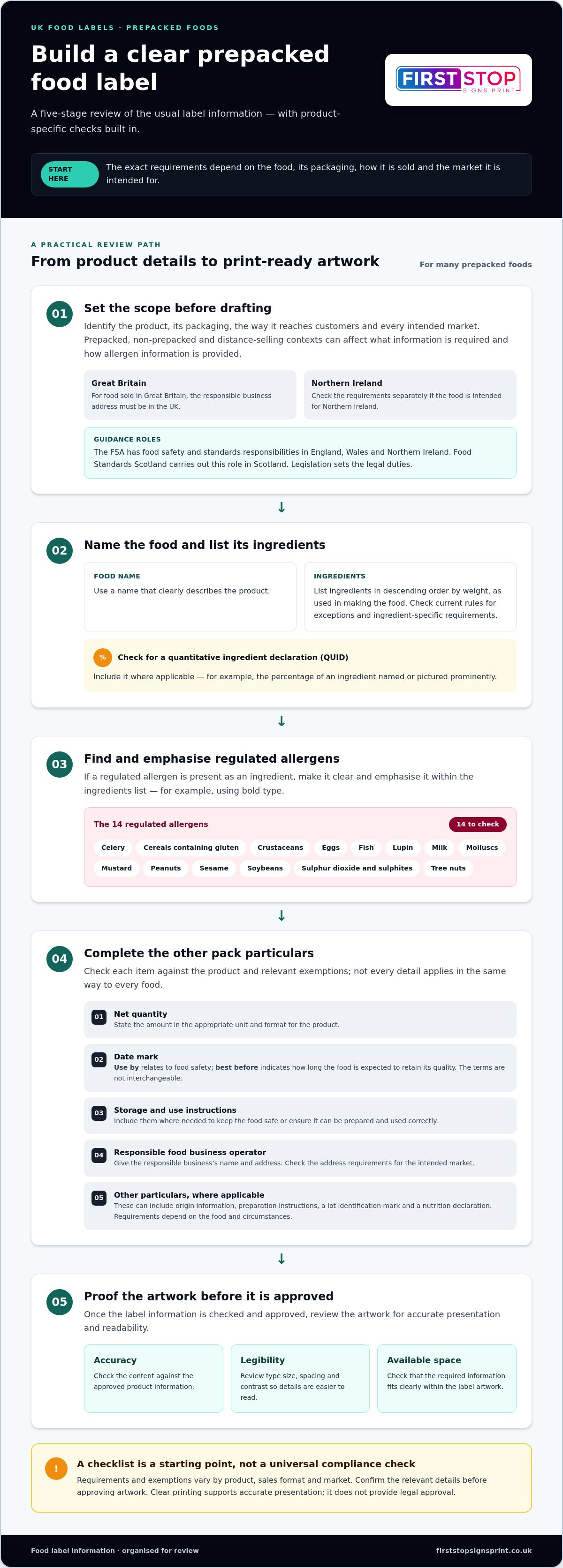
Use this checklist to organise the information for a prepacked food label. It answers the common question “what information is required on food labels uk 2026”, but it isn’t a substitute for checking the rules for the specific product and market. GOV.UK’s UK food labelling rules provide a practical reference.
- Name of the food: Use a name that clearly describes the product.
- Ingredients: List ingredients in descending order by weight, as used in making the food. Include any applicable quantitative ingredient declaration (QUID), such as the percentage of an ingredient named or pictured prominently.
- Allergens: Where present, make regulated allergens clear and emphasise them within the ingredients list, for example in bold type.
- Net quantity: State the amount of food in the pack using the appropriate unit and format for the product.
- Date mark: Use a “best before” or “use by” date as appropriate. These terms aren’t interchangeable.
- Storage and use instructions: Include them where needed to keep the food safe or ensure it can be prepared and used correctly.
- Food business operator details: Give the responsible business’s name and address. For food sold in Great Britain, the address must be in the UK. Check the requirements separately for Northern Ireland.
- Other particulars, where applicable: These can include origin information, preparation instructions, a lot identification mark and a nutrition declaration. Whether each is needed depends on the food and circumstances.
How should ingredients and allergens appear?
Ingredients are generally listed by weight in descending order, so the ingredient used in the greatest amount appears first. Check the current rules for exceptions and ingredient-specific requirements. The 14 regulated allergens are celery, cereals containing gluten, crustaceans, eggs, fish, lupin, milk, molluscs, mustard, peanuts, sesame, soybeans, sulphur dioxide and sulphites, and tree nuts. If one is present as an ingredient, it must be clearly emphasised in the ingredients list.
Which dates, quantities and business details belong on-pack?
A “use by” date relates to food safety, while “best before” indicates the date until which food is expected to retain its quality. Net quantity tells customers how much food the pack contains. Date-marking and lot-marking rules have exceptions, so check how they apply to the product instead of assuming every pack needs the same format.
For many prepacked foods, the usual checklist covers the food name, ingredients and allergens, net quantity, date mark, relevant storage or use instructions, responsible business details and nutrition information, subject to product-specific rules and exemptions. Once the content is approved, bespoke food label printing can bring it together in organised artwork. Printing supports the presentation of approved information; it doesn’t provide legal approval.
When food label requirements change: allergens, claims and sales format
The answer to “what information is required on food labels uk 2026” can change with the way a food is packaged and sold. Allergen information remains essential, but its format and timing depend on the sales context. Use this comparison as a guide, then check the relevant rules for your business model.
| Sales format | What to focus on |
|---|---|
| Prepacked | Provide the required particulars on the packaging. For food packed for direct sale (PPDS), Natasha’s Law requires a full ingredients list with regulated allergens emphasised. |
| Non-prepacked | Provide allergen information for the food. It may be communicated in different ways, but written information is encouraged as good practice. |
| Distance selling | Make required information, particularly allergen details, available before purchase, and provide the required information with the food at delivery. The precise requirements depend on the food and sales arrangement. |
What changes for non-prepacked food and online sales?
For non-prepacked food, such as meals sold loose at a counter, allergen information still needs to reach the customer. Food Standards Agency guidance strongly encourages providing this information in writing rather than relying only on verbal communication. Clear written details can help customers make an informed choice and staff give consistent answers.
Online orders need a separate check. For prepacked food sold at a distance, required information generally needs to be available before the customer completes the purchase, with the durability date allowed to be provided at delivery. All required particulars must be available by delivery. For non-prepacked foods, allergen details need to be available before purchase and when the food is delivered. Review the Food Standards Agency guidance for the specific channel and product.
Do food claims or product categories need extra checks?
Yes. Nutrition and health claims, such as “high in fibre” or a statement linking a food to a health benefit, can trigger additional rules. Check that each claim is permitted and supported before adding it to artwork. An origin statement can also require further information, particularly if it might give customers a misleading impression or the primary ingredient comes from elsewhere.
Nutrition declarations have exemptions for some foods and circumstances, but don’t assume a product qualifies without checking. Supplements, alcoholic drinks and other specialist categories can have tailored requirements. Confirm the rules for the actual product and intended UK market before finalising the label. The checklist for ordinary prepacked food may not cover every detail.
How to proof a food label for readability and accuracy
A careful proof turns approved product information into artwork that customers can read and your team can reproduce accurately. Keep content approval separate from design approval: a polished layout doesn’t establish that the label meets legal requirements.
How can businesses keep mandatory information clear on-pack?
Give key particulars a clear visual order. Use legible type, strong contrast and logical grouping, and keep decorative graphics away from essential wording. Check the layout at its actual printed size and on the finished pack, including across folds, seams or curved surfaces. Text that looks clear on a large screen can become difficult to read once reduced or wrapped around packaging.
For many prepacked foods, mandatory particulars must meet a minimum x-height of 1.2 mm. A reduced 0.9 mm minimum applies where the largest surface area of the packaging is under 80 cm². These rules can have exceptions and product-specific conditions, so verify the applicable threshold and any special format against current guidance for the intended market. A design preference doesn’t replace the legal minimum.
What should the final artwork proof check include?
Use a numbered review so each check has a clear place in the approval process:
- Lock the product specification. Work from the current approved recipe, product description, pack dimensions and sales channels.
- Check the content. Compare ingredient wording and allergen emphasis with the specification. Review any applicable quantities, dates, storage directions, operator details, origin statements and claims.
- Confirm market wording. Check the requirements for Great Britain or Northern Ireland, as relevant, and make sure the correct label version is being prepared.
- Inspect the design at size. Review legibility, contrast, hierarchy and available space. Make sure no required wording is hidden by artwork, folds or other pack features.
- Approve and record the proof. Record who approved the final content and which product or recipe version it represents. Keep the approved file distinct from earlier drafts.
Finally, compare the proof with the physical product and finished packaging, not just the digital file. If an ingredient, recipe, claim or sales route changes, reassess the label before reprinting. Food label printing can reproduce approved artwork, but it cannot replace a legal review of the information.
Prepare approved artwork for production with professional food label printing.
From compliant information to professionally printed food labels
Once the product information has been checked against current requirements, follow a clear production sequence: confirm the product facts, verify the rules for the intended market, approve the artwork, then print. This keeps content decisions separate from design and production, and helps prevent an outdated draft from being printed.
What information should be ready before label production?
Prepare a single approved content file for the specific product and pack. It should include the final product name, recipe and ingredient list, allergen data, and nutrition information where required. Add verified food business operator details, net quantity, date and storage information, and any preparation instructions, origin wording or claims that apply.
Record the intended pack format and sales market too. A label for one product version or market may not suit another. If the recipe, pack size, sales channel or destination changes, review the information again before approving revised artwork. For anyone asking what information is required on food labels uk 2026, the answer must be applied to the actual product and how it will be sold.
How can a print partner support the finished label?
With the wording approved, a commercial print partner can help turn it into organised artwork. A clear content hierarchy helps customers locate key information, while considered spacing and legible type give ingredients, allergens and other particulars room to be read. Proofing the artwork at its intended size can reveal layout issues before production.
First Stop Signs Print provides bespoke commercial label and packaging printing using customer-approved information. The printer’s role is to produce the artwork, not to decide whether the food complies with labelling law or to approve product claims. Those decisions remain with the responsible food business.
When your content has been reviewed and the final artwork is ready, commercial food label printing can bring your packaging design into print.
Take the next step towards print-ready food labels
A dependable label starts with accurate product information, not a template copied from another product. The answer to what information is required on food labels uk 2026 depends on the food, its packaging, how it’s sold and whether it’s intended for Great Britain or Northern Ireland. Use the standard checklist as a starting point, then verify product-specific rules, exemptions and claims against current guidance.
Before printing, compare the final artwork with the approved recipe and product details. Check allergen emphasis, date and quantity information, market wording and readability at the actual size. A clear information hierarchy helps customers find what they need, while a final content review can help prevent outdated or incorrect details from reaching print.
First Stop Signs Print provides commercial label and packaging printing using customer-approved information. Printing can bring a carefully organised design to life, while legal review of the label content remains separate. With a considered process, you can move forward with clear, well-presented labels that give your product the visibility it deserves.
Frequently Asked Questions
What information is legally required on a food label in the UK?
For many prepacked foods, required particulars include the food’s name, ingredients, emphasised regulated allergens, net quantity, an appropriate date mark, storage instructions where needed, the responsible food business operator’s name and address, and a nutrition declaration. Origin, preparation instructions and other details may also apply. The exact answer to “what information is required on food labels uk 2026” depends on the product, packaging, sales method and intended UK market, so check current guidance before approval.
Do all food products need an ingredients list?
No. Some foods are exempt from the ingredients-list requirement, but the exemption depends on the food and how it is presented or sold. Don’t assume a short ingredient list or a single-ingredient product automatically qualifies. Prepacked for direct sale (PPDS) food has a specific rule: it must carry a full ingredients list with regulated allergens emphasised. Check the current requirements for the exact product and sales format before preparing label artwork.
How many allergens must be declared on a UK food label?
UK food information rules identify 14 regulated allergens: celery, cereals containing gluten, crustaceans, eggs, fish, lupin, milk, molluscs, mustard, peanuts, sesame, soybeans, sulphur dioxide and sulphites, and tree nuts. For prepacked food, allergens present as ingredients must be emphasised in the ingredients list so they stand out clearly. Allergen information is also essential for non-prepacked food, although how it is provided can depend on the sales context.
Is a nutrition declaration required on every food label?
No. A nutrition declaration is generally required on prepacked food, but exemptions apply to certain foods and circumstances. Whether an exemption covers a particular product depends on its type, presentation and other details, so verify rather than assume. If a nutrition or health claim appears on the pack, extra requirements may apply even where an exemption would otherwise be relevant. Check the claim and nutrition information against current rules before approving the label.
What happens if food is sold online or without packaging?
Requirements depend on the food and sales arrangement. For distance sales, certain information, including allergen details, generally needs to be available before purchase, with required particulars also provided by delivery. For non-prepacked food, allergen information must reach customers; written information is encouraged as good practice. PPDS food, such as food packed on the same premises before a customer selects it, needs a full ingredients list with regulated allergens emphasised.
Can I use the same food label across Great Britain and Northern Ireland?
Don’t assume one label is suitable for both markets. Check Great Britain and Northern Ireland requirements separately for the product and the date it will be sold. For food sold in Great Britain, the responsible food business operator’s address must be a UK address. Review the full label, including operator details and any market-specific wording, against current official guidance before using the same artwork in both locations.
What is the difference between a best-before date and a use-by date?
A “use by” date relates to food safety and is used for foods that can become unsafe to eat after that date, even if they look or smell fine. A “best before” date concerns quality: after it, the food may not be at its best, but that doesn’t automatically mean it is unsafe. Choose the appropriate date mark for the product and follow relevant storage instructions.


