
A distinctive sticker shape can make your branding more noticeable, but an unclear cut or cramped artwork can leave the result looking untidy. If you’re considering die cut sticker printing london, start by thinking about where the sticker will be used and what it needs to communicate.
Die-cutting means trimming a sticker to follow the outline of its design rather than using a standard square or circle. The artwork and cut need to work together: a shape that looks clear on screen may lose detail when printed small. A practical brief helps you decide what to simplify and gives the finished sticker a polished, intentional look.
This guide covers how die-cut stickers differ from other formats, what to include in a print brief and how to prepare artwork for a clean result. First Stop Signs Print provides commercial printing, including labels and packaging, alongside design and production support to help London businesses create branded print materials.
Key Takeaways
- Choose an outline that supports your logo or artwork, rather than adding complexity without a clear purpose.
- Consider the artwork, cut path, finished size and application together so the sticker suits its intended use.
- Compare standard, die-cut and kiss-cut formats, including whether the backing should be cut through or left intact as a sheet.
- Build a useful print brief with the purpose, final artwork, dimensions, quantity and application details.
- For die cut sticker printing london, a clear brief and tailored design-to-production support help turn business artwork into a considered printed result.
What is Die-Cut Printing for London Businesses?
Die-cut stickers follow a custom outline instead of a standard shape such as a rectangle or circle. The edge can trace a logo, illustration or other piece of artwork, making the sticker’s shape part of its visual identity. For businesses considering die cut sticker printing london, decide what the sticker needs to do before settling on its outline.
The cut path is the line that defines the sticker’s outer edge. It needs to work with the design: if it follows too many tiny details, the finished silhouette may look busy or unclear. Review the artwork at its intended size and consider where it will be applied. This makes it easier to see whether the main features will still read clearly in print.
How is a die-cut sticker different from a standard sticker?
A standard sticker is commonly supplied in a familiar format, such as a square, rectangle or circle. A die-cut sticker is trimmed around a custom design, so its edge can echo a brand mark or illustration. The shape is part of the presentation, not just a picture printed on a standard sticker. The artwork and agreed cut path define the outline, so check that the important details remain clear at the finished size.
Where can London businesses use custom-shaped stickers?
Custom shapes can help businesses carry a consistent visual identity across products and customer touchpoints. An independent shop might use a logo-shaped sticker on a paper bag, while a food business could add a branded design to suitable packaging. Event organisers may use illustrated stickers on handouts, and small businesses can include them with orders or promotional materials.
In each case, the outline should help people recognise the design rather than make it harder to understand. A simple silhouette can keep a logo legible on a small package, while a detailed illustration may need simplifying before it becomes a cut shape. Consider where the sticker will appear, what it needs to communicate and how it fits with your existing branding. For broader context on choosing and using printed stickers, read this guide to professional vinyl sticker printing.
First Stop Signs Print provides commercial printing for London businesses, including labels and packaging, with design and production support. Share the artwork and intended application as part of the brief so the design and print requirements can be considered together.
How the Cut, Artwork and Intended Use Shape the Finished Sticker
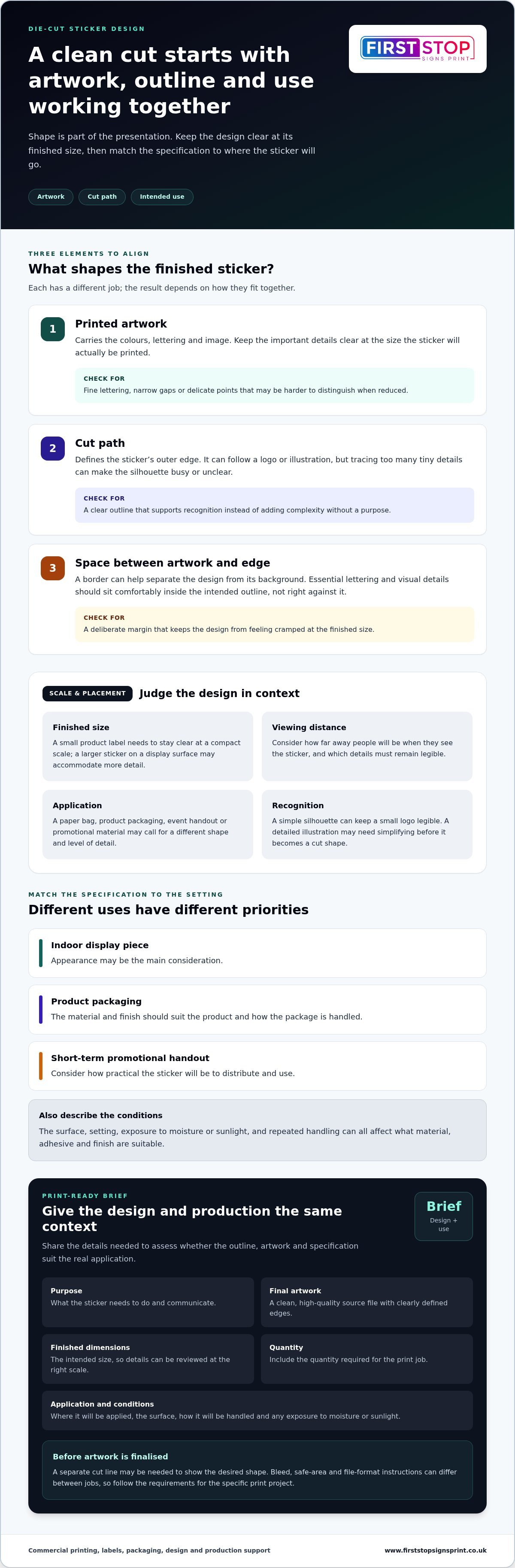
A clean die-cut result depends on three elements working together: the printed artwork, the cut path and the space between them. The artwork carries the colours, lettering and image; the cut path defines the outer edge. A border can help separate the design from its background, but it needs to be considered alongside the artwork and cut rather than added as an afterthought.
Size and placement matter too. A logo for a small product label needs to remain clear at that scale, while a larger sticker on a display surface may accommodate more detail. Fine lettering, narrow gaps and delicate points can become harder to distinguish when reduced. Before finalising the design, think about where the sticker will be applied, how far away it will be viewed and which details must remain legible.
What artwork should you prepare for a die-cut sticker?
Start with a clean, high-quality source file and artwork with clearly defined edges. Keep essential lettering and visual details comfortably inside the intended outline instead of placing them right against the edge. The print workflow may require a separate cut line to show the desired shape. Bleed, safe-area and file-format instructions can differ between projects, so follow the requirements for the specific print job rather than assuming one set of settings applies to all artwork.
Share the final design with the intended finished size and application. This context helps assess whether the outline suits the artwork and whether the key details are likely to stay clear when printed.
How should the sticker’s use guide its specification?
Think about the conditions the sticker will encounter before choosing its material, adhesive and finish. An indoor display piece, a label on product packaging and a short-term promotional handout have different priorities. Appearance may be the main consideration for a display piece; packaging needs to suit the product and how it is handled; a handout should be practical to distribute and use.
Consider the surface as well as the setting. A smooth package, a frequently handled item and a temporary event display can call for different specifications. Exposure to moisture, sunlight or repeated handling may also affect what is suitable. Describe these conditions in your brief so the material and finish can be considered for the real application, rather than assuming one option will suit every job.
For die cut sticker printing london, First Stop Signs Print brings design requirements and commercial print production together. To start shaping a project brief, explore tailored printing support and share the artwork, dimensions and intended use.
Die-Cut, Kiss-Cut or Standard Shape: Which Sticker Format Fits?
The right format depends on how the sticker will be presented and used. A custom outline can make a brand mark feel distinctive, but it isn’t automatically the best choice. If the shape adds little meaning or recognition, a standard format may be simpler and just as suitable.
| Format | How it’s cut | Useful for |
|---|---|---|
| Standard shape | A familiar outline, such as a square, rectangle or circle. | Designs that sit comfortably within a regular border, including straightforward labels and information stickers. |
| Die-cut | The sticker and its backing are cut to follow a custom outline. | Logos, illustrations or other designs where the silhouette is part of the visual identity. |
| Kiss-cut | The sticker layer is cut, whilst the backing sheet remains intact around it. | Stickers supplied on a backing sheet, which can make them easier to handle or present as part of a set. |
When is a die-cut outline worth choosing?
Choose die-cutting when the outline is central to the design. A logo with a distinctive, recognisable shape may feel more coherent when the sticker edge follows its silhouette. A custom edge can also help an illustrated design stand apart from a plain rectangular format.
Make sure the custom shape adds something. If the design is mostly text, or the edge does little to improve recognition, a standard rectangle or circle may be a more direct fit. For die cut sticker printing london, start with the message and application, then choose the format that supports them.
How do kiss-cut and die-cut stickers differ?
The key difference is what happens to the backing. With a die-cut sticker, the cut follows the custom outline through the sticker and backing. With a kiss-cut sticker, only the sticker layer is cut, leaving the surrounding backing sheet intact. That backing can provide a border around the design and keep it on a sheet until it is peeled away.
Think about distribution as well as appearance. Individual die-cut stickers can suit handouts or packaging inserts where each one is given out separately. Kiss-cut stickers may suit a sheet presentation, such as a selection of designs offered together. A standard shape is practical when a familiar border meets the brief. Match the cut to the artwork and the way people will receive, peel and apply the sticker.
How to Prepare a Print-Ready Brief for Die-Cut Stickers
A useful print brief connects the design to the job it needs to do. Share the final artwork and intended use together so the size, cut style and production choices can be considered in context. For die cut sticker printing london, that preparation helps turn an initial idea into a clear specification.
What information belongs in a sticker-printing brief?
Use this checklist to gather the details that shape the project. If you’re unsure about a technical choice, describe the requirement instead of guessing at a specification.
- Purpose: Explain whether the stickers are for product branding, packaging, an event or a promotion.
- Artwork: Supply the final design, brand colours and essential wording. Identify details, such as small text or a logo feature, that must stay clear.
- Dimensions and cut: Give the preferred finished size and say whether you have a standard, die-cut or kiss-cut format in mind.
- Quantity: State how many stickers you need for the planned use.
- Application: Describe the surface, setting and expected handling. A sticker for indoor display may have different requirements from one applied to product packaging or handed out at an event.
This context helps connect the visual design to the material and adhesive choices suited to its application. For design principles that also apply to printed graphics, see this guide to practical sign design guidance, including contrast and legibility.
How should you review artwork before production?
Before sending artwork, check spelling, logo proportions, image clarity and the intended cut outline. View the design at its planned size, not just enlarged on screen. Small lettering or fine details that look clear when zoomed in may be harder to read on a compact sticker.
A separate cut line may be needed, and instructions for bleed, safe areas and file formats depend on the print brief. Follow the requirements for the job instead of relying on generic settings. Where a proof or visual representation is included in the agreed process, review the outline, placement and wording before production.
First Stop Signs Print provides design support and commercial printing for business requirements. Share your sticker design brief, including the intended use, dimensions and quantity, to begin planning the project.
Order Bespoke Die-Cut Sticker Printing in London with First Stop Signs Print
A clear brief is the starting point for a considered custom sticker project. First Stop Signs Print works with London businesses on commercial printing, including labels and packaging, bringing design requirements and production together. Explain what the stickers need to achieve, where they’ll be used and how the artwork should appear so these details can shape the print specification.
What to expect from a bespoke print project
Start with the intended application and the outcome you want. A sticker for a product, an item of packaging or a promotional handout has a different role, so the design and specification should reflect its setting. Include the final artwork, preferred cut style, dimensions and required quantity, along with details about the surface and expected handling.
The brief then helps guide production choices. Material, adhesive and finish should be considered in relation to the application instead of assumed to be standard choices. This keeps the focus on a finished sticker that suits its purpose and represents your business clearly. First Stop Signs Print’s commercial print and label services support business requirements from design through production.
How can stickers support a consistent London brand identity?
Stickers can carry the same visual cues across different customer touchpoints. Repeat your approved logo, colours and clear messaging on product labels, packaging and promotional print so each item feels connected to the wider identity. Consistency doesn’t mean every design has to be identical; it means the choices work together and remain recognisable.
Consider how printed materials sit alongside your physical brand presence, too. For ideas on maintaining a joined-up identity across these touchpoints, explore bespoke business sign ideas. With die cut sticker printing london, careful attention to brand details can help a custom outline feel like a natural part of your packaging and promotional materials.
To discuss a print project, share your sticker brief with First Stop Signs Print, including the artwork, intended use and key requirements.
Turn Your Sticker Idea into a Clear Print Brief
A distinctive outline works best when it supports the design and the sticker’s intended use. Before you start die cut sticker printing london, decide whether a custom shape adds useful recognition or whether a standard or kiss-cut format better suits how the stickers will be distributed. Then bring the final artwork, dimensions, quantity and application details together in one brief.
Let the artwork and application guide the specification. Clear lettering, considered colour choices and an outline that complements the design all contribute to a polished result. First Stop Signs Print supports London businesses with commercial printing, including labels and packaging, and provides design and production support.
Ready to move from concept to print? Share your die-cut sticker brief with First Stop Signs Print, including what the stickers need to do and where they’ll be used.
Frequently Asked Questions
What does die-cut sticker printing mean?
Die-cut sticker printing produces a sticker cut to a custom outline, often following a logo, illustration or other artwork. The cut is planned around the design rather than limited to a standard rectangle or circle. The finished result depends on the artwork, specification and production setup. For die cut sticker printing london, provide a clear brief explaining what the stickers are for and where you intend to use them.
What is the difference between die-cut and kiss-cut stickers?
A die-cut goes through both the sticker and its backing, following the chosen outline. A kiss-cut cuts the sticker layer but leaves the backing sheet intact around it. The surrounding backing can help present stickers together on a sheet or make them easier to handle individually. Choose between the formats based on how you plan to distribute, peel and apply the stickers.
Can I have stickers cut to the shape of my logo?
Yes. A logo can provide the outline for a custom-shaped sticker when the artwork is prepared for production. Share the design, desired finished size and intended application. Clear shapes and readable details help communicate the intended result and guide the artwork and cut requirements.
What file format should I use for die-cut sticker printing?
The right file format depends on the design and the production requirements for the job. Vector artwork can be useful for logos and defined shapes, while high-quality raster artwork may suit other designs. Follow the artwork instructions for your print brief and make the intended cut outline clear so it can be considered alongside the design.
Are die-cut stickers suitable for outdoor use?
Outdoor suitability depends on the sticker’s material, adhesive and finish, as well as the conditions it will face. Sunlight, moisture, temperature changes and regular handling may affect performance. Describe the application surface, exposure and how long the sticker needs to remain in place when preparing your brief. Choose a specification for those real-world conditions rather than judging suitability by appearance alone.
How do I choose between a standard shape and a custom die-cut sticker?
Choose a standard shape if its simple outline suits the design and application. Consider a custom die-cut when the silhouette is an important part of the artwork or brand presentation, such as a logo with a recognisable profile. Compare how each format will look, peel and be distributed. Custom cutting isn’t automatically better; let the sticker’s purpose guide the choice.
Can a print company help prepare sticker artwork?
Design and production support can help shape a sticker project around its intended use. First Stop Signs Print provides design support and commercial printing, including labels and packaging. Share your logo or artwork, preferred size, cut style and application so the requirements are clear from the outset. The project brief can then guide artwork preparation and production details for your business stickers.


