
A stunning packaging design counts for nothing if your print peels under shower steam, dissolves against botanical oils, or triggers an audit from Trading Standards. Sourcing durable cosmetic product labels uk beauty businesses can depend on requires balancing tactile luxury with the strict legal demands of assimilated UK cosmetic safety legislation.
You've poured months into refining your formulations, so it's deeply frustrating when bubbling stickers, smudged INCI lists, or ambiguous address rules threaten your brand reputation. You shouldn't have to choose between flawless legal compliance and high-end shelf appeal. This guide outlines how to select durable, oil-proof, and fully compliant packaging tailored to Great Britain's retail and regulatory standards. From mandatory Article 19 requirements to selecting the right waterproof vinyls, flexible tube films, and protective laminates, we'll help you dress your jars, bottles, and containers with confidence.
Key Takeaways
- Master the essential Article 19 regulatory checklist, from mandatory UK Responsible Person details to INCI formatting, ensuring your packaging satisfies Trading Standards.
- Discover how to specify resilient cosmetic product labels uk brands rely on to resist hot water, sebum, and essential oils without peeling or smudging.
- Compare roll labels and sheet formats to choose the most efficient workflow for automated machinery or hand-applied boutique batches.
- Prevent label flagging, creasing, and adhesive failure by matching your facestocks directly to challenging container curves and squeeze tubes.
- Learn how local UK pre-press auditing guarantees razor-sharp micro-text legibility and luxury colour fidelity across every production run.
UK Cosmetic Labelling Regulations: Mandatory Information Checklist
Creating legal, market-ready packaging in Great Britain means meeting the strict standards of the UK Cosmetics Regulation, enforced by the Office for Product Safety and Standards (OPSS) alongside local Trading Standards. Whether you run an artisan skincare studio or manage a commercial beauty brand, statutory requirements don't change based on production volume. Non-compliant packaging risks immediate stock seizures and costly product recalls. Sourcing compliant cosmetic product labels uk regulations demand is your primary operational defence.
To ensure your formulations and packaging designs stay fully compliant before you head to print, watch this helpful breakdown:
Mandatory Legal Fields for British Cosmetic Packaging
Every primary container and outer carton must display key statutory details in indelible, easily legible English:
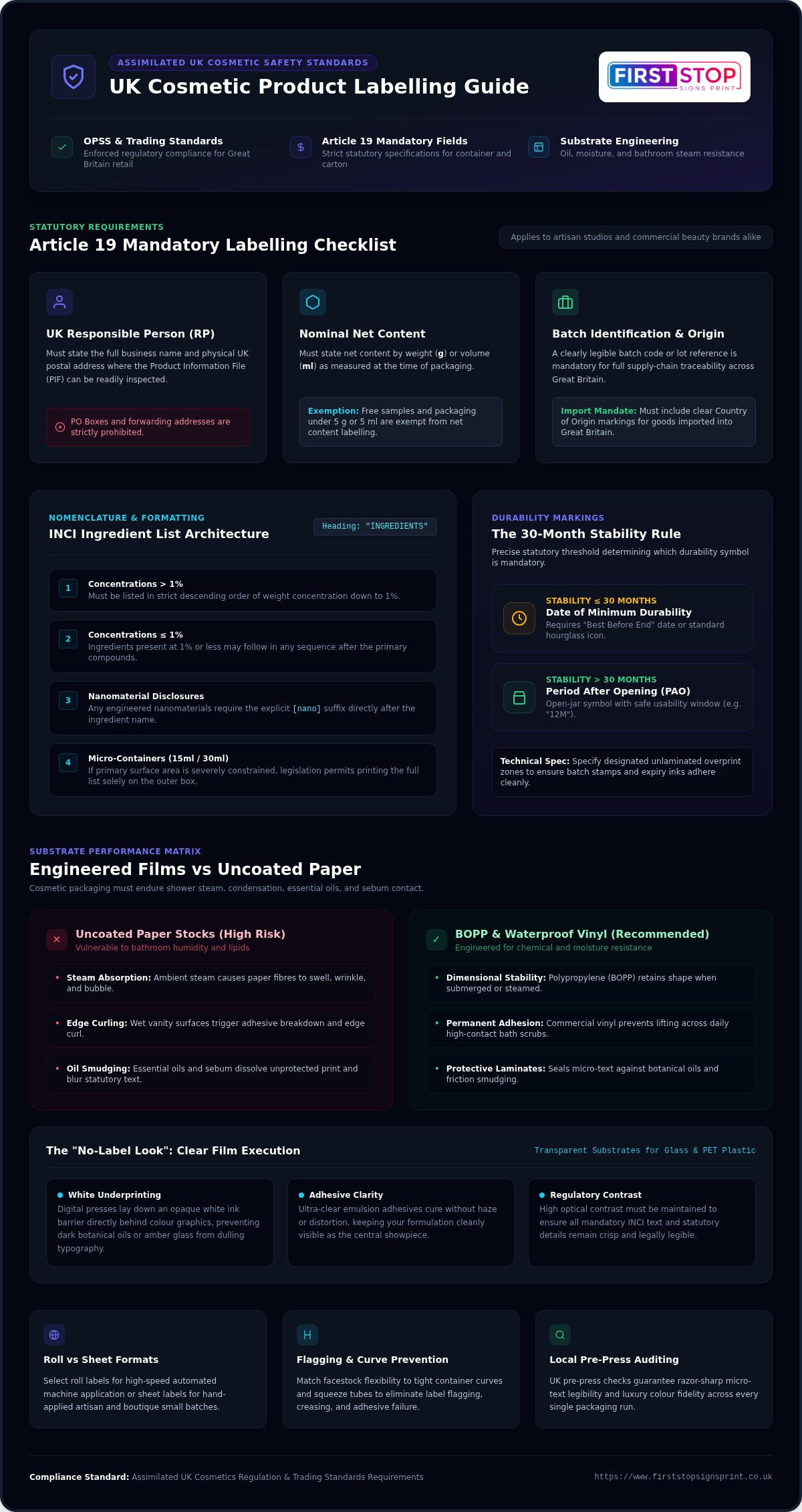
- UK Responsible Person (RP): The full business name and physical UK postal address where the Product Information File (PIF) can be readily inspected. PO boxes and forwarding addresses are strictly prohibited.
- Nominal Net Content: Stated by weight (g) or volume (ml) at packaging time, except for free samples or containers under 5 g or 5 ml.
- Batch Identification: A legible batch code or lot reference alongside clear country of origin markings for products imported into Great Britain.
INCI Ingredient Lists and Micro-Text Typography
Formulations must appear under the heading "INGREDIENTS" using the standardised International Nomenclature of Cosmetic Ingredients (INCI) system. List compounds in descending order of weight concentration down to 1%; ingredients present at 1% or less may follow in any sequence. Any engineered nanomaterials require the explicit [nano] suffix. When labelling compact 15ml eye creams or 30ml droppers, high-definition digital printing is essential to prevent microscopic lettering from bleeding together. If surface area is severely constrained, UK legislation permits printing the full ingredient list solely on the outer box.
Durability Markings: PAO Symbols versus Expiry Dates
Durability labels depend on a precise 30-month stability threshold. If your product's total shelf life is 30 months or less, your label must display a Date of Minimum Durability (a Best Before End date or hourglass icon). If stability exceeds 30 months, print the open-jar Period After Opening (PAO) symbol showing safe usability in months (such as "12M"). Always specify designated, unlaminated overprint zones so your batch stamps and expiry codes adhere cleanly during production.
Choosing the Best Materials and Finishes for Cosmetic Packaging
Skincare and personal care products present harsh physical environments for packaging. Between shower humidity, bathroom condensation, and daily contact with lipid-rich oils, selecting the right material is vital. Producing durable cosmetic product labels uk shoppers trust requires moving past standard stationery stocks and investing in engineered print substrates built for chemical resistance.
Synthetic Films versus Paper Labels in Humid Environments
Uncoated paper labels absorb ambient steam, causing fibres to swell, wrinkle, and peel. Polypropylene (BOPP) and waterproof vinyl provide dimensional stability, meaning they won't bubble or lift when submerged in water or stored on wet vanity counters. Investing in commercial vinyl sticker printing delivers permanent moisture protection for high-contact cleansers and bath scrubs, preventing unsightly edge curl over the life of the product.
The "No-Label Look": Clear Film Labels for Bottles and Jars
Transparent film substrates create a sleek, modern visual where graphics appear applied directly onto glass or PET plastic. To execute this properly:
- White Underprinting: Digital presses lay down an opaque white ink barrier directly behind colour graphics, preventing dark botanical oils or amber glass from dulling your typography.
- Adhesive Clarity: Opt for ultra-clear emulsion adhesives that cure without haze, ensuring your formulation remains the visual centrepiece.
- Regulatory Legibility: Confirm that contrast remains crisp enough to satisfy statutory OPSS guidance on cosmetic products in Great Britain, keeping mandatory legal copy fully readable against varied product colours.
Lamination and Protective Coatings for Chemical Resistance
Active lipids, surfactant blends, and alcohol bases act as industrial solvents against exposed digital inks. Without a protective barrier, a single drop of cleansing oil running down the neck of a bottle can dissolve your batch codes and graphics. Applying a robust overlaminate shields your design permanently:
- Gloss Laminates: Provide maximum chemical repellence, high colour saturation, and an easy-wipe surface ideal for liquid soaps.
- Matte and Soft-Touch Finishes: Offer a tactile, velvety feel that diffuses light, delivering understated luxury for premium facial serums.
- Spot Varnishes and Foils: Highlight brand logos with raised gloss textures or metallic foil accents without compromising the protective synthetic base.
If you need help selecting resilient substrates for an upcoming product launch, exploring the options available through First Stop Signs Print label printing offers direct access to durable, beauty-grade finishes crafted in the UK.
Roll Labels versus Sheet Labels: Selecting the Right Format
Deciding between sheet and roll formats isn't just an inventory choice; it directly impacts your production speed, labour overhead, and final container alignment. Hand-sticking labels on a dozen test jars feels straightforward. Scaling up to hundreds of retail-ready units is an entirely different challenge. Specifying the correct format for your cosmetic product labels uk orders ensures your packaging line runs smoothly without costly line stops or wasted stock.
When to Choose Sheet Labels for Boutique Skincare
Sheet labels remain the practical choice for micro-batch releases, limited seasonal runs, and promotional gift sets. If you apply labels by hand across varied jar diameters, flat sheets store neatly in standard studio drawers without requiring dedicated mechanical reels. They give emerging creators the agility to test new skincare formulations without committing to the mechanical setup parameters required for automated machinery.
Transitioning to Roll Labels for Automated Dispensing
Manual application quickly becomes a bottleneck once production batches grow beyond 500 units. Hand placement often introduces human error: crooked angles, mismatched heights across shelf displays, and micro-bubbles that compromise visual polish. Continuous rolls feeding into semi-automatic or benchtop label applicators solve this instantly. Machines apply uniform tension, ensuring identical placement across every cylindrical bottle while keeping your team focused on filling and quality control.
Specifying Unwind Direction and Core Diameters
Mechanical applicators require precise reel specifications to operate without jamming. Missing these details during the pre-press stage leads to inverted branding or backwards application. Always verify these core technical parameters with your packaging engineer:
- Core Diameter: Ensure your roll core matches your machine spindle. Standard commercial applicators typically require 25mm, 38mm, or 76mm cardboard cores.
- Unwind Orientation: Applicator sensors require specific lead edges. Whether your system needs top-edge first, bottom-edge first, or right-edge leading, matching your artwork orientation is vital.
- Outer Roll Diameter: Confirm the maximum roll diameter your dispenser can mount without straining the feed motor or causing web drag.
- Regulatory Alignment: Uniform machine feeding ensures statutory markings mandated under Article 19 of the UK Cosmetics Regulation land in consistent, visible positions on the primary container rather than wrapping awkwardly into seams or recesses.
Consulting your print team before sending artwork to press prevents adhesive bleed and roll jamming, keeping your packaging run clean, efficient, and retail-ready.
Container Compatibility: Adhesion, Ergonomics, and Shape Engineering
A label can look stunning in flat artwork proofs yet fail entirely once wrapped around a curved container. Real-world cosmetic packaging involves tight radii, flexible walls, and varied surface energies. Securing reliable cosmetic product labels uk brands can trust requires engineering the adhesive, substrate, and cut geometry to your specific container physics.
Adhesive Selection for Difficult Packaging Surfaces
Different materials interact with adhesives in radically distinct ways. High-surface-energy containers like glass and coated aluminium bond readily with standard permanent acrylic emulsions. Low-surface-energy plastics, particularly High-Density Polyethylene (HDPE) and untreated polypropylene, act like non-stick frying pans. They resist adhesive wetting, causing edges to lift over time. To avoid failure:
- High-Tack Emulsions: Deploy high-initial-grab acrylics to bite into slick plastic surfaces without oozing under pressure.
- Flagging Prevention: Eliminate edge-lift on narrow 10ml to 30ml dropper vials by leaving a deliberate 2mm to 3mm gap between label ends, rather than attempting a flush edge-to-edge seam.
- Temperature Stability: Confirm the adhesive cures across a broad service window, staying firmly anchored whether placed in a steaming bathroom or a refrigerated beauty display.
Engineering Labels for Squeeze Tubes and Flexible Containers
Applying standard biaxially oriented polypropylene (BOPP) to a squeezable hand cream tube is a recipe for creasing. Rigid films cannot compress. Repeated flexing creates unsightly tunnels and permanent wrinkles along the label face. Flexible low-density polyethylene (LDPE) squeeze tubes demand conformable polyethylene (PE) or vinyl substrates. These supple films flex and rebound smoothly as the customer dispenses product, maintaining a pristine face without delaminating.
Die-Cut Shapes and Ergonomic Jar Lid Accents
Modern cosmetic packaging often relies on multi-label systems to balance branding with mandatory text. Balancing this visual hierarchy follows proven sign design fundamentals: establish clean contrast, guide the consumer's gaze, and maintain harmony between front facings and closures. Round jar tops benefit from custom circular lid stickers showcasing your primary logo, freeing up the perimeter label for compliance details. Incorporating perforated, tamper-evident neck bands provides immediate visual proof of hygiene that shoppers value on physical retail shelves.
To produce precision die-cut stickers and custom-engineered adhesives matched to your containers, order custom label printing from First Stop Signs Print and ensure your beauty packaging performs reliably from first use to last drop.
Procuring Custom Cosmetic Labels in the UK: First Stop Signs Print Solutions
Automated online print portals often treat cosmetic packaging like generic stationery. Uploading complex regulatory artwork into an unmonitored digital queue leaves your brand vulnerable to font substitutions, unreadable micro-copy, and costly compliance rejections. Partnering with a dedicated UK print workshop bridges the gap between digital design files and flawless physical presentation on the retail shelf. Sourcing high-grade cosmetic product labels uk manufacturers rely on requires hands-on pre-press diligence alongside commercial-grade machinery.
Pre-Press File Preparation and Artwork Guidelines
Precision setup prevents printing delays and legibility errors. Before sending packaging files to press, ensure your artwork strictly follows these commercial print benchmarks:
- Colour Mode & Resolution: Build all files in CMYK colour space at a minimum of 300 DPI to prevent colour shift and pixelation.
- Bleed & Safety Margins: Include an exact 2mm bleed allowance around all outer cut lines, keeping critical text 2mm inside the trim line.
- Vector Outlines: Convert all micro typography, PAO symbols, and INCI text to vector outlines. This step completely eliminates unexpected font corruption during plate processing.
Streamlined Ordering and Bespoke Consultation in London & Essex
Emerging beauty brands shouldn't have to over-order stock simply to clear excessive minimum run requirements. Operating from Romford, First Stop Signs Print provides direct workshop support for commercial label printing across London, Essex, and nationwide. You get bespoke technical guidance tailored to your specific container profiles, custom roll dimensions, and flexible volume needs. Having direct access to experienced print specialists eliminates bureaucratic friction, guaranteeing swift turnaround times and dependable British production quality.
Harmonising Your Cosmetic Brand Identity Across Touchpoints
A luxury customer journey extends well beyond the front of a dropper bottle. Cohesive visual branding requires unifying your label colour palettes with secondary product cartons, mailing packaging, and retail merchandising displays. First Stop Signs Print pairs precision label production with full-scale physical brand solutions. You can easily coordinate your shelf-ready cosmetics with promotional print and high-impact business signs, creating an authoritative physical footprint that commands attention across salon counters, department store concessions, and independent boutiques.
Bring Compliant, Luxury Packaging to Your Beauty Range
Balancing statutory safety compliance with luxury shelf appeal doesn't have to be an uphill battle. Sourcing high-calibre cosmetic product labels uk beauty brands rely on ensures your formulations look exceptional and perform flawlessly under real-world conditions. When you combine durable, moisture-resistant vinyl and synthetic film substrates with precision digital printing technology, even the most intricate INCI ingredient listings remain razor-sharp against hot water, bathroom steam, and botanical oils.
You shouldn't have to navigate technical print parameters or faceless automated online portals alone. Operating from our dedicated production workshop in Romford, First Stop Signs Print provides direct pre-press expertise and dependable delivery across London, Essex, and nationwide. Whether you're launching a boutique serum line or scaling commercial packaging runs, our experienced team ensures your labels fit your containers precisely. Order your bespoke UK cosmetic labels from First Stop Signs Print today and dress your skincare range with unshakeable confidence.
Frequently Asked Questions
What information is legally required on cosmetic product labels in the UK?
UK cosmetic labels must display eight core details: the UK Responsible Person name and physical postal address, nominal net content (by weight or volume), and country of origin for imported goods. You must also include the batch code, product function, precautionary warnings, durability date or open-jar symbol, and a complete INCI ingredient list. PO boxes or mail-forwarding addresses are legally prohibited by Trading Standards and OPSS.
Are waterproof labels strictly necessary for cosmetic and skincare containers?
Waterproof labels are necessary for any product used in bathrooms, showers, or damp environments. Uncoated paper stocks rapidly absorb humidity, leading to bubbling, wrinkling, and peeling. Specifying water-resistant synthetic films like polypropylene (BOPP) or vinyl guarantees your packaging retains its visual appeal and keeps critical safety instructions intact despite continuous exposure to hot water and ambient steam.
What is the minimum legible font size permitted for UK cosmetic ingredient lists?
UK cosmetics legislation mandates that ingredient declarations must be indelible, easily visible, and clearly legible to consumers, rather than specifying a rigid point size. In practical commercial printing, typography should never drop below 4.5pt to 6pt. Sourcing high-resolution cosmetic product labels uk printers produce ensures these miniature characters hold sharp vector edges without fill-in or ink spread.
Can cosmetic product labels resist essential oils, alcohol, and active serums?
Standard printed inks dissolve quickly when exposed to active lipids, surfactants, and alcohol bases. To achieve robust chemical resistance, labels must feature a clear film overlaminate, such as gloss or matte polypropylene. This protective barrier seals the underlying print from direct liquid contact, preventing concentrated facial oils or cleansing gels from stripping your branding and batch codes.
What is the difference between roll labels and sheet labels for cosmetics?
The core difference lies in application workflow and production volume. Sheet labels are cost-effective for micro-batches, seasonal gift sets, and hand-application in small studios. Continuous roll labels are engineered for high-volume automated or semi-automated dispensing machines. Rolls require specific core diameters and unwind orientations to ensure consistent, high-speed application without creasing or skewing on cylindrical bottles.
How do I choose the correct label adhesive for glass versus plastic cosmetic jars?
Your choice depends on the surface energy of the container material. Glass and aluminium offer high surface energy, bonding securely with standard permanent acrylic adhesives. Low-surface-energy plastics like HDPE or flexible LDPE squeeze tubes require aggressive, high-tack adhesives paired with supple polyethylene films. This combination prevents the label edges from lifting or flagging over extended customer use.
What is a Period After Opening (PAO) symbol and when must it be used?
The Period After Opening (PAO) symbol, depicted as an open jar, indicates how many months a cosmetic remains safe for consumer use once unsealed. It is legally required under Article 19 for any cosmetic product with a total shelf life exceeding 30 months. Formulations stable for 30 months or less must display a Date of Minimum Durability instead.


