
The desktop roll printer in your back office might feel like the quickest route to retail shelves, but it often proves to be an expensive bottleneck. When condensation makes inks smear or labels peel away inside commercial chillers, ruined stock quickly eats into your profit margins. If you've spent late nights wrestling with printer jams or worrying about mandatory allergen formatting, you already know the stakes. Securing professional food packaging label printing uk services is essential to protecting your brand, staying compliant, and commanding consumer attention in busy retail aisles.
In this 2026 buyer guide, you'll discover how to select durable, high-impact labels engineered to survive extreme temperatures, moisture, and natural food oils. We compare the hidden costs of in-house printing against commercial production runs, outline vital Food Standards Agency typography rules, and help you identify the specialist adhesives that keep your packaging immaculate from the delivery pallet to the customer's shopping basket.
Key Takeaways
- Understand how high-durability synthetic stocks and cold-tack adhesives protect your packaging from moisture, natural food oils, and extreme freezer cycles.
- Uncover the hidden operational costs of desktop machinery and see how professional food packaging label printing uk solutions prevent downtime and wasted stock.
- Navigate mandatory Food Standards Agency requirements, including statutory allergen typography and minimum font sizing, to safeguard your brand from trading penalties.
- Discover how partnering with an experienced UK print specialist delivers vibrant, retail-ready shelf appeal and reliable application across every product run.
Understanding Food Packaging Label Printing in the UK
Commercial food labelling does far more than list ingredients; it preserves your brand's integrity through demanding supply chains. From bakery goods exposed to natural oils to chilled ready meals subjected to refrigeration condensation, retail food labels face severe environmental stress. Relying on basic desktop machinery often leads to scuffed edges, peeling corners, and faded type. In contrast, professional packaging and labeling systems combine barrier-grade stocks with specialized adhesives, ensuring your product looks pristine from the distribution depot to the domestic kitchen.
British consumers evaluate food quality within seconds of scanning a retail shelf. Crisp typography, vibrant colour reproduction, and tactile finishes communicate authority and food safety immediately. Investing in dedicated food packaging label printing uk services ensures your brand delivers that premium visual impact whilst fully addressing critical operational realities, such as moisture barriers, wipe resistance, and robust tamper evidence.
To see how commercial prepress and engineering bring food packaging to life, watch this step-by-step production overview:
Primary vs Secondary Food Packaging Labels
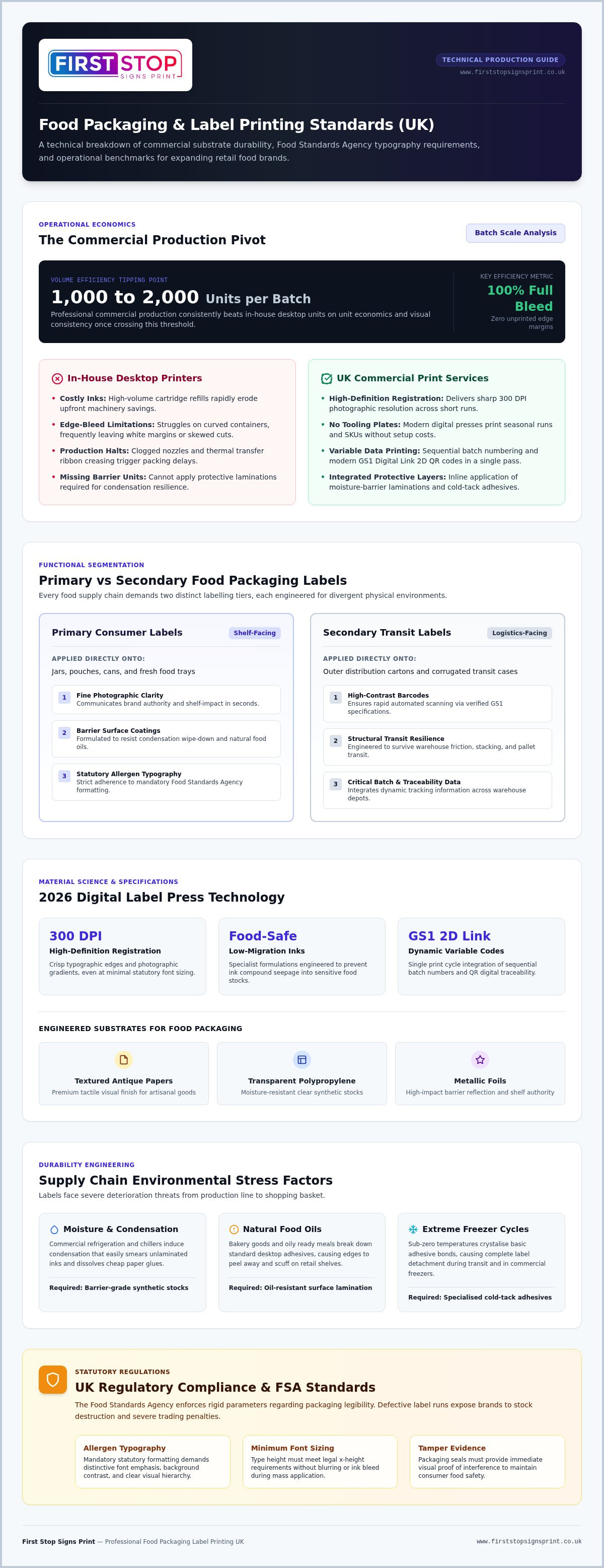
Primary packaging labels sit directly on the consumer-facing jar, pouch, can, or tray. These labels require fine photographic clarity, barrier coatings to resist oils and water, and tight adherence to statutory allergen typography. Secondary labels, applied to outer cartons and corrugated transit cases, prioritise logistic data, high-contrast GS1 barcodes, and structural resilience to survive pallet handling and warehouse transit.
The Evolution of Digital Label Presses in 2026
Modern commercial digital presses have changed food packaging label printing uk by removing costly setup plates. This technology gives expanding producers critical commercial advantages:
- Agile Short Runs: Print bespoke seasonal batches or regional SKU variations without punitive tooling expenses.
- Dynamic Variable Data: Seamlessly integrate sequential batch numbering, production timestamps, and modern GS1 Digital Link 2D QR codes across single print cycles.
- Substrate Versatility: Achieve rich, 300 DPI high-definition registration across textured antique papers, transparent polypropylene, and metallic foils using low-migration, food-safe inks.
In-House Label Printers vs Commercial Print Services
Buying a desktop label printer often seems like the most economical choice for an emerging food producer. The appeal of printing on demand without waiting for external delivery makes hardware catalogues tempting. However, experienced food business operators quickly discover that the purchase invoice represents only a fraction of the real financial commitment. The actual total cost of ownership spirals once you tally replacement pigment cartridges, continuous rolls of blank die-cut media, and the internal staffing hours dedicated to managing finicky desktop units.
Every hour your team spends troubleshooting paper feed jams, running print head cleaning cycles, and aligning margins is an hour taken away from packing orders and growing your business. Desktop inkjets also lack integrated finishing units. If your packaging design requires protective barrier laminations to withstand condensation, in-house machinery simply cannot apply them. When you cross roughly 1,000 to 2,000 units per product batch, professional commercial production consistently beats in-house printing on both unit economics and visual consistency.
Hidden Drawbacks of Desktop Food Label Printers
While tabletop thermal and inkjet printers handle basic variable data, they introduce severe production risks when tasked with high-volume retail labels:
- Costly Proprietary Inks: High-volume desktop cartridge refills quickly erode the initial machinery savings.
- Edge-Bleed Limitations: Consumer desktop gear struggles with full-bleed prints on curved containers, frequently leaving unsightly white margins or skewed cuts.
- Production Halts: Clogged nozzles and thermal transfer ribbon creasing cause costly packaging delays during peak fulfillment periods.
Benefits of Partnering with a UK Commercial Printer
Outsourcing your primary labels to a dedicated print specialist removes capital expenditure and machinery maintenance entirely. Industrial digital label presses deliver uncompromising colour repeatability across multiple batches, ensuring your product range maintains identical shelf branding across every supermarket or farm shop. Commercial production also delivers finished goods on precisely wound machine rolls ready for automated lines, or as cleanly kiss-cut individual sheets for manual application.
Beyond machinery advantages, commercial partners actively audit your production files. Prepress technicians verify that mandatory allergen decks and barcode dimensions comply with official UK food labelling and packaging regulations before a single metre of substrate runs through the press. For expanding companies seeking complete physical retail cohesion, pairing packaging runs with expert sign design ensures consistent brand typography across packaging, display stands, and exterior shop fronts. If you want to streamline production and eliminate costly print errors, exploring bespoke commercial runs with a dedicated label printing partner guarantees retail-grade execution every time.
Substrates and Adhesives Engineered for Food Durability
Selecting the wrong material combination for food containers leads straight to packaging failure. A label that wrinkles when cold, lifts at the corners, or absorbs greasy spills instantly destroys consumer trust on retail shelves. Successful food packaging label printing uk requires balancing face materials, barrier barriers, and chemical adhesives to withstand harsh real-world conditions. Direct and indirect packaging components must align with rigorous food contact materials safety standards, preventing chemical migration through thin plastic packaging or porous boards into the edible product inside.
Applying an over-laminate or UV barrier varnish is vital for extending durability. Unprotected inks dissolve quickly when exposed to vegetable oils, fruit acids, or frequent condensation wipes. A clear polypropylene film lamination seals printed graphics beneath an impervious shield, preserving legible barcodes and pristine brand colours throughout cold-chain transit.
Selecting Substrates: Paper, Polypropylene, and Vinyl
Matching your face stock to the storage environment prevents unsightly peeling and structural collapse:
- Uncoated and Semi-Gloss Papers: Excellent for dry artisan pantry goods, dry spice jars, and dry confectionery. They offer rustic, premium tactile appeal but absorb ambient moisture if refrigerated.
- Biaxially Oriented Polypropylene (BOPP): The commercial workhorse for chilled food, drinks, and sauces. BOPP films are waterproof, greaseproof, and highly resistant to scuffs.
- Flexible Vinyl: Conforms smoothly over irregular curves, squeeze pouches, and textured plastic bottles. Implementing specialist vinyl sticker printing techniques ensures total adhesion across flexible surfaces without wrinkling or edge-lifting.
Adhesive Classifications for Food Containers
An adhesive must match both application temperature and long-term storage temperatures. Standard permanent water-based acrylic adhesives perform reliably on ambient goods applied above +5°C. However, standard glues crystallise and lose tack when placed onto frozen goods or condensation-covered packs.
For sub-zero storage, deep-freeze acrylic adhesives provide an engineered operating range from -40°C to +80°C. They grab moisture-laden cardboard or frozen plastic tubs immediately, preventing inventory loss in commercial freezers. Where reusable glass containers, catering tubs, or returns are involved, specialised removable adhesives detach cleanly in industrial wash cycles without leaving sticky adhesive residues behind.
UK Regulatory Compliance and Food Labelling Standards
Selling packaged food in the United Kingdom requires strict adherence to statutory declarations enforced by the Food Standards Agency (FSA) and local Trading Standards. Omitting a legal element or failing readability checks risks product recalls, substantial fines, and reputational damage. Reliable food packaging label printing uk ensures your artwork files render accurately on press, keeping mandatory nutritional panels, quantitative declarations, and warning copy legible throughout supply chain distribution.
Commercial digital printing gives producers agile control over packaging compliance. When recipes change or new statutory requirements take effect, digital file workflows allow updates between print runs without leaving you with thousands of obsolete labels. That flexibility prevents unnecessary packaging write-offs whilst keeping your retail products fully aligned with current British trading laws.
Mandatory Information Required on UK Food Labels
Under assimilated Regulation (EU) No 1169/2011, prepacked foods distributed across Great Britain must display specific statutory details:
- Legal Food Name: An accurate description of the food, distinguishing it from similar items.
- Weight-Ordered Ingredients: Every ingredient listed in descending order by weight, including Quantitative Ingredient Declaration (QUID) percentages for highlighted components.
- Durability and Traceability: A clear 'Use By' or 'Best Before' date, alongside the Food Business Operator (FBO) name and UK address.
- Net Quantity: Expressed in grams, kilograms, millilitres, or litres on the primary display field.
Natasha’s Law and Allergen Presentation Rules
Under the Food Information (Amendment) Regulations (Natasha’s Law), foods prepacked for direct sale (PPDS) require complete ingredient lists with all 14 statutory allergens distinctly emphasized. Whether presenting celery, mustard, peanuts, or gluten, the allergen must stand out using bold typography, high contrast, or distinct background shading.
Assimilated FIC legislation also strictly governs font visibility. Mandatory declarations must meet a minimum x-height of 1.2 mm. On compact packages where the largest surface area falls below 80 cm², the legal minimum x-height reduces to 0.9 mm. Basic in-house desktop printers often bleed ink into paper fibres, blurring 0.9 mm characters into unreadable dark shapes. Commercial digital presses operate at 300 DPI or higher, maintaining razor-sharp edges on minuscule letters so every warning remains compliant.
Don't let small technical oversights derail your retail rollout. Send your packaging artwork to First Stop Signs Print for professional label printing, and ensure your labels are completely compliant, durable, and shelf-ready.
Bespoke Food Label Printing with First Stop Signs Print
First Stop Signs Print manufactures premium, highly durable labels for ambitious food producers who refuse to compromise on presentation. Operating from our specialized Romford production facility, we supply brands across London, Essex, and nationwide with tailored packaging solutions. Rather than forcing your packaging into rigid templates, our digital finishing systems handle intricate custom die-cutting without expensive tooling charges. This lets you produce distinctive silhouette shapes that reflect your brand identity directly on crowded retail displays.
Every commercial production run benefits from end-to-end craft oversight. Whether you need oil-resistant polypropylene for hot sauce bottles or heavy-tack vinyl for chilled ready meals, we guide you toward the right substrate and adhesive pairings. Providing reliable food packaging label printing uk services means ensuring your packaging performs flawlessly from the manufacturing floor right through to retail checkouts.
Comprehensive Design-to-Print Support
Working alongside an established manufacturing partner eliminates the expensive trial-and-error common with self-service online printers. Our technical team supports your production schedule through every phase:
- Pre-Flight File Audits: We rigorously inspect artwork files to detect bleed misalignments, low-resolution raster graphics, colour mode shifts, and minimum regulatory font sizing errors before printing begins.
- Responsive UK Turnaround: Localized production keeps delivery timelines swift and dependable, protecting your packaging line against sudden stock shortages.
- Substrate Sample Packs: Test adhesive formulations, matte finishes, gloss films, and textured stocks directly on your containers before committing to a full run.
Connecting Packaging with High Street Visibility
Physical branding extends well beyond the jar or carton. When launching products into retail spaces, matching your container graphics with surrounding architectural signage establishes an immediate, professional impression. Coordinating your food packaging with bespoke business signs creates cohesive brand recognition across farm shops, bakeries, cafes, and independent delis.
Our workshop bridges the gap between primary packaging and wide-format retail presence. From printed counter display boards and window graphics to shelf strips, we help your business project an unmistakable retail identity. To discover how our bespoke commercial printing service can transform your product presentation, speak with our Romford print team today to discuss your next packaging project.
Scale Your Brand with Retail-Ready Food Packaging
Winning retail shelf space requires more than great recipes; it demands packaging that commands attention and performs under pressure. Choosing moisture-proof synthetic stocks, sub-zero adhesives, and crisp typography protects your business from costly Trading Standards issues and damaged inventory. Moving away from troublesome desktop machinery frees up valuable production hours whilst ensuring every container looks sharp and professional.
Investing in commercial food packaging label printing uk gives your brand the polish it deserves. Operating from our Romford manufacturing facility, First Stop Signs Print delivers high-definition digital printing across food-safe substrates with fast national delivery. Our full-service graphic and production team verifies your artwork to guarantee complete regulatory compliance, helping you launch distinctive packaging that survives harsh refrigeration cycles.
Don't let subpar labels undermine your product's potential. Partner with an experienced UK team that understands both visual impact and technical durability. Order bespoke food packaging labels from First Stop Signs Print today and put your best face forward on retail shelves across the nation.
Frequently Asked Questions
Do I legally need specialised food packaging label printing in the UK?
Yes, all commercial food products sold across the United Kingdom must meet strict Food Standards Agency presentation guidelines. Labels must display mandatory ingredient declarations, net weights, and traceable operator addresses legibly. Investing in professional food packaging label printing uk ensures your packaging achieves the statutory minimum x-height typography requirements and avoids heavy fines or immediate product withdrawals from Trading Standards officers.
What is the best label material for products kept in freezers?
Biaxially Oriented Polypropylene (BOPP) paired with a cryogenic acrylic adhesive offers the best performance for sub-zero retail packaging. Unlike standard paper stocks that absorb condensation and disintegrate during thawing, synthetic BOPP film repels water and prevents edge-lifting. The specialized adhesive maintains an aggressive bond down to minus forty degrees Celsius, keeping inventory organized inside commercial deep freezers.
Can desktop inkjet printers produce retail-compliant food packaging labels?
Desktop inkjets rarely satisfy the demands of commercial retail food distribution. While they work fine for back-of-house date coding, consumer-grade water-based inks smear quickly when exposed to moisture, cold chiller condensation, or natural vegetable fats. They also lack inline protective varnishing and often blur mandatory fine-print allergen disclosures, leaving your brand exposed to compliance penalties.
How does Natasha’s Law affect the printing of my packaging labels?
Natasha's Law requires food prepacked for direct sale (PPDS) to display the complete product name and a full ingredient list on the physical packaging. Crucially, all fourteen statutory allergens must be distinctly highlighted within the ingredient deck using bold typography or contrasting colours. Your print resolution must remain exceptionally crisp so these mandatory allergen highlights remain legible on small containers.
What is the difference between direct thermal and thermal transfer printing?
Direct thermal printing applies heat directly onto chemically treated paper, making it prone to blackening under UV light or ambient friction. Thermal transfer printing utilizes a heated ribbon to fuse durable resin or wax ink onto synthetic media. For commercial food packaging label printing uk applications requiring shelf longevity, chemical resistance, and deep-freeze stability, thermal transfer and high-definition digital presses are vastly superior.
Are commercial food labels safe for direct contact with food items?
Commercial food packaging labels use low-migration inks and food-safe barrier adhesives tested against strict regulatory migration standards. Standard commercial inks contain volatile organic compounds that can seep through porous cardboards or thin films into edible food. Working with a dedicated manufacturing partner guarantees your materials comply with safe food-contact practices, preserving the aroma, taste, and safety of your products.
Can I get custom-shaped labels without paying expensive tooling charges?
Modern digital print and finishing technology allows intricate custom dielines without ordering expensive bespoke metal cutting plates. Digital cutters use precision blades guided entirely by your vector artwork paths to cut stars, circles, or unique brand silhouettes seamlessly. This flexibility lets you produce distinctive packaging profiles on short runs without facing punitive upfront setup charges.
How quickly can commercial food labels be printed and dispatched in the UK?
Working with a domestic manufacturing hub based in Romford ensures rapid production cycles compared to offshore suppliers. Standard turnaround typically takes just a few working days once your artwork passes prepress inspection. Local production keeps your supply chain resilient, letting you respond quickly to seasonal rushes, supermarket restocking deadlines, or sudden recipe adjustments without halting packing lines.


