
The cheapest label can become the costly choice if it doesn’t suit your product, application or packing routine. Choosing affordable product labels for small business use isn’t about stripping away every option. It’s about paying for the specifications that matter and leaving out the ones you don’t need.
If you’re watching both your first order and repeat costs, it’s natural to focus on the price per label. But dimensions, artwork, quantity and the conditions the label will face all affect whether it works well. A label that looks right on screen may be too crowded at its finished size, or unsuitable for the way the product is stored and handled.
This guide explains what affects label-printing costs, how to choose specifications for your product and what to include in a clear print brief. Use it to balance a professional appearance with practical use, whether you’re preparing a first batch or planning repeat orders. A well-matched label presents your brand clearly without paying for features that add little value.
Key Takeaways
- Affordable product labels for small business are fit for purpose, consistent and practical, not simply the lowest-priced option.
- Separate essential label requirements from optional design features before comparing specifications.
- Compare options against the application, must-have features and the risk of holding unused or outdated stock.
- Prepare a clear print brief by defining the product, label dimensions, copy, quantity and application before finalising artwork.
- First Stop Signs Print provides label printing alongside design and production expertise for clearly scoped label projects.
Affordable product labels for small business: what does value really mean?
Small businesses need to protect cash flow without making product presentation feel like an afterthought. Choosing the lowest unit price isn’t always the best value. If labels don’t fit the packaging, communicate clearly or work with your packing process, they can go unused or need replacing.
Affordable labels are fit-for-purpose labels that present your products professionally, work in your day-to-day process and stay consistent across the range you intend to sell. Choose specifications around real needs rather than paying for every available feature. A label can identify a product, communicate information and contribute to its packaging; read a broader overview of what a product label is.
What makes product labels affordable for a small business?
Value depends on how labels will be used, how many you need and whether you expect to reorder them. A smaller first run can help avoid tying up cash in stock before you know how quickly products sell. Ordering too few, however, can mean arranging another print run sooner than expected. Estimate likely use across the products you plan to label before setting a quantity.
Match the specification to the job. A straightforward label with clear product information and a recognisable brand mark may be all you need. Extra finishes or decorative details can add cost without making the label more useful. Affordability also means being able to reproduce the design consistently on repeat orders, so products continue to look like part of the same brand.
Where do product labels support a small-business brand?
A label has both a practical and a visual role. It can help customers identify a product, find key information and recognise your business on its packaging. Legible text makes information easier to use, while a clear brand mark helps the finished product feel considered and connected to the rest of your range.
Think about the finished pack, not just the artwork on screen. Check whether the important details will still be readable at the intended label size and whether the design fits the shape of the packaging. A simple, well-proportioned layout can make a professional impression without elaborate decoration.
Consistency can extend beyond packaging. If customers also encounter your business at a shop, workplace or event, a joined-up visual identity can connect those physical touchpoints. Our guide to bespoke business signs explores how signs can contribute to that wider brand presence.
What affects the cost and usefulness of small-business product labels?
A label’s specification should follow the product and the way you handle it, rather than a list of features chosen by default. Quantity, dimensions, artwork complexity and application all affect what needs to be produced. A compact label with a simple design has different requirements from a larger label carrying detailed information or several visual elements.
Before requesting a quote, separate what the label must do from what would simply be nice to have. Start with the information your product needs to display. Requirements vary by product type, so use the UK government’s Product labelling: the law guidance as a starting point for understanding relevant rules. Then consider practical needs, such as fitting the pack neatly and remaining legible during handling.
Which label requirements should a small business prioritise?
Consider the product surface, packaging shape and conditions during storage, transport and use. A label on dry outer packaging may face different demands from one on a product that could be exposed to moisture. Describe how the finished item will be stored and handled so the specification reflects its actual use, rather than assuming one solution suits every product.
Prioritise clear product information, a recognisable brand mark and a specification suited to the application. Decorative choices, such as an elaborate finish or extra artwork detail, come later. They can support a particular brand impression, but should earn their place by improving presentation or serving a clear purpose. This keeps affordable product labels for small business practical as well as professional.
How can order quantity and repeat demand affect your decision?
Estimate demand over a realistic period and compare it with the space and cash available for storing labels. A larger order may reduce the need for frequent reorders, but it can leave you holding stock if products sell slowly or details change. Smaller, more frequent orders can limit that risk, though they require more regular replenishment planning.
Think about what could change before you reorder. A new product name, revised ingredients or updated branding could make existing labels unsuitable. If a product is still evolving, avoid ordering more stock than you can reasonably use before its details are settled. For established products, keep the approved artwork and specification clear to support consistency between orders.
In short, label-printing requirements are shaped by quantity, dimensions, artwork complexity and the conditions in which the label will be applied and used. A clear brief makes those needs easier to assess. For a tailored label-printing project, explore First Stop Signs Print’s label printing.
How can you compare affordable product label options confidently?
Compare each specification against the job the label must do, rather than judging by appearance or headline price alone. Start with the packaging and the conditions the label will face, then assess essential features and possible upgrades. For information that must appear on a particular product, consult the official guidance on UK product labelling laws before finalising the design.
Which label choice suits your product and packaging?
Consider the container’s shape, the area available and how the label will look once applied. Check that the brand name and product details remain readable at the actual size, not just on a large screen. A product label usually identifies the item or carries information; a promotional sticker may instead promote a brand or message. For a closer look at that format distinction, see our guide to professional vinyl sticker printing.
| Use case | Essential requirement | Optional feature | Stock risk |
|---|---|---|---|
| Dry product packaging | A suitable size, clear information and a brand mark that fits the pack | A decorative finish, if it adds a useful presentation benefit | Consider whether the product design or wording may change before all labels are used |
| Product exposed to moisture | A specification suited to the conditions the label will face | Extra decorative detail beyond what the application requires | A mismatch between label and use could leave stock unsuitable |
| New or changing product | Accurate, legible copy and a layout that accommodates the required details | More elaborate artwork or finishing | Keep quantities aligned with demand and the likelihood of changes |
How do you balance label quality with a limited budget?
Protect the essentials first: correct information, legibility, a clear brand identity and suitability for the product’s use. Then consider upgrades one at a time. An added visual feature may be worthwhile if it improves the packaging presentation, but it shouldn’t displace a practical requirement or be included simply because it’s available.
Compare the complete specification and order against expected use. A basic, fit-for-purpose option can keep artwork and presentation straightforward. A more decorative option may add detail, but only makes sense if that detail serves a clear purpose. Include quantity and the risk of unused or outdated stock in your assessment, not just the unit price. This gives you a more useful basis for choosing affordable product labels for small business. For a project tailored to your product and packaging, explore First Stop Signs Print’s label printing.
How should a small business prepare an affordable label-printing brief?
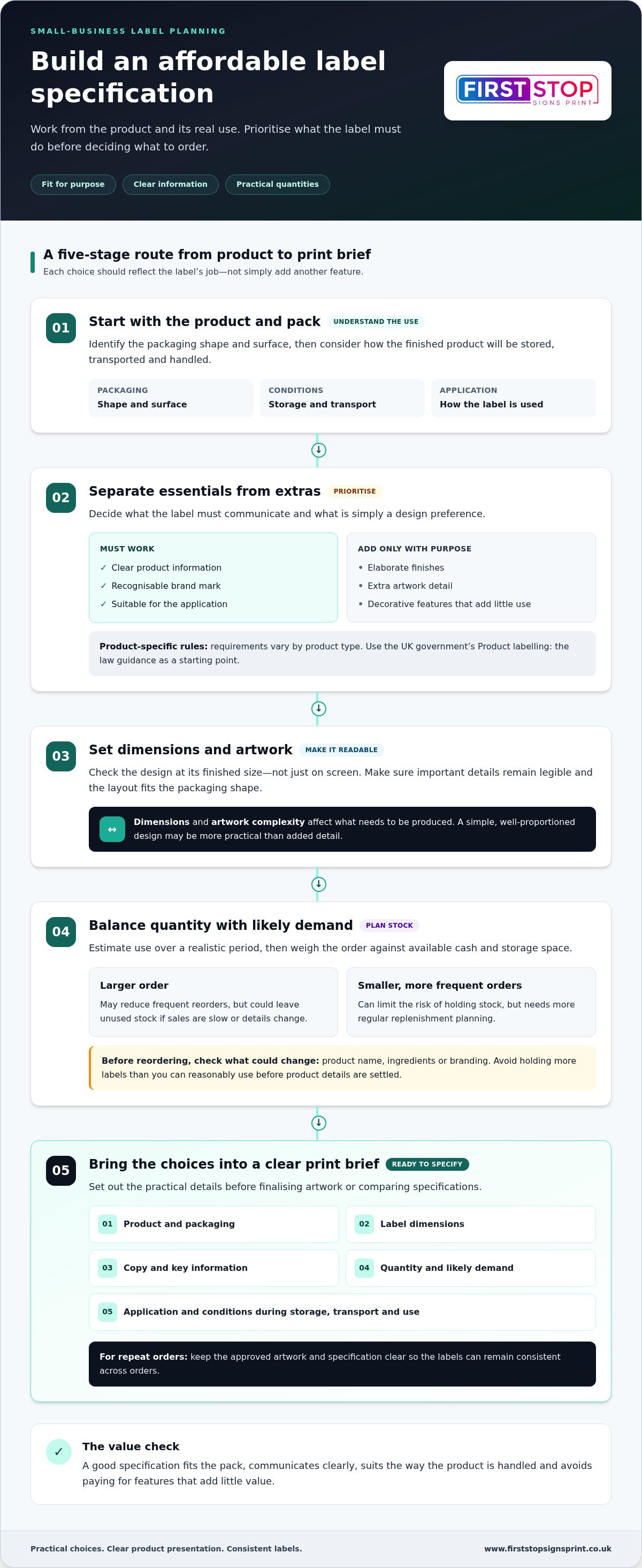
A clear brief turns your product needs into a practical print specification and reduces the chance of avoidable revisions. Before finalising the design, confirm the label’s dimensions, wording, quantity and application. These details affect how the artwork fits the product and keep the project focused on what you actually need.
What information belongs in a label-printing brief?
Gather the facts and preferences in one place before artwork begins. Separate fixed requirements, such as exact product wording, from visual preferences that could be adjusted. This makes it easier to prioritise essentials and create affordable product labels for small business use without designing around assumptions.
- Clarify the product. Note what the item is and what information the label needs to communicate.
- Describe the packaging. Record the available label area, packaging shape and surface, along with how the product will be stored, handled or used.
- Confirm dimensions and application. Decide where the label will sit and how it needs to fit the finished pack.
- Set the quantity. Estimate the number needed for the initial order and consider expected use before the next reorder.
- Gather approved content and brand assets. Provide the exact wording, required product information, logo and any agreed brand colours.
- Define the visual direction. Describe the impression you want the packaging to make, and distinguish must-haves from optional design preferences.
- Prepare and review the artwork. Follow guidance suited to the chosen print process, then check the final proof before production.
How can you prepare artwork to reduce avoidable revisions?
Check the copy carefully before it goes into the design. Incorrect or changing product information can lead to rework, so make sure the wording is approved and complete. Review the layout at its intended finished size: the brand name should be easy to identify, and essential details should be legible without crowding the label.
Keep the information hierarchy clear. Give the most important details enough space, and avoid adding decorative elements that compete with them. Artwork requirements can vary with the print process, so use the relevant production guidance rather than assuming file settings or technical thresholds.
Finally, review the proof as a finished label, not just as a design on screen. Check spelling, alignment, dimensions and product details. Resolve content changes before approving production. A well-defined brief and carefully checked artwork give the print process a clearer starting point.
Ready to put your requirements into a practical label project? Explore label printing for your business.
How First Stop Signs Print supports affordable product labels for small business
First Stop Signs Print is a UK commercial printer, with label printing as its primary service. For a small business, getting the right result starts with understanding the product, its packaging and the label’s purpose. That context helps shape a practical specification instead of adding features that don’t support the finished product.
First Stop Signs Print brings design and production expertise to label projects, helping turn a clear brief into labels suited to the intended application and brand presentation. Keep three decisions in view: where and how the label will be used, which details are essential, and what quantity makes sense for expected demand. That is the foundation of affordable product labels for small business, with choices guided by use rather than price alone.
What should a small business expect from a label-printing partner?
A useful print conversation begins with the product and packaging. Share the container or pack shape, the area available for the label, how the product will be handled, and which information or brand elements need to appear. Clear communication about the artwork and intended use gives production a more reliable starting point.
A bespoke approach can align the result with your brief, whether the priority is a straightforward, legible design or a stronger visual presence on the shelf. Bring your confirmed dimensions, copy, quantity and application details together. This gives the project a practical scope and keeps decisions focused on the requirements that matter to your business.
When is it time to review your product labels?
Review your labels whenever the product or the way you present it changes. Revised product information may require new artwork, while an updated package shape can affect dimensions and layout. A change in brand presentation is also a good opportunity to check that labels still feel consistent across your range.
Order quantities deserve a fresh look too. If demand shifts, you may need to adjust how much stock you plan to hold. Labels accumulating in storage can be a sign that the quantity no longer matches your sales pattern, particularly if product details could change before the stock is used. For established products, check that the approved design and specification remain suitable before arranging a repeat order.
Take your completed brief into your next print conversation, including the intended application, essential specification and a sensible quantity for your needs. Discuss your product label printing needs.
Make your next label order work harder
Good value comes from choosing labels for the job they need to do. Match the specification to the product and packaging, prioritise clear information and a professional brand presentation, then set an order quantity that reflects demand without tying up cash in stock you may not use.
A clear brief makes those decisions easier. Confirm the label’s dimensions, application, wording and quantity before finalising the artwork. This keeps the project focused and reduces the risk of avoidable changes. It’s a practical starting point for affordable product labels for small business, whether you’re preparing a first order or reviewing labels for an established range.
First Stop Signs Print provides label printing as its primary service, alongside packaging and other business print. Its design and production expertise supports a considered approach shaped around your product and brief.
Ready to plan labels that suit your products and workflow? Discuss your product label printing needs. A clear brief is a confident next step towards packaging that presents your business well.
Frequently Asked Questions
How much do affordable product labels for a small business cost?
There’s no single price for affordable product labels for small business orders; the specification and quantity affect the cost. Label dimensions, artwork complexity and intended use also shape the brief. First decide what the label needs to do, then leave out features that don’t support that purpose. Giving the same clear requirements for each option you compare makes it easier to assess like for like, rather than judging by a headline figure alone.
What is the cheapest type of label for a small business?
There isn’t one universally cheapest type, because a suitable specification depends on the product, packaging, use and order quantity. A simple design containing essential information may avoid unnecessary complexity, but it still needs to fit the packaging and remain readable in use. Consider storage and handling conditions before prioritising price. A label that doesn’t work for its intended application may be wasted, so suitability matters as much as the initial cost.
Can a small business order product labels in small quantities?
A small business can plan an initial order around expected demand, available storage and the likelihood that product details will change. A smaller run may help limit the amount of stock held while you learn how quickly a product sells. Before setting a quantity, estimate near-term use and consider whether changes to product wording, ingredients or branding could make unused labels unsuitable.
What information should go on a product label?
Include a clear brand identifier and the product information customers need, but the exact content depends on the product and its intended market. Check applicable labelling requirements for your product before preparing the artwork. Then make sure the wording is accurate, spelling is correct and the layout remains legible at the finished label size. A clear hierarchy helps customers locate key details without crowding the design or obscuring the brand.
Are paper or waterproof labels better for small businesses?
The better option depends on where the product will be stored, handled and used. A label on dry indoor packaging may face different conditions from one exposed to moisture or frequent handling. Describe the actual environment and how the label will be applied, then match the specification to those demands. Don’t choose on appearance alone. The right choice balances practical use with how you want the finished product and packaging to look.
How can I make product labels look professional on a tight budget?
Use a simple visual hierarchy, consistent brand colours and type that stays easy to read at the finished size. Give the product name and essential details clear prominence, then add decorative features only if they strengthen the presentation. Check the design on the actual packaging, as a layout that looks clear on screen may feel crowded when printed small. A considered, uncluttered design can look polished without extra finishes.
What artwork do I need for custom product labels?
Prepare approved brand assets, final wording, product details and the intended label dimensions. Artwork requirements can vary with the print process, so follow the relevant guidance for your project rather than assuming one file setup suits every job. Review the layout at its finished size and proofread all copy before approval. First Stop Signs Print’s design and production expertise supports a clearly scoped label project and helps keep the process organised.


