
What if the best commercial 3D wall panels for your business aren’t the most striking ones in a catalogue, but the ones designed around your space? Choosing commercial 3d wall panels uk businesses can use to create a distinctive interior means balancing visual impact with your brand, the room’s purpose and the practicalities of installation.
Before committing, consider how a dimensional wall feature will sit alongside existing colours and signage, suit the people who use the space and work with the room’s layout. Start with the impression you want to make, then choose a panel style that supports it.
This guide covers the main decisions to make before commissioning panels, from assessing the wall and refining the design to planning installation. First Stop Signs Print brings design, fabrication and professional installation together in-house. Every custom order includes a free digital proof and unlimited revisions before sign-off, so you can review the proposed design in context before production begins.
Key Takeaways
- Use dimensional wall finishes to give a commercial space a more memorable focal point.
- Bring brand identity into the room through considered choices of scale, pattern and placement.
- Compare commercial 3d wall panels uk with paint, wallpaper and flat graphics to choose a finish that suits your design aims.
- Plan around the wall’s purpose, measurements, location, access and nearby fixtures before approving a design.
- First Stop Signs Print coordinates bespoke design, fabrication and installation from its Romford workshop, serving Greater London, Essex and the Home Counties.
Why UK businesses choose commercial 3D wall panels for feature spaces
A business interior has a clear job to do: help people recognise the organisation, feel comfortable in the space and know where to focus. A painted wall can provide a clean backdrop, but a reception, waiting area or customer-facing room may need more visual character. Dimensional surfaces introduce depth, shadow and pattern, giving a wall a more considered role in the room.
Commercial 3D wall panels are dimensional wall treatments designed to add texture, depth and visual interest to business interiors. Their role differs from practical signage and wayfinding. Panels can reinforce atmosphere and identity, while signs communicate a name, message or direction. They can work together when the wall treatment leaves essential information easy to see.
When comparing commercial 3d wall panels uk options, start with what visitors or staff should notice and feel, not just the pattern. Traditional panelling has long served decorative and architectural purposes; History and types of wall panelling offers useful background on that broader design tradition.
Which commercial spaces can benefit from a dimensional wall feature?
A reception wall often shapes visitors’ first impression of a business. A considered pattern or textured backdrop can make the space more recognisable and aligned with the organisation’s identity. In restaurants, bars and salons, a feature wall can establish a focal point and contribute to the intended mood. In offices, panels can help create a consistent look across reception, meeting and shared areas.
What should a commercial feature wall achieve?
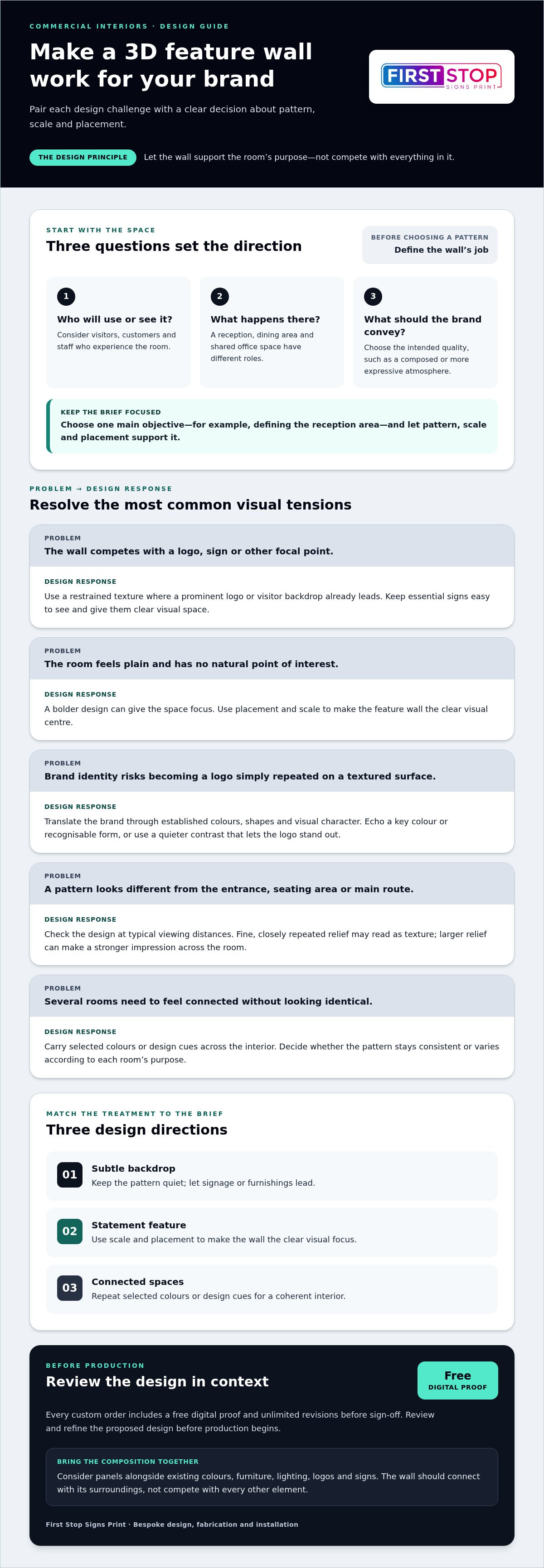
Begin with three questions: who will use or see the room, what happens there, and what qualities should the brand convey? A client-facing office might call for a composed, professional backdrop, while a salon may suit a warmer, more expressive atmosphere. Choose one main objective, such as defining the reception area, then let the pattern, scale and placement support it.
A focal wall should connect with its surroundings rather than compete with every other element. Consider existing colours, furniture, lighting, logos and signs as parts of the same composition. If the wall already carries a prominent logo or serves as a backdrop for visitors, a restrained texture may be more effective than an elaborate pattern. If the room feels plain and lacks a natural point of interest, a bolder design can give it focus.
Before settling on a direction, describe the intended result in one sentence. For example: “This wall should make the reception easy to recognise” or “This feature should give the dining area a more intimate feel.” A clear objective helps keep decisions focused, from the visual weight of the pattern to how the finished wall fits the wider interior.
How commercial 3D wall panel design brings brand identity into the space
A strong panel design translates a business’s visual identity into the room instead of simply repeating its logo on a textured surface. Start with established brand colours, shapes and visual character, then consider how to express those cues through relief, rhythm or scale. A restrained pattern in a familiar colour can create a subtle backdrop; a larger, more pronounced design can give the wall greater visual weight.
A well-planned panel design supports a consistent commercial identity by connecting the brand’s visual character with the way people experience its interior. The whole composition matters: panels, logos, nearby signs, furniture, finishes and lighting should feel considered together.
How can a panel design complement an existing business brand?
Use the brand’s established palette as a reference, not a rule that every surface must match exactly. A panel might echo a key colour, repeat a recognisable geometric form or provide a quieter contrast that lets a logo stand out. First Stop Signs Print provides a free digital proof with unlimited revisions for every custom order, so you can review and refine the proposed design before production.
Consider the wall in its actual setting. A nearby sign needs clear visual space, while furniture and lighting affect which details attract attention. For broader inspiration, Current trends in commercial interior design considers approaches such as adaptable spaces and natural elements. Use those ideas as a starting point, then choose a direction that fits your brand and premises.
How should pattern and placement shape the finished look?
A single focal wall gives one area clear emphasis, which can suit a reception backdrop or a defined customer-facing zone. Panels across a wider interior can create a more continuous design language, but repetition needs planning. Decide whether the pattern should stay consistent or vary according to each room’s purpose. In either case, consider how the wall will look from the entrance, seating areas and main routes through the space.
Scale matters. A fine, closely repeated pattern may read as texture from a distance, while a larger relief can make a stronger impression across the room. Check that the design works at typical viewing distances and doesn’t obscure logos, signs or other important information. Aim for balance, not visual competition.
- For a subtle backdrop: keep the pattern quiet and let signage or furnishings lead.
- For a statement feature: use placement and scale to make the wall the clear visual focus.
- Across several spaces: carry through selected colours or design cues to create a coherent interior.
Once you’ve identified the brand cues and the wall’s role, bring them together in a bespoke concept. Explore bespoke 3D wall panel design as a way to develop a feature that connects with your wider identity.
Comparing commercial 3D wall panels with other wall finishes
The right finish depends on the room’s purpose and the visual effect you want. Paint establishes colour, wallpaper introduces a printed pattern, and flat graphics carry branded imagery or messages. Panels add physical dimension to the surface, making them a useful option when a wall needs texture as well as colour or graphics. The comparison below focuses on each finish’s design role.
| Finish | Visual depth | Design role | Brand impact | Planning focus |
|---|---|---|---|---|
| 3D wall panels | Raised, dimensional surface | Create a textured focal area or a repeated wall treatment | Can express brand character through pattern, scale and colour | Consider wall dimensions, placement and surrounding fixtures |
| Paint | Flat colour | Set a backdrop or define areas through colour | Can use established brand colours without adding a pattern | Choose the colour and how it relates to other finishes |
| Wallpaper | Printed surface pattern | Add a repeat, image or decorative motif | Can introduce recognisable colours or visual themes | Consider pattern scale, repeat and how it meets edges |
| Flat graphics | Printed or applied graphic surface | Display imagery, messaging or branded artwork | Can communicate specific visual content directly | Plan the artwork, position and relationship to signage |
For commercial 3d wall panels uk projects, ask whether visible texture will add something meaningful to the space. A dimensional finish can turn a plain wall into a distinct focal point, while paint or a flat graphic may be clearer when colour or printed information is the priority. Wallpaper adds pattern without the same raised surface effect. Each option can contribute to a cohesive interior when its role is defined before the design is settled.
When do 3D wall panels make more sense than a flat finish?
Choose panels when the wall needs a perceptible change in surface, not just a new colour or image. Their pattern is shaped by the way light and shadow meet the raised design, giving the wall a different visual character as people move through the room. If the space needs a quiet backdrop for furniture, artwork or clear signage, a flat finish may be more suitable. Base the decision on the intended appearance and how the wall will be used.
How do panels differ from 3D lettering and wall signage?
Panels treat a broader area of wall, using surface design to shape the look of an interior. 3D lettering and logos are dimensional characters or symbols, usually used to identify a business or highlight its name. They can sit alongside panels, but their roles differ: one creates a wall treatment, while the other presents a specific identity. For more on dimensional characters, see The Ultimate Guide to 3D Lettering: Elevating Your British Business Presence. This comparison concerns interior wall panels, not exterior signage or built-up lettering.
Planning commercial 3D wall panels: a practical project checklist
A clear brief turns an initial idea into a wall feature that suits the business and the space. For commercial 3d wall panels uk projects, work from the room’s purpose towards design approval. Share practical details early so the concept can respond to the actual wall and its surroundings. Wider visual planning, including how signs and other brand elements work together, is explored in The Art of Sign Design: A Guide for UK Businesses 2026.
- Define the wall’s purpose. Decide what the feature should do, such as creating a focal point, giving a reception area a clear identity or bringing a consistent visual detail into a customer-facing room.
- Record its location and dimensions. Note which wall is involved and provide its approximate width and height. Identify whether it is a single feature wall or part of a broader interior scheme.
- Gather useful visual references. Bring together brand assets, colour references and photographs of the room. Include surrounding finishes, furniture, lighting, logos and signs so the proposed design can be considered in context.
- Flag access and nearby features. Note entrances, counters, fixtures or other details that may affect the layout or access for installation.
- Review and approve the design. Check that the proposed scale, pattern and placement suit the brief and the room before signing off for production.
What information should a business prepare before commissioning panels?
A concise brief is more useful than a collection of disconnected ideas. Record the wall’s location, approximate measurements and intended use, then add brand colours and relevant photographs. Mention anything that affects the visual layout, such as a doorway, display, reception desk or existing sign. These details help the design respond to the setting rather than treating the wall as an isolated surface.
What happens between design approval and installation?
First Stop Signs Print provides a free digital proof with unlimited revisions before production. Review the proof against the brief, including the proposed placement and its relationship to nearby features, then approve the design when it reflects the intended result. The standard turnaround is 5-10 working days after proof approval. Design, fabrication and professional installation are coordinated in-house, with installation planned around the project.
With design, production and fitting coordinated together, the project can move from an agreed concept towards a finished feature through one process. To discuss a bespoke panel project and its requirements, get in touch with First Stop Signs Print.
Commission bespoke commercial 3D wall panels with First Stop Signs Print
A distinctive commercial feature wall takes more than a design idea. The design needs to suit the space, fabrication must follow the approved concept, and installation completes the project in context. First Stop Signs Print designs, fabricates and professionally installs bespoke 3D wall panels from its workshop in Romford.
This joined-up approach gives businesses a clear route from initial brief to finished wall. The design team develops the concept around the wall’s dimensions, intended use and visual direction. Fabrication follows the approved design, with professional installation as part of the service. Keeping these stages in-house helps each part of the project stay connected to the agreed brief.
What makes an in-house commercial panel project easier to coordinate?
Design, fabrication and installation each have a distinct role, but they need to work towards the same result. With all three handled in-house, the details established during design carry through production and fitting. This keeps the visual plan and practical delivery connected, rather than treating the panel as a standalone product. Every installation is covered by a 2-year warranty.
First Stop Signs Print installs commercial 3D wall panels across Greater London, Essex and the Home Counties. UK-wide delivery is also available. The standard turnaround is 5-10 working days after design proof approval, giving businesses a clear production timeframe from sign-off.
How can a business take the next step?
Share where the panels will go, how the space is used and the visual direction you have in mind. Brand colours, photographs of the interior and approximate wall measurements can all help shape a useful brief. You don’t need to have every design detail settled. The team can use the project information to develop a bespoke concept for review.
Every custom order includes a free digital proof and unlimited revisions before sign-off. Review the proposed design, consider how it will sit with the surrounding interior, and request changes before production begins. You can refine the visual direction against your brief before approving the finished concept.
For businesses researching commercial 3d wall panels uk, one in-house partner for design, fabrication and professional installation can make a project easier to coordinate from the first conversation through to fitting. If you’re ready to discuss your wall, its intended use and your preferred look, request a no-obligation quote for your commercial 3D wall panel project.
Give your commercial space a distinctive next step
A strong wall feature begins with a clear idea of how you want people to experience your business. Choose a wall and consider the impression it should create, then bring that intention into the design conversation. This keeps the project focused on what matters to visitors, staff and your brand, rather than selecting a pattern simply because it looks striking on its own.
For businesses considering commercial 3d wall panels uk, the next step is to develop that idea into a design for the space. First Stop Signs Print brings design, fabrication and professional installation together from its Romford workshop. Each custom project includes a free digital proof with unlimited revisions before sign-off, and every installation carries a 2-year warranty.
Share your wall, intended use and preferred visual direction to start shaping a feature for your premises. Discuss your commercial 3D wall panel project and take the first step towards a more distinctive business interior.
Frequently Asked Questions
How much do commercial 3D wall panels cost?
The cost depends on the design and scope of the project. First Stop Signs Print provides a no-obligation quote for custom work. Every custom order includes a free digital proof, with unlimited revisions before sign-off, so you can review the proposed design before manufacture. To help shape the quote, share the wall’s approximate dimensions, location and intended use.
Can commercial 3D wall panels be customised to suit a business?
Yes. First Stop Signs Print creates bespoke panels, with design, fabrication and installation handled in-house. Include your brand assets, preferred colours and visual direction in the brief, along with details about the space. This gives the design a clear starting point. Every custom order includes a free digital proof with unlimited revisions before sign-off, so you can refine the proposed look before production.
How long does it take to make commercial 3D wall panels?
The standard production turnaround is 5-10 working days after the design proof has been approved. The countdown begins at proof approval, not when you first discuss the project, so allow time to review and sign off the design. Installation is planned separately around the project.
Can 3D wall panels be installed in an existing commercial space?
Yes. Bespoke panels can be designed for an existing business interior. In your brief, describe the wall’s position, approximate dimensions, access and nearby fixtures, such as shelving, counters or lights. These details help the proposed layout fit the room as it stands. First Stop Signs Print provides professional installation across Greater London, Essex and the Home Counties, and UK-wide delivery is available.
Can a business review the panel design before production?
Yes. Every custom order includes a free digital proof, and you can request unlimited revisions before signing off the design. Use the review to consider how the panel’s layout will sit alongside your logo, furniture and other elements in the room. Production starts after the proof is approved. The standard turnaround of 5-10 working days applies from that point.
Where does First Stop Signs Print install commercial 3D wall panels?
First Stop Signs Print installs commercial 3D wall panels across Greater London, Essex and the Home Counties, working from its in-house workshop in Romford. UK-wide delivery is also available. Include the premises’ location in your brief when planning professional fitting.
What warranty comes with a commercial 3D wall panel installation?
Every installation comes with a 2-year warranty. Keep the approved design and quote details with your installation information for your project records.


