
The most useful exterior signage doesn’t always come in a standard size. Outdoor sign trade pricing can be offered across different specification tiers, while the final price depends on factors such as material, dimensions, design complexity and illumination. Bespoke Correx panels, for example, can be made up to 2400 x 1200 mm.
It’s understandable to focus on the price first, especially when comparing exterior signage for a shopfront or business premises. But panel dimensions and materials affect more than the quote: they influence visibility, fit and how well the sign suits your brand.
This guide explains how outdoor sign materials perform, what to consider when choosing custom sizes and panel dimensions, and how trade pricing options relate to specification and order requirements. You’ll also find practical guidance on selecting a sign style and position for your premises, so you can make a confident decision about the visibility your business needs.
Key Takeaways
- Choose outdoor sign materials according to the site, exposure and finish you need, rather than appearance alone.
- Correx, Foamex, Dibond and acrylic offer different options for promotional signs, shopfronts and other business uses.
- Trade pricing can vary with the sign specification and order, so compare like-for-like materials, sizes and finishes.
- Plan the fixing method alongside the sign’s dimensions and location to ensure the installation suits the site.
- Measure the available panel area and consider viewing distance before settling on a custom size and layout.
What is the best material for outdoor retail signage?
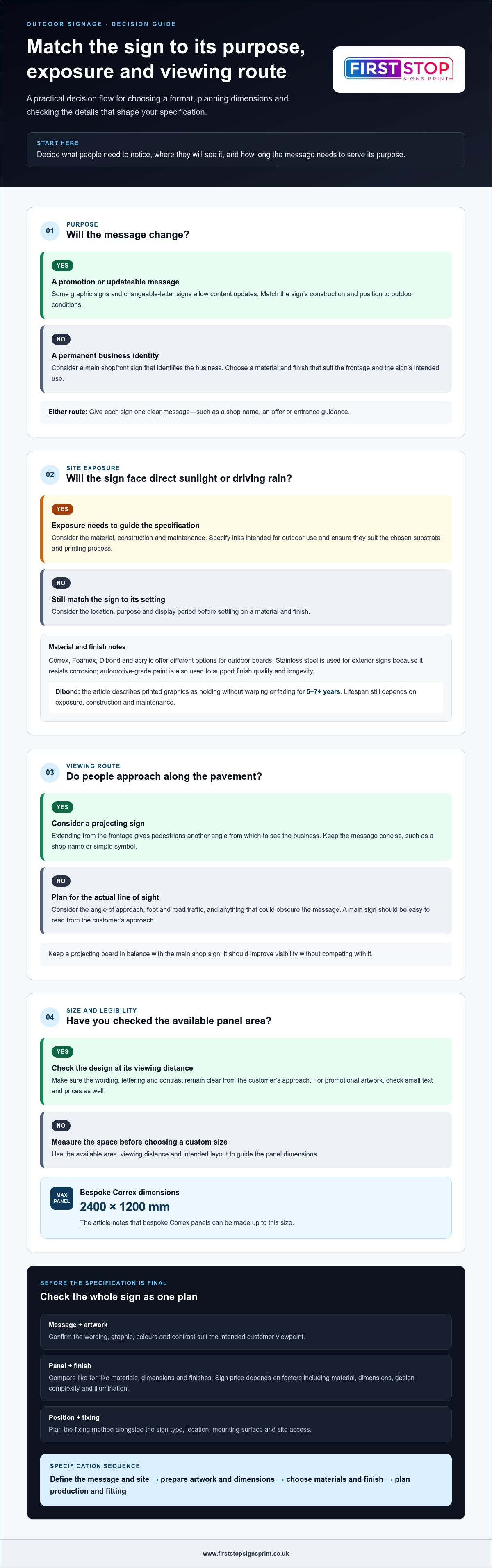
The right material for retail signage depends on the sign’s location, purpose and display period. A pavement promotion, shopfront board and directional panel face different demands. Start by deciding what customers need to notice, then match the panel and finish to its setting. A temporary sale message, for example, may call for a different construction from a permanent shop name.
Outdoor signs face rain, wind, sunlight and changing temperatures. Materials should suit those conditions, while construction and maintenance also affect how well a sign holds up. Stainless steel is used for exterior signs because it resists corrosion. Automotive-grade paint is also used on outdoor signs to support finish quality and longevity. Consider exposure before selecting a material, especially for a sign facing direct sunlight or driving rain.
Correx, Foamex, Dibond and acrylic are options for different sign formats and visual finishes. Choose by considering the setting, the message and the appearance you want. A flat promotional panel may suit a different finish from a polished shopfront display. Surface finish also affects contrast: bold lettering against a clear background can help a short offer stand out. Check that the design remains legible from the customer’s approach.
With direct-to-panel printing, the graphic is printed onto the sign surface rather than applied as a separate panel graphic. This can create a clean, integrated appearance for a logo, product image or promotion. Specify inks intended for outdoor use, and ensure they suit both the chosen substrate and the printer’s process. For a retail offer, check that small text, prices and colour contrast remain clear at the intended viewing distance.
Outdoor signage can advertise a promotion, identify a business or direct visitors towards an entrance. For example, a café might use a board to promote a seasonal menu, while a shop uses its main sign to display its name. Some graphic signs and changeable-letter signs allow content updates. That makes them useful where the message changes, but the sign’s construction and location should still suit outdoor conditions.
A practical signage process starts by defining the message and site, then preparing the artwork and dimensions, choosing materials and finishes, producing the sign and arranging fitting. The fixing approach depends on the sign type, location and access. A freestanding promotional board, for example, needs a different plan from a panel mounted on a shopfront.
Production and fitting times depend on artwork approval, material choice, design complexity and site access. A printed panel involves different work from a fabricated sign. Installation planning also takes account of the mounting surface and equipment required. Agreeing the artwork, dimensions and fixing method together helps organise the job and reduces late design changes.
Before ordering, check the message, artwork, panel size, finish and mounting position as one complete specification. For a sale sign, prioritise a readable offer and strong contrast; for a permanent shop sign, consider how the material complements the frontage. These decisions help match exterior signage to its purpose and setting, rather than choosing by material name alone.
Why Choose Custom Outdoor Signs for Business?
A sign should suit its location, audience and purpose, rather than forcing your message into a standard format. Custom shop signs can help customers recognise your business, notice an offer or find an entrance.
Sign Materials and Formats
Correx, Foamex, Dibond and acrylic each provide different options for outdoor boards. Choose by considering the sign’s setting, intended use, desired appearance and how it will be mounted. For example, a temporary promotion may call for a different format from a permanent shopfront display. Dibond signs are described as holding printed graphics without warping or fading for 5-7+ years.
A sign’s lifespan depends on its exposure, construction and maintenance, so no single figure applies to every board. Choose the material for the job, then decide how the graphics, colours and lettering should look. A consistent finish across the main sign and smaller entrance boards can help create a recognisable retail identity.
Projecting Signs for Street Visibility
A projecting sign extends from a building frontage, giving pedestrians another angle from which to see a business name. It can be useful on a busy street where shoppers approach along the pavement rather than directly towards the shopfront. Keep the message concise, such as a shop name or simple symbol, so it remains legible from the passing route.
Consider the frontage, nearby signs and pedestrian flow before choosing a sign’s position and format. A projecting board should improve visibility without competing with the main shop sign. Custom dimensions can help it sit comfortably against the façade, while clear lettering makes its purpose obvious to people passing by.
Retail Sign Choices
Retail signs can serve different purposes: a main board identifies the shop, window graphics highlight a promotion, and entrance signs direct customers. Give each format one clear message. A sale board should emphasise the offer, while a door sign can focus on opening information or entry guidance.
Signage works best when its wording and design suit the customer’s viewpoint. Consider foot and road traffic, the angle of approach and anything that could obscure the message. Use a consistent colour palette across the signs, but vary their content to distinguish shop identification from a temporary offer.
Illumination and LED Lighting
Illuminated signs can help a business remain visible after daylight fades. First Stop Signs Print offers illuminated signs using LEDs, as well as traditional glass neon for heritage projects. Decide whether the light should highlight lettering, a logo or the complete sign face. Plan illumination alongside the artwork and position so the finished sign suits the frontage.
Consider the surrounding street as well as the shop. Contrast, letter size and viewing angle still matter when lighting is added. A bright display cannot make crowded wording easier to read. Keep the design focused, then coordinate the illuminated sign with unlit boards for entrances or promotions.
Protect the sign’s appearance through regular inspection and cleaning. Professional cleaners should clean exterior signs semi-regularly, with more extensive cleaning potentially needed in locations with extreme climates. Look for dirt, damaged graphics or loose fixings; repair or replace the sign when its condition prevents the message from being read clearly.
Entrance, name and warning signs serve practical purposes alongside marketing. A business may use a branded door sign to identify its entrance, then place a warning panel where visitors need to see it. Keep each message direct and positioned for its intended audience. For a coordinated frontage, consider custom business signs designed around the premises and its visibility needs.
Are there outdoor sign trade pricing options available?
Trade pricing can be requested for business signage, with the final quote shaped by the sign specification and installation needs. Compare quotes using the same material, dimensions, finish, fixing method and quantity so you can assess equivalent work.
The price depends on the project and is calculated after the artwork and measurements are reviewed. Key factors include material, size, design complexity, illumination and installation requirements. A small Foamex panel and a large illuminated sign involve different materials and production steps, so a single headline figure cannot describe both.
Sign mounting and fixing options
The fixing method depends on the sign type, location and access requirements. A flat panel on a suitable wall may need a different arrangement from a projecting sign or freestanding board. Consider the mounting surface, panel weight, exposure and the direction from which people will view the message.
Wall brackets, mechanical fixings and posts are possible approaches, selected to suit the sign and site. A panel fixed to a shopfront, for example, needs a different plan from a board on a freestanding support. Specify the fixing method alongside the sign’s dimensions and position, rather than treating installation as an afterthought.
Signage column options
A signage column can raise a business name or directional message above ground level, helping visitors identify an entrance from a distance. It can display a message on one or more sides, depending on approach routes and visibility needs. Keep the text focused, such as a business name and a clear direction.
Before selecting a column, consider its position, the available ground area and how visitors approach the site. The column’s base and fixing arrangement must suit the location and sign structure. A driveway entrance, for instance, may need a different layout from a pedestrian path leading to reception.
Foamex sign options
Foamex is a rigid PVC panel used for printed displays. Its suitability depends on the intended use, dimensions, setting and desired finish. A compact panel for an indoor reception has different demands from an outdoor board exposed to weather, so specify where it will be displayed.
For a consistent brand, coordinate the panel’s colour, logo and wording with your other business signs. Clear artwork and agreed dimensions help define the finished layout. Include the fixing method in the specification, especially if the board will be mounted rather than displayed on a stand.
Trade quotations are easier to compare when each specifies the same quantity, material, size, print finish, fixings and installation scope. Ask for sign production and fitting to be shown separately, so it’s clear what the quote includes. Installation planning also depends on access: the sign and site determine whether a ladder, cherry picker or platform is needed.
Installation planning should protect workers and people using the premises. Consider overhead work, falling tools, unstable mounting surfaces and trip hazards, and keep entrances and accessible routes clear. Position columns and projecting boards so they don’t obstruct pedestrian movement or make signs difficult to approach and read.
Custom sign sizes and panel dimensions
Custom dimensions help a sign fit its position, message and surroundings. Correx outdoor panels can be made to bespoke dimensions up to 2400 x 1200 mm. That gives room for larger promotional graphics or site information, while smaller panels can suit doors, gates and counters. Begin by measuring the available mounting area, then record the required width and height.
Check the proportions as well as the overall size. A wide panel may suit a fascia, while a square format can work for a logo or symbol. Examples of outdoor sign dimensions include 1500 x 500 mm for an aluminium panel and 600 x 600 mm for an acrylic sign. These formats show how different shapes can support different layouts.
Choose dimensions around the distance and angle from which people will read the message. A sign viewed from across a car park needs a clear hierarchy, with the business name or main instruction prominent. A smaller panel beside a door can focus on opening information. For example, a 385 x 93 mm vinyl sign gives a long, narrow format suited to concise wording.
Artwork needs to fit the chosen panel without crowding its edges. Set the layout to the final dimensions and allow space around logos, text and important symbols. A 500 x 300 mm transparent acrylic sign, for example, has a landscape proportion that can accommodate a short message and brand identity. Review the design at its intended viewing size, not only on a screen.
Material and dimensions work together. A 1500 x 1200 mm brushed aluminium sign has a different presence from a 295 x 93 mm brushed aluminium panel. The larger example can carry more visual information, while the smaller format suits a focused label. Match panel size to the job, then select a material and finish that suit its setting.
For a signage scheme with several components, plan the dimensions as a set. A main fascia, entrance panel and directional sign should share a visual identity, even when each has a different role. Record each panel’s width, height, orientation and position. This makes it easier to coordinate artwork and compare specifications across the scheme.
Before production, confirm measurements against the actual mounting surface. Note obstacles such as frames, windows, doors or existing fixings, and check that the proposed panel won’t cover them. A 500 x 100 mm reflective aluminium sign, for instance, has a narrow profile that may suit a specific instruction. Accurate site measurements help the finished panel fit its intended location.
How do I choose a sign size, style and location for my premises
Start with the sign’s purpose: identify the business, attract passing customers or guide visitors. Then assess the frontage, viewing direction and available fixing area. A shop on a pedestrian street may need a different layout from a unit set back behind a car park. Sketch approach routes and note where doors, windows or architectural details could interrupt the design.
Choose dimensions around viewing distance and message length. A business name needs clear, prominent lettering; a directional panel can focus on a short instruction. For a pavement sign, position it 1-2 metres from the shop entrance and angle it towards pedestrians approaching from the busiest direction. Keep the placement clear of the entrance route so the sign draws attention without obstructing access.
Choose a style that supports the building and brand identity. Compare the frontage’s colours, materials and architectural lines before selecting a finish. A traditional shop might suit restrained lettering, while a contemporary unit could use a crisp, high-contrast design. Use consistent colours and a logo across the main board, door sign and window graphics, giving each one a distinct purpose.
Consider the viewing conditions at the site. A sign facing a busy road needs a simple message that can be read quickly; a panel beside an entrance can carry more detail. Check the approach angle, nearby traffic, natural light and possible obstructions. If the sign will be seen after dark, consider whether illumination would improve legibility and suit the frontage.
In the UK, whether planning permission is needed can depend on a sign’s size, location and type. Shop signs may benefit from deemed consent when they meet applicable size and illumination limits. Check the relevant planning requirements before finalising a design, especially for a prominent, illuminated or unusually sized sign. This helps avoid settling on a layout before understanding the conditions for displaying it.
Turn the site assessment into a clear specification. Record the panel’s width and height, mounting surface, orientation and wording. Note whether the design needs illumination, multiple panels or a projecting format. A measured frontage drawing or annotated photograph can show how the proposed sign relates to doors, windows and nearby signs.
Before production, review the artwork at its intended size and viewing angle. Check spelling, contrast, logo proportions and the amount of information on each panel. A sign that looks balanced on a screen may feel crowded across a shopfront. Discuss your business sign requirements to develop a design and specification suited to your premises.
First Stop Signs Print: Label Printing
First Stop Signs Print can help turn your site measurements and design requirements into bespoke business signage. Its Custom Business Signs include options such as 3D signs and LED signs, while 3D Wall Panels and Metal Wall Art can support a coordinated visual identity across business premises.
Gather the practical details before getting started: the sign’s purpose, dimensions, location, artwork and preferred finish. This creates a clear basis for discussing a shopfront board, entrance sign or dimensional feature. First Stop Signs Print also provides label printing for businesses that need branded labels alongside their signage.
Contact First Stop Signs Print to discuss your signage requirements and the right format for your premises.
Make your premises easier to recognise
The next step is to turn your priorities into a clear signage brief. Note what customers should notice first, where they will approach from and how the sign should fit the character of your premises. These choices help shape exterior signage that feels connected to your business, rather than added as an afterthought.
First Stop Signs Print can help develop a tailored signage solution for your business. If you’re ready to discuss your requirements, contact First Stop Signs Print and take the next step towards a more visible, distinctive premises.
Frequently Asked Questions
Are outdoor signs a long-lasting option?
Yes, outdoor signs typically last 5-10 years with basic cleaning. Their longevity depends on the materials, construction, weather exposure and ongoing care. For example, a sign exposed to direct sunlight and wind may need more attention than one in a sheltered entrance. Inspect the surface and fixings during cleaning; address dirt or damage early to keep the message legible and the sign presentable.
Can you produce different shapes of signs and cut-outs?
Yes. Signs can be made in bespoke shapes, including cut-out lettering and logo forms. First Stop Signs Print offers flat-cut letters in acrylic, MDF and metal. A salon, for example, might use its logo as a shaped feature, while a shop could use cut-out letters for its name. Provide clear artwork and dimensions so the intended shape and spacing are understood before production.
Can you produce small quantity orders and one-off signs?
Yes. There are no minimum order values or quantities for signs, so you can order a one-off shop sign or a small batch. This can suit an independent business replacing a damaged panel or testing a new shopfront design. The price is calculated after the artwork and measurements are reviewed. Installation is optional and requires a postcode when requested.
Do I need planning permission for a projecting shop sign?
Projecting shop signs don’t all have the same permission requirements. In the UK, whether planning permission is needed can depend on a sign’s size, location and type. Shop signs may benefit from deemed consent when they meet applicable size and illumination limits. Consider the format, lighting and position together before settling on the design.
What is the most effective outdoor sign for a shop?
The most effective sign is the one that meets your shop’s main visibility need. A fascia board identifies the premises, while a projecting sign can help pedestrians spot it along a street. For a shop open after dark, an illuminated sign may improve visibility. Keep the message brief, with the business name or key information as the clearest element.
What size range do your outdoor signs come in?
Outdoor signs can be made to custom dimensions, so there isn’t one standard size for every format. Suitable measurements depend on the available mounting area, viewing distance and amount of wording. A door sign, for example, needs less space than a fascia board. Provide the required width and height, along with the sign’s location, to define the specification.
What types of exterior signage are available for businesses in the UK?
Businesses can choose from shop fascia boards, projecting signs, sign panels, 3D letters, LED signs, window graphics and pavement A-boards. Each format serves a different purpose: a fascia identifies the premises, window graphics promote an offer, and an A-board can highlight information to passers-by. The right combination depends on the frontage, customer approach and messages the business needs to display.
How much does exterior business signage cost in the UK?
The price depends on the sign’s material, dimensions, artwork, finish, lighting and installation requirements. First Stop Signs Print calculates the price after reviewing the artwork and measurements, rather than applying one figure to every project. Installation is optional, and a postcode is required for an installation request. A clear brief helps shape a tailored quote.


