
A barcode label can look sharp on screen and still fail where it matters: at the scanner. Choosing a barcode label printing service isn’t just about getting a design onto a label. The code, size, material and finish all need to suit the product, scanning system and conditions the label will face.
If you’re unsure whether to use a linear or 2D barcode, how much space to allow, or whether a label will withstand handling, heat or moisture, you’re not alone. Artwork requirements and file formats can also be difficult to pin down before requesting a quote.
This guide explains how to specify barcode labels for their intended use and what to confirm before approving an order. We’ll cover barcode types, label dimensions, materials, adhesives, print clarity and artwork, then outline the job details to discuss with a potential UK print partner. First Stop Signs Print provides label design and production, so you can raise bespoke requirements with the team before production begins. A clear brief helps you assess whether the proposed label suits your workflow and gives the barcode the best chance of scanning reliably.
Key Takeaways
- Start with where and how the barcode will be scanned, then confirm which format fits that system.
- Match label stock and adhesive to the product surface, exposure and handling the label will face.
- Before requesting a print run, note the label’s purpose, dimensions, quantity and application method.
- When comparing a barcode label printing service, ask about artwork formats, proofs and barcode capabilities before approving production.
- Confirm available materials, label formats, turnaround and delivery directly with your chosen print partner.
Barcode label printing service: what businesses need to know
Barcode label printing is the production of adhesive labels carrying machine-readable codes and supporting printed information. A barcode label printing service can produce labels for products, stock, parcels or other items, with the format and specification chosen for the intended scanning task.
Scanned codes can help identify products, update stock records, support fulfilment and connect items to traceability information. The barcode encodes data, while printed text helps staff recognise an item at a glance. These functions are related but not interchangeable: the code is designed for scanning, and the accompanying text is a visual reference. The Barcode overview explains the broad distinction between one-dimensional and two-dimensional codes. Choose a format to suit the application and scanning system, not simply because it looks familiar.
To see how a desktop label printer is set up, watch this equipment example:
What information does a barcode label carry?
The bars and spaces in a linear code, or the modules in a 2D code, represent data that a compatible scanner can read. A human-readable number may appear beneath a linear barcode, while a product name or description gives staff another way to identify the item. For example, a warehouse label might pair a product barcode with its stock description. A worker can check the description when picking an item, then scan the code to record it in the stock or fulfilment system.
Printed labels, desktop printers and print-and-apply systems
Pre-printed labels may suit businesses that need a consistent batch or want printing handled as part of a wider design and production job. A desktop label printer is a separate option. It lets a business print labels on site, which can be useful when information changes or labels are needed as required. Before choosing either route, check that the printer is compatible with the label format and barcode artwork.
Print-and-apply machinery is different again. It prints and applies labels automatically as products move through a production line, so it involves equipment and workflow decisions beyond ordering printed labels. First Stop Signs Print provides label design and production. Discuss the barcode symbology, materials, format and any verification requirements with the team, and confirm what can be accommodated before approving the job.
Choose a barcode format and artwork that support reliable scanning
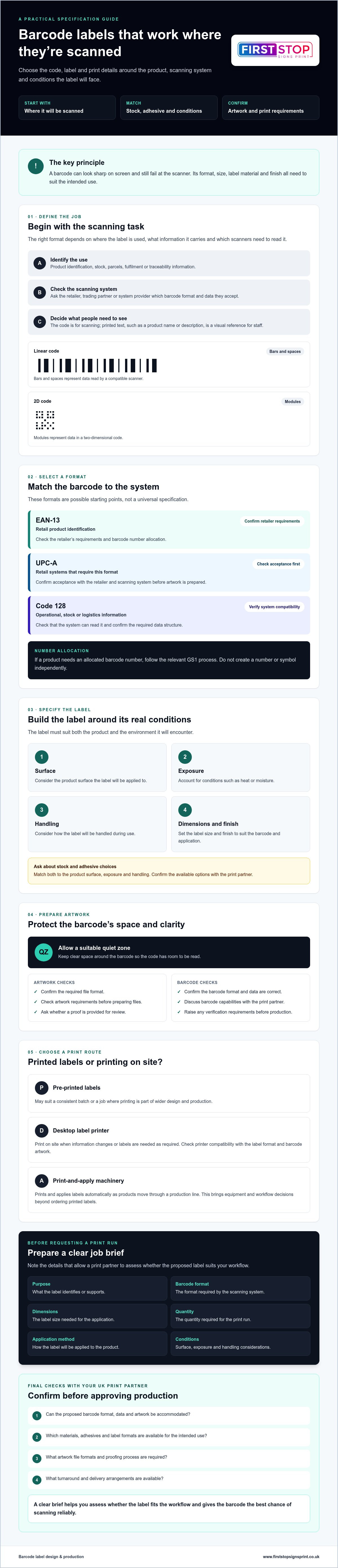
The right barcode depends on where the label will be used, what information it must carry and which scanners need to read it. Retail systems, warehouse scanners and internal stock processes may have different requirements, so don’t choose a format on appearance alone. Check with your trading partner or system provider, and use GS1 UK standards for guidance on barcode numbers and retail applications.
Which barcode type should you ask about?
EAN-13 and UPC-A are familiar retail-oriented formats, but neither is a universal choice. The retailer, market and scanning system determine what’s accepted. Code 128 may suit operational uses where businesses need to encode information for logistics or stock processes. Confirm the required data and format with the relevant system owner before preparing artwork.
| Format | Possible context | What to check |
|---|---|---|
| EAN-13 | Retail product identification in markets that use this format | Confirm the retailer’s requirements and barcode number allocation. |
| UPC-A | Retail systems that specifically require this format | Check acceptance with the retailer and scanning system before artwork is prepared. |
| Code 128 | Operational, stock or logistics information | Verify that the system can read it and confirm the data structure required. |
This table is a starting point, not a specification. If a barcode number must be allocated for a product, follow the relevant GS1 process rather than creating a number or symbol independently.
How should barcode artwork be prepared?
Clear artwork supports scanning. Keep a suitable quiet zone, the clear space around the barcode, and maintain strong contrast between the symbol and its background. Keep text and decoration out of the quiet zone. Don’t stretch, compress or otherwise alter the barcode’s proportions, as this can change the symbol and make it harder for scanners to read.
Size and print detail must suit the chosen symbology and scanning setup. Ask the printer for its accepted file formats, resolution requirements and artwork rules before supplying files. Vector artwork may be appropriate if the provider accepts it, but confirm rather than assume. A barcode label printing service should be able to discuss the supplied specification and clarify which artwork it can use.
Before approving production, review the final proof for the correct data, dimensions, quiet zones and legible supporting text. If possible, ask whether a sample can be checked with the scanner and workflow that will be used in practice. For a bespoke label job, you can discuss label design and production with First Stop Signs Print, confirming barcode, artwork and material requirements before proceeding.
Compare barcode label materials, adhesives and print options
A label that scans well at dispatch may not suit a chilled product, a frequently handled asset or packaging stored in a damp area. Choose stock and adhesive around the label’s real journey: where it will be applied, what it will encounter and how long it needs to remain legible. Paper and synthetic stocks are broad categories, not complete specifications. Confirm the exact grade, adhesive and finish with the print provider.
Match the label stock to the product and environment
Describe the product surface and conditions before asking for a recommendation. Moisture, abrasion, temperature changes and storage conditions can affect label adhesion and printed information. A curved container, textured carton or flexible pack may also be harder to label than a flat, clean surface. Confirm that the proposed material and adhesive suit that combination, and ask whether a proof or sample is available before approving production.
| Application | Stock to discuss | Exposure and surface | Adhesive and handling checks |
|---|---|---|---|
| Short-term indoor stock or packaging | Paper label stock may be a candidate | Check for dry storage and limited friction; note whether the surface is smooth or textured. | Confirm the adhesive suits the surface and application method, and that labels won’t be rubbed during handling. |
| Labels exposed to moisture or more frequent handling | Ask about suitable synthetic stock options | Describe the type and duration of exposure, plus any temperature changes. | Confirm the full stock-and-adhesive combination, print suitability and expected durability for the actual use. |
| Curved, flexible or textured products | Discuss both paper and synthetic candidates | Explain the material’s shape, texture and flexibility. | Check adhesion, label placement and how the label behaves as the product is handled or flexed. |
This comparison is a prompt for a specification discussion, not a guarantee that a particular stock will work. Give the barcode label printing service the surface, exposure and handling details so available options can be checked before placing the order.
Choose a print format and durability level
Roll or sheet format should suit how labels are stored, handled and applied. Rolls may fit a compatible dispenser or labelling process, while sheets can suit manual handling or certain office workflows. Confirm which formats the printer can supply and whether they match your equipment.
Direct thermal and thermal transfer are printing methods to ask about, not assumed capabilities. Their suitability depends on the label stock, intended life and exposure. Check which print methods are available, how the barcode will be produced, and whether a protective finish can be supplied if abrasion or moisture is a concern. First Stop Signs Print provides label design and production. Discuss the application and durability needs with the team, then confirm available materials, adhesives, finishes and formats before approving the job.
Prepare your barcode label brief before requesting a print run
A clear brief helps a printer assess the job and flag details that need checking before production. Start with how the label will be used, then add the practical specifications. If you’re unsure about a requirement, mark it as something to confirm rather than guessing.
What details should a barcode label brief include?
- Purpose: Explain what the label identifies, such as a retail product, warehouse stock item or parcel.
- Barcode and scanning: State the required symbology and final code data, if known. Describe the scanner, system and environment where the barcode will be read.
- Printed information: Provide any human-readable number, product description or other text that should appear alongside the code.
- Size and placement: Give the finished label dimensions and say where it will sit on the product. Note if the surface is curved, textured or flexible.
- Material and conditions: Describe the stock, adhesive and finish you need, or ask the printer to recommend suitable options. Include expected exposure to moisture, friction, temperature changes and storage conditions.
- Format and application: Specify whether you need labels on rolls or sheets, how they’ll be applied, and any dispenser or packing constraints.
- Order and delivery: State the quantity, delivery location and any relevant packing requirements.
- Artwork and production: Share the artwork file or ask which formats the printer accepts. Confirm proofing, sample availability, print method, turnaround and delivery arrangements directly.
A barcode label printing service can assess the job only against the details provided, so separate confirmed requirements from open questions. That makes it easier to compare options and avoid approving a specification that doesn’t match your workflow.
How can you check a proof before production?
Check the proof against the source information, not just its overall appearance. Confirm the encoded data is correct and that any printed number or description matches it. Then inspect the barcode’s proportions, contrast, quiet zones and position, along with the label dimensions and required brand elements.
A proof can show layout and text, but may not confirm how a finished label behaves in use. Ask whether a printed sample is available and, if so, test it with the intended scanner and system before approving the run. Confirm whether the printer offers barcode verification, as this capability shouldn’t be assumed.
For a bespoke label brief, discuss your label printing requirements with First Stop Signs Print, including the barcode specification and intended use.
Choose a barcode label printing service and plan your next steps
A reliable print partner should be willing to discuss the job specification before production, rather than simply taking an artwork file and assuming it’s ready. Compare providers by how clearly they explain their process and which details they’ll confirm for your application.
Questions to ask a barcode label printer
Use these questions to check whether a provider can meet your requirements:
- Barcode and artwork: Which symbologies can you print, and which artwork file formats do you accept? Can you work from the barcode data, or do you need a supplied symbol?
- Materials and format: Which label stocks, adhesives and finishes are available? Can you supply the required dimensions in rolls or sheets?
- Proofing and checks: Is a proof or printed sample available? Can a sample be tested in the intended scanner setup, and what production checks are included? Ask how revisions are handled before approval.
- Order and delivery: What quantities can you produce, what are the current lead times, and where do you deliver? Confirm these details directly rather than relying on assumptions.
Pay attention to how the provider responds. Clear explanations and written confirmation of the agreed specification help prevent misunderstandings about barcode data, label construction or delivery expectations. Assess a barcode label printing service against your actual requirements, including any points that still need technical confirmation.
Discuss your bespoke label requirements with First Stop Signs Print
First Stop Signs Print is a UK commercial printer offering label design and production. Discuss barcode symbologies, artwork formats, materials, print methods, proofing and verification with the team, and confirm which options are available before approving a job.
To start a useful conversation, share what the barcode will identify and where it will be scanned. Include your artwork, label dimensions, product surface, application environment, preferred roll or sheet format and required quantity. If some details are undecided, say so. The team can discuss the label design and production brief with you and confirm which specifications it can accommodate.
Discuss your barcode label requirements with First Stop Signs Print and confirm the details before moving ahead with production.
Turn your barcode label brief into a clear next step
A dependable label starts with the job it needs to do. Confirm the barcode format with the relevant system or trading partner, then match label dimensions, stock and adhesive to the product and its working environment. A clear brief, accurate artwork and careful proof review help you spot issues before production.
Choosing a barcode label printing service also means asking what the provider can accommodate. Confirm barcode and artwork capabilities, materials, formats, proofing, quantities, turnaround and delivery directly rather than assuming they’re available.
Label printing is a core offering from First Stop Signs Print, with commercial printing that includes label design and production. Share your barcode use, artwork, dimensions and application conditions to start a practical discussion about your requirements. Discuss your bespoke label printing requirements with the team. Agree the key details before approval so you can order labels suited to your products and workflow.
Frequently Asked Questions
What is barcode label printing?
Barcode label printing is the production of adhesive labels that carry machine-readable codes, often alongside text such as a product name or number. A scanner reads the encoded data to identify an item or retrieve related information from a system. Businesses can use these labels for product identification, stock control, fulfilment and traceability. The label’s format and construction should suit its scanning task and working environment.
Which barcode format should I use on product labels?
The right format depends on the retailer or trading partner, the information being encoded and the scanners that will read it. EAN-13 and UPC-A are retail-oriented examples, while Code 128 may be considered for operational information. Don’t select a format based on appearance alone. Confirm requirements with your trading partner or system provider, and consult GS1 guidance if barcode number allocation applies to your products.
How do I make sure printed barcode labels scan?
Use the correct barcode data and symbology for the intended system, then keep the artwork clear and undistorted. Strong contrast, adequate quiet zones around the symbol and suitable sizing all matter. Check the proof against your source information, including the human-readable text. If a printed sample is available, test it with the scanner and setup used in practice. Ask the printer directly whether barcode verification is offered.
What material is best for barcode labels?
There isn’t one best material for every barcode label. Paper may suit some indoor, short-term uses, while synthetic stocks may be worth discussing for labels facing more demanding conditions. The right choice depends on the product surface, adhesive, moisture, friction, temperature changes and storage. Tell the printer how the label will be used, then confirm that the proposed stock and adhesive are suitable before approving production.
Can a barcode label printing service print my existing barcode artwork?
A barcode label printing service may be able to use supplied artwork, but acceptance depends on the provider’s file requirements and production capabilities. Before sending files, ask which formats and artwork specifications are accepted, and whether the barcode can be checked in a proof or sample. Confirm that the symbol, encoded data and dimensions are correct. Don’t assume a file will be suitable simply because it opens on screen.
Should I order barcode labels on rolls or sheets?
Choose the format that fits how labels will be stored, handled and applied. Rolls may suit compatible dispensers or some labelling workflows, while sheets can be easier to handle manually or use with certain office processes. Check your equipment and application method first. Then confirm the printer can supply the required format and label dimensions. Roll or sheet availability varies, so ask before finalising the brief.
What information should I provide when ordering barcode labels?
Give the printer the label’s purpose, barcode type and data, scanning environment, finished dimensions and quantity. Include your artwork, any accompanying text, product surface, exposure conditions, preferred material, adhesive and finish, plus whether you need rolls or sheets. Explain how labels will be applied and note packing or delivery requirements. Also ask about accepted file formats, proofing, samples, turnaround and delivery before approving the order.
Can First Stop Signs Print help with bespoke barcode labels?
First Stop Signs Print offers commercial printing that includes label design and production, and label printing is a core offering. You can discuss a bespoke brief with the team, including barcode use, artwork, dimensions and application environment. Confirm barcode formats, materials, label formats and verification capabilities directly before proceeding with production.


